
When Financial Performance Raises Difficult Questions
A business can meet its annual revenue goal, post stronger margins and win investor praise while serious weaknesses sit unnoticed inside its financial processes. Red flags often turn up in corners that rarely get airtime in board meetings: customer dues that keep ageing, supplier advances with no clear explanation, odd accounting adjustments, or contracts whose commercial rationale is hard to pin down.
Picture an Indian infrastructure company getting ready to raise fresh capital. Management paints a confident financial picture, yet the finance team has been stretching credit terms for certain customers and booking some transactions just before the reporting cut-off. Meanwhile, sizeable payments are going to vendors who were onboarded only recently. Not one of these facts proves fraud by itself. Taken together, though, they pose questions that directors ought not to wave away before the underlying evidence has been checked.
This is where the audit committee comes in, and its role is a significant one. Oversight of finances cannot be limited to receiving statements, listening to explanations and noting approvals. Members must grasp how the reported numbers are built, at which points management judgment shapes the result, and whether the company’s controls are strong enough to catch improper transactions before they grow into major problems.
Forensic accounting supports that effort by studying financial records, payment trails, contracts, digital evidence and patterns in transactions. It does not start from the assumption that management has done something wrong. Instead, it helps establish the facts when inconsistencies, allegations or suspicious patterns call for a deeper look.
The task is getting wider in 2026. Indian companies have to deal with financial reporting obligations, related-party dealings, technology-led processes, cyber exposure and growing scrutiny of sustainability disclosures. On 7 January 2026, the National Financial Reporting Authority (NFRA) released a circular stressing effective communication between statutory auditors and those charged with governance, audit committees among them. It underlines why significant audit matters need to be discussed in a timely and substantive way. Read the official NFRA circular.
For directors, CFOs, senior executives and aspiring Independent Directors, the core question is simple: can the organisation show that its reported results rest on dependable evidence and working controls? To answer it, one needs financial understanding, independent thinking and the readiness to dig into explanations that do not quite add up.
Table of Contents
Forensic Accounting in Corporate Governance
Why routine financial reviews may not reveal the complete picture
Financial statements summarise a company’s results and position under the reporting framework that applies to it. Forensic accounting goes to the underlying evidence once the reliability of specific transactions, records or explanations is in doubt. What differs is the method: rather than just reviewing reported balances, professionals may rebuild the sequence of transactions, compare independent records and follow the money.
Take a consumer goods company whose distribution costs are climbing even though sales volumes have barely moved. Management blames higher logistics charges. A look at supplier invoices, delivery records and payment instructions shows that several vendors have the same contact details and are paid in a repeating pattern. On their own these findings do not prove wrongdoing, yet they give a sound reason to investigate further.
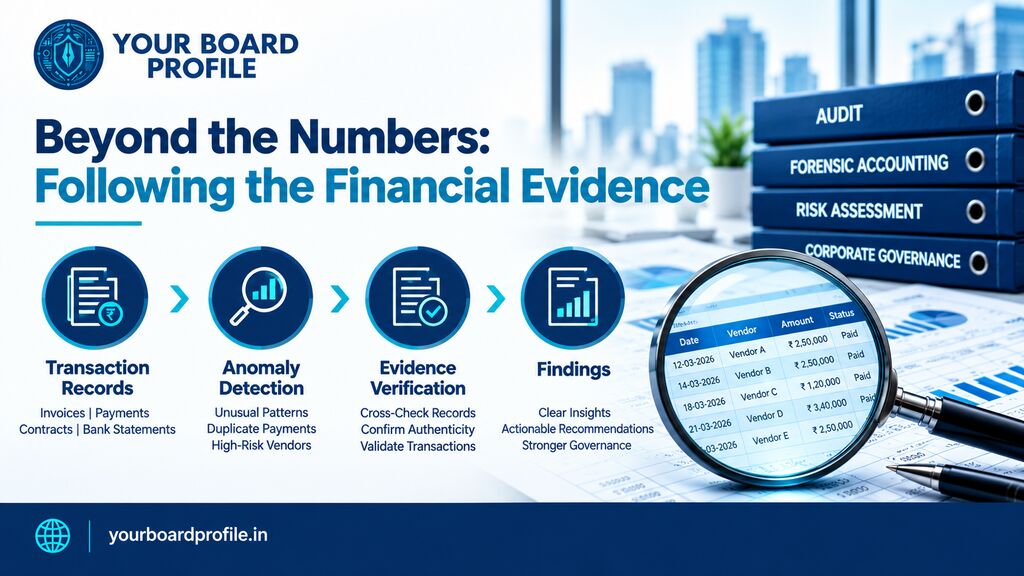
This is an important distinction for forensic accounting in corporate governance. A good investigation depends on evidence that can be verified, not on hunches, assumptions or pressure to land on a conclusion decided in advance. It also calls for proper independence, confidentiality and documentation.
The audit committee need not turn itself into an investigation team. What it must do is make sure that credible concerns are looked at by suitably qualified people, that important findings reach the right decision-makers, and that management is unable to close a serious matter quietly without adequate backing.
To tighten oversight, a committee can look at control failures that keep recurring, track whistleblower complaints, question unusual financial movements and check whether earlier fixes actually worked. Where needed, it can bring in specialist forensic support and obtain independent legal advice.
The practical benefit is better-informed oversight. Directors get a clearer sense of whether a financial anomaly stems from real commercial conditions, process breakdowns, accounting mistakes or possibly intentional misconduct.
SEBI Related Party Transactions Oversight in 2026
Related-party transactions are routine in many corporate structures. Group companies may buy services from each other, share infrastructure, lend money or deal with businesses linked to the promoters. The governance question is whether such dealings have a genuine business purpose and meet the relevant approval, disclosure and pricing rules.
For listed Indian companies, the SEBI Listing Obligations and Disclosure Requirements (LODR) framework places related-party transactions squarely within the audit committee’s oversight. SEBI’s industry standards on the minimum information needed to approve such transactions have applied since 1 April 2025. Companies should check the latest circulars, amendments and clarifications that bear on their own transactions instead of leaning on an outdated compliance checklist.
A sound review in 2026 starts with the commercial substance of the proposal. What is actually being bought, and how was the price arrived at? Can the counterparty deliver on its commitments? Are ownership links and possible conflicts fully disclosed? Might the arrangement bring unusual credit, operational or reputational exposure?
Suppose a listed company wants to award a large technology contract to a supplier connected to a promoter. Management tables a quotation and says the supplier can deliver fast. The audit committee might request a comparison with other providers, proof of technical capability, particulars of the ownership link, termination terms and an account of the payment milestones.
Scrutiny should not stop once approval is given. Monitoring afterwards can show whether the contract value has crept up unexpectedly, whether services were delivered as agreed, or whether payments have strayed from the approved terms. Transaction analytics can also surface vendors that share bank details, addresses or other unusual features.
Such patterns are leads for investigation, not proof of wrongdoing. Their worth lies in helping the committee decide where more evidence is needed.
An effective related-party process thus brings together proper approvals, transparent disclosure, dependable documentation and monitoring after approval. It safeguards genuine commercial activity while lowering the chance that company resources are used in ways shareholders would not reasonably anticipate.
ESG Greenwashing and Scope 3 Verification
Sustainability disclosures can sway investors, shape customer relationships and affect access to capital. How credible they are depends on whether public claims can be backed by dependable operational data and clear calculation methods.
An audit committee should be wary of sweeping claims, such as a large cut in environmental impact, unless it knows how the figure was measured. An apparent improvement could come from real efficiency gains, a shift in business activity, a changed calculation method or different assumptions. Directors need enough information to tell these apart.
Verifying Scope 3 emissions is especially hard because they cover activities across the whole value chain. Depending on the company’s operations and reporting framework, the data may come from suppliers, transport providers, purchased materials and the use or disposal of products.
A workable review can start with the biggest contributors to reported emissions. The committee can ask if supplier data is up to date, how gaps have been estimated, whether methods have changed, and whether management can reconcile the reported results with procurement or operational records.
Forensic techniques can spot duplicated data, unsupported adjustments, supplier figures that do not match or claims that conflict with the available evidence. Where the measurement methodology is technical, sustainability specialists may need to be involved.
The committee should also keep legal reporting duties, voluntary targets and public commitments apart. What binds one company may not bind another in the same way, and expectations around assurance differ depending on the framework in question.
The aim is not to treat every environmental statement as if misconduct had already been proven. It is to make sure material claims match the evidence, major uncertainties are properly disclosed and gaps are fixed before they erode the confidence of stakeholders.
Internal Audit Effectiveness and Forensic Data Analytics
Internal audit can show whether an organisation’s controls actually work in practice. It adds the most value when it digs into why failures keep recurring instead of just noting that a procedure was skipped.
Forensic data analytics lets auditors go through large volumes of transactions and pick out patterns worth a closer look, such as duplicate payments, vendors with overlapping bank details, repeated transactions sitting just under approval limits and manual entries posted at odd hours.
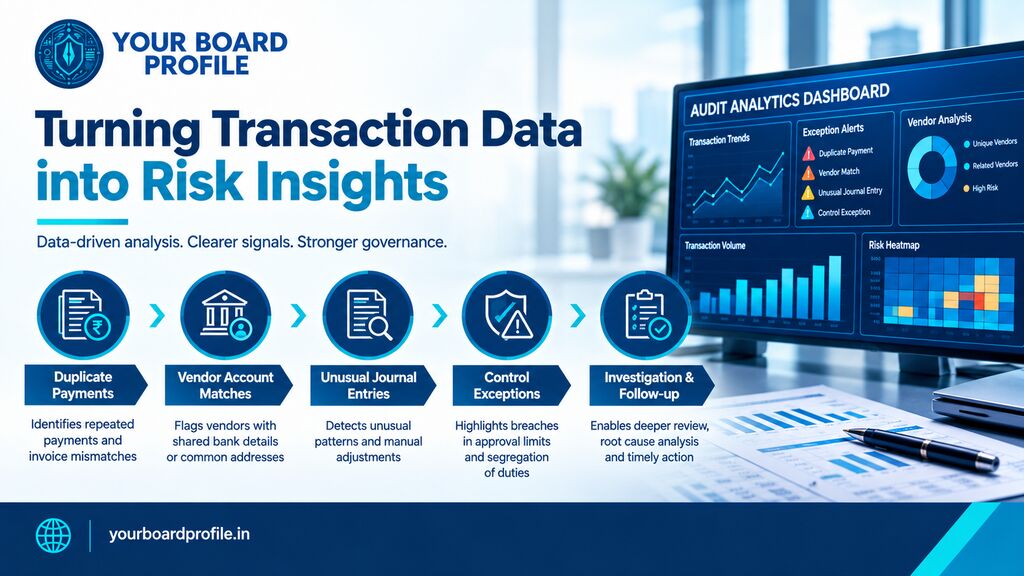
Think of a company that handles thousands of supplier invoices each month. A traditional sample-based review could easily miss several vendors using the same account details. An analytics run could flag those links, after which an authorised reviewer examines the supporting records and decides whether there is a legitimate explanation.
Technology does not replace professional judgment. Poor-quality data can trigger misleading alerts, and sophisticated misconduct may not look like any known pattern. Internal audit needs to document how exceptions were chosen, investigated and closed.
The audit committee should also assess whether internal audit has enough independence, access to information, specialist skills and resources. A function that finds weaknesses but cannot get management responses or confirm that corrective action was taken may achieve little in practice.
| Internal audit priority | Evidence the committee should seek |
| Fraud risk assessment | A refreshed assessment that reflects changes in the business and in technology |
| Transaction testing | Written analysis of significant anomalies and how they were resolved |
| Whistleblower processes | Proof of proper escalation, confidentiality and independent review |
| Remediation monitoring | Named owners, agreed deadlines and independent re-testing |
| Investigation quality | Clear findings backed by evidence and documented conclusions |
The committee should watch repeat findings closely. When the same control weakness shows up in consecutive reporting periods, management should explain why earlier fixes did not work and what will be done differently.
For more on this theme, see Your Board Profile’s guide to board risk oversight in 2026–27.
Audit Committee Skills, Bandwidth and Finance Talent
How well a committee oversees depends not just on its mandate but on the time, expertise and information its members have. Financial reporting now overlaps with technology, data protection, cybersecurity governance, sustainability and complicated commercial arrangements, and it is unrealistic to expect every director to be an expert in all of them.
A strong committee therefore needs a clear picture of the skills it has collectively. Members should be able to read financial statements, question material accounting judgments and understand internal controls. Where specialised knowledge is needed, the committee should be able to call on qualified professionals who can explain complex matters in plain, practical terms.
Meeting time counts too. When the agenda is packed with routine approvals, directors have little room to look into unusual transactions or open findings. Papers that arrive late or are overloaded with technical detail also make meaningful challenge harder.
The capacity of the finance team is another factor. Vacancies in key roles, high turnover and heavy reliance on a few individuals can weaken reporting processes. If one person initiates transactions, records adjustments and carries out reconciliations without effective independent review, errors are more likely to go unnoticed.
The committee should ask management whether critical roles have adequate backup, whether reporting deadlines are being met in a sustainable way, and whether manual workarounds have become standard practice. Such questions can expose operational weak spots before they hit the accuracy of the financial statements.
Succession planning matters as well, since a change in senior finance leadership can disrupt controls and take institutional knowledge out the door. For another angle, read Your Board Profile’s article on CEO succession planning and the NRC agenda in 2026.
For aspiring Independent Directors, these duties show that boardroom readiness takes more than familiarity with governance jargon. Directors need the confidence to ask questions grounded in evidence, to recognise where their own expertise ends and to seek more information whenever a decision carries significant risk.
Your Board Profile’s guide to the Independent Director board value proposition offers more context on how directors contribute through well-informed oversight.
A Practical Audit Committee Action Plan for 2026
A long list of risks does not by itself produce effective oversight. The committee needs a manageable process that ties each concern to evidence, an accountable person and follow-up.
The framework below is only an illustration. It should be tailored to the organisation’s risk profile, reporting calendar, regulatory duties and resources.
| Period | Suggested focus | Intended result |
| First 30 days | Go through major audit findings, fraud risks and accounting judgments | A ranked list of concerns that need attention |
| Days 31–60 | Look at related-party transactions, journal controls, vendor records and system access | Greater visibility of weaknesses in transactions and controls |
| Days 61–90 | Test chosen high-risk areas with internal audit or specialist help | Recorded findings and corrective-action plans |
| Quarterly thereafter | Revisit unresolved findings, emerging risks and regulatory developments | Continuing accountability and steadier oversight |
At every meeting, the audit committee can structure its discussion around five practical questions:
What has changed? Directors should know whether the company’s risk profile has moved since the last review.
What supports the reported result? Significant accounting judgments need backing from proper evidence, not merely management’s confidence.
Where are the exceptions? Unusual transactions, repeated control failures and unexplained differences merit attention in proportion to their importance.
Who has independently examined the issue? Depending on how serious it is, the issue may call for internal audit, the statutory auditor or a specialist investigator.
What happens next? Every major finding needs a clear owner, a realistic completion date and a suitable way of verifying the fix.
Minutes should clearly capture material concerns, decisions and who is responsible for follow-up. Where credible evidence points to serious misconduct, the committee should see that the matter is escalated through the right channels and the evidence is preserved.
The committee should also check whether its own agenda gives enough room to high-risk matters. The point is not to create more paperwork or to turn each meeting into an investigation, but to make oversight sharper, more evidence-based and more useful to the board.
Executives looking to deepen their governance knowledge and boardroom presence will find Your Board Profile’s professional services and portfolio resources a helpful starting point.
Conclusion: Turning Financial Oversight into Strategic Assurance
In 2026, the audit committee agenda has to reflect a business environment where financial reporting, technology, regulation and operational risk increasingly overlap. Reviewing the final statements is still essential, but directors also need assurance about the processes, evidence and judgments behind the reported figures.
Forensic accounting proves its worth when unusual transactions, conflicting explanations or possible misconduct need a closer look. Backed by effective internal audit, meaningful auditor communication and reliable technology controls, it helps organisations spot weaknesses and act before they turn into bigger problems.
The best committees neither assume that every anomaly is fraud nor take each management explanation at face value. They weigh evidence in proportion, recognise the limits of the assurance available and make sure serious concerns reach the right people.
For senior executives, CFOs and aspiring Independent Directors, building this mindset is part of growing into a more effective boardroom contributor. Financial knowledge is the base, but independent judgment, disciplined questioning and the ability to sense emerging risks are what make that knowledge useful.
Frequently Asked Questions
1. What is the role of an audit committee in 2026?
An audit committee oversees financial reporting, internal controls, internal audit and the statutory audit, together with compliance matters that fall within its remit. It questions significant accounting judgments, keeps an eye on material fraud risks and follows through on important control weaknesses.
2. Why is forensic accounting important for an audit committee?
Forensic accounting helps examine suspicious transactions, trace the flow of funds and evaluate evidence when irregularities or suspected misconduct call for investigation. It complements routine audit and control work but is not a substitute for the statutory audit.
3. What are the main audit committee priorities for 2026?
Key priorities include reliable financial reporting, related-party transactions, fraud risk assessment, communication with auditors, AI controls, cybersecurity, privacy compliance, ESG verification and the effectiveness of internal audit.
4. How should an audit committee review related-party transactions?
The committee should look at the commercial rationale, pricing, the relationships involved, supporting documents and the approval and disclosure requirements that apply. Listed companies should also confirm the current SEBI LODR provisions and relevant industry standards.
5. What are common warning signs of financial statement fraud?
Possible indicators include unusual journal entries, revenue movements that cannot be explained, weak cash collections, adjustments without support, repeated overriding of controls and unexpected vendor relationships. Each should be assessed in context and not automatically treated as fraud.
6. How does forensic data analytics help internal audit?
It can flag duplicate payments, unusual transaction patterns, suspicious journal entries and links between vendors or accounts. Investigators need to check alerts against supporting evidence, because an anomaly by itself is not proof of wrongdoing.
7. What is NFRA’s role in audit quality?
NFRA has statutory duties relating to accounting and auditing standards and to audit oversight within its regulatory remit. Its circulars and publications can help companies, auditors and audit committees understand expectations on governance and audit quality.
8. What should audit committees know about IFRS 18?
IFRS 18 changes how financial statements are presented and disclosed, introducing defined profit subtotals and disclosures on management-defined performance measures. It takes effect for annual reporting periods beginning on or after 1 January 2027, and earlier adoption is allowed. Indian entities should check what applies under their own reporting framework.
9. How can AI create financial reporting risks?
AI systems may generate inaccurate outputs, depend on poor-quality data or offer explanations that have no documentary support. When AI is used in financial processes, access controls, human review, validation and clear accountability are essential.
10. Why is cybersecurity part of fraud prevention?
Unauthorised access to financial systems can enable payments to be diverted, supplier details to be altered and records to be manipulated. Strong identity controls, payment verification and incident response help protect financial information.
11. How does the DPDP framework affect forensic investigations?
The Digital Personal Data Protection Act and the DPDP Rules come with commencement dates that differ by provision. Companies should work out which rules apply to them and handle personal data in investigations under suitable legal, security and access controls.
12. How can audit committees identify ESG greenwashing?
They can check whether major sustainability claims rest on dependable records, documented calculation methods and consistent operational data. Where claims involve complex environmental measurements, a specialist review may be sensible.
13. Why are Scope 3 emissions difficult to audit?
Scope 3 figures can depend on suppliers, estimates and value-chain data whose completeness and reliability vary. Documented assumptions, consistent methods and proportionate verification build confidence in the results.
14. What skills should an effective audit committee possess?
Members need financial literacy, independence, sound judgment and the ability to challenge management constructively. Depending on the company’s risk profile, access to expertise in technology, cybersecurity, forensic investigation and sustainability can also matter.
15. How can aspiring Independent Directors prepare for audit committee responsibilities?
They can build their understanding of financial statements, accounting judgments, internal controls, enterprise risk and the regulatory requirements that apply. Practising evidence-based questioning and learning to weigh competing explanations also improves their effectiveness in the boardroom.
Ready to Strengthen Your Audit Committee Expertise and Boardroom Readiness?
At Your Board Profile, senior professionals and aspiring Independent Directors can explore ways to strengthen their governance knowledge, boardroom communication and professional positioning. The focus is on helping experienced leaders demonstrate the financial awareness, independent judgment and strategic perspective that effective board service demands.
Book a complimentary discussion with Dr. Amit Nagpal to explore how your professional experience can be translated into a credible and compelling board value proposition.
Schedule a Complimentary Session with Dr. Amit Nagpal
Visit the Your Board Profile blog for more practical insights on audit committee effectiveness, forensic accounting, risk oversight and boardroom readiness.