
Why Your Board Ready CV Needs a Different Approach
Imagine two senior professionals applying for the same Independent Director position. Both have more than 25 years of experience, have led large teams, managed substantial business operations and delivered impressive financial results. Their professional backgrounds appear equally strong. However, one candidate submits a conventional executive resume filled with operational achievements, revenue growth figures and departmental responsibilities. The other presents a carefully structured board ready CV that explains how their experience contributes to strategic decision-making, risk oversight, corporate governance and long-term organisational value. Which candidate makes it easier for a nomination committee to understand their potential contribution to the boardroom?
The distinction is important. A board appointment is not simply another senior management opportunity. Boards require individuals who can exercise independent judgement, question management constructively, understand fiduciary responsibilities and contribute to decisions that influence an organisation’s future. A professional may have excellent operational credentials but still struggle to communicate their suitability for a directorship if their CV focuses exclusively on execution. The challenge is not necessarily a lack of experience; it is often a lack of appropriate positioning.
A well-structured board ready CV helps bridge this gap by presenting professional achievements in a way that reflects the expectations and responsibilities of a modern boardroom.
A board ready CV addresses this difference by presenting professional experience through a governance-oriented lens. It connects leadership achievements with boardroom responsibilities, highlights oversight capabilities and demonstrates how an individual’s expertise can strengthen collective board effectiveness. Guidance from the Financial Reporting Council and the National Association of Corporate Directors reinforces the importance of board composition, strategic oversight, risk management, committee effectiveness and director competencies.
For CXOs, entrepreneurs, senior executives and aspiring Independent Directors, preparing this document requires a deliberate change in thinking. Instead of asking, “What have I managed?”, the more relevant question becomes, “What can I contribute to an organisation through informed oversight and strategic judgement?”
This article explores six essential rules for creating a compelling board profile, supported by practical examples, a comparison table and guidance on presenting governance experience effectively.
Table of Contents
Executive Resume vs Board CV: Understanding the Difference
An executive resume and a board CV may describe the same professional journey, but they serve different purposes. An executive resume generally communicates an individual’s ability to lead an organisation, deliver business objectives, manage resources and execute strategy. A board CV, on the other hand, must demonstrate the ability to oversee management, evaluate strategic choices, assess organisational risks and protect stakeholder interests.
Think of the difference this way: an executive is responsible for driving the vehicle, while a director helps determine the destination, evaluates the route and ensures that appropriate safeguards are in place.
This does not mean operational experience becomes irrelevant. On the contrary, experience in finance, technology, manufacturing, human resources, legal affairs, sales or business transformation can be extremely valuable in a boardroom. What matters is explaining how that experience translates into informed oversight rather than presenting it simply as a list of management responsibilities.
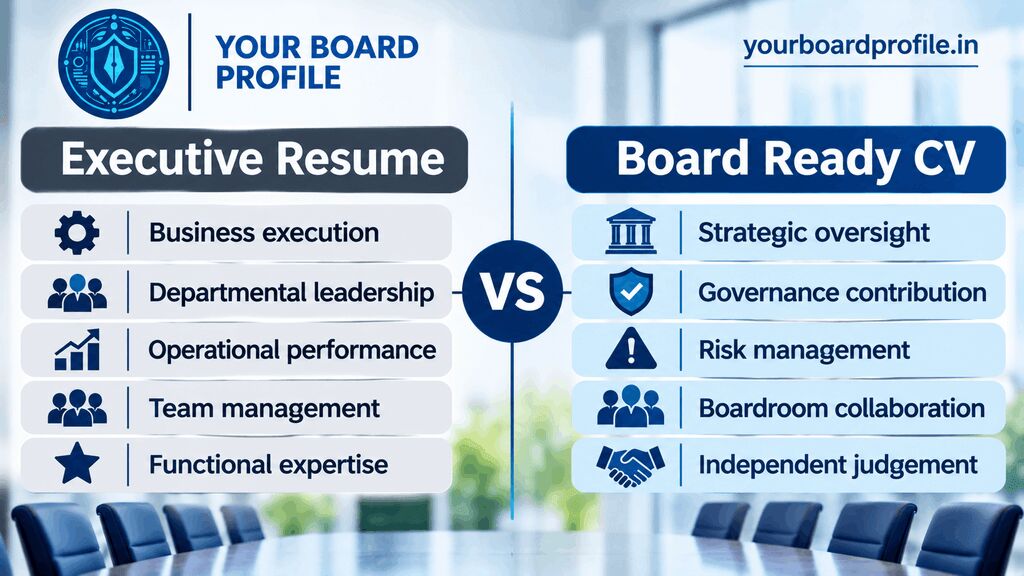
| Executive resume | Board ready CV |
| Focuses on business execution | Focuses on strategic oversight |
| Highlights departmental leadership | Highlights governance contributions |
| Emphasises operational performance | Demonstrates long-term value creation |
| Lists management responsibilities | Explains accountability and judgement |
| Measures business delivery | Connects outcomes with governance metrics |
| Highlights team and resource management | Highlights boardroom collaboration and constructive challenge |
| Demonstrates functional expertise | Connects expertise with board requirements |
For example, a CFO’s executive resume might highlight responsibility for financial planning, budgeting and reporting. A governance-focused CV would explain how this experience supports financial oversight, capital allocation decisions, internal controls, audit committee discussions and financial risk evaluation.
Similarly, an HR leader might have managed recruitment, employee engagement and leadership development. A board-oriented presentation would highlight experience relevant to CEO succession planning, leadership continuity, executive remuneration, organisational culture and human capital oversight.
The objective is not to exaggerate responsibilities or suggest that an executive has performed duties they have never undertaken. It is to communicate the governance relevance of genuine professional experience.
For a deeper understanding of this distinction, explore Executive vs Board Language: How to Transform Your Board Director CV.
Rule 1 – Build a Strong Board Positioning Statement
The first section of your CV should answer one important question: Why should an organisation consider you for a board position?
A recruiter or Nomination and Remuneration Committee (NRC) member may review several profiles within a limited period. A compelling board ready CV should communicate the candidate’s professional strengths, industry knowledge and potential governance contribution within the opening section. They should not have to read five pages before understanding your professional strengths and potential boardroom contribution. A clear board positioning statement helps establish this connection immediately.
Avoid opening with generic descriptions such as “dynamic business leader”, “results-oriented professional” or “seasoned corporate executive”. These expressions may sound impressive, but they do not communicate what makes you relevant to a particular board.
Instead, your opening statement should combine three elements: your professional identity, your strongest areas of expertise and the governance value you can potentially bring to an organisation.
What Should Your Board Profile Summary Include?
A well-developed board profile summary generally covers:
- Professional experience and leadership background.
- Industry expertise and areas of specialisation.
- Strategic planning and business transformation exposure.
- Financial understanding and risk oversight capabilities.
- Corporate governance knowledge.
- Experience relevant to board committees.
- Leadership judgement and stakeholder engagement.
Consider the following example.
Weak positioning statement:
“Experienced CEO with 28 years of experience in managing business operations, leading teams, improving profitability and achieving organisational objectives.”
Stronger board positioning statement:
“Senior business leader with 28 years of experience across financial strategy, organisational transformation and enterprise risk management. Brings strong commercial understanding, experience in capital allocation and exposure to complex stakeholder environments, with the ability to contribute to strategic oversight, governance effectiveness and sustainable organisational growth.”
The second version provides a clearer picture of potential boardroom relevance.
It also avoids making unsupported claims about previous board appointments. If the individual has not served as a director, the CV should demonstrate transferable capabilities without implying formal governance experience.
Your board profile summary should be concise, specific and aligned with the types of organisations you intend to approach. A professional with extensive financial services experience may emphasise financial governance, regulatory understanding and risk oversight. A technology entrepreneur may highlight digital transformation, cybersecurity awareness, innovation strategy and technology-related risks.
A board positioning statement is not a miniature version of your entire career history. It is the strategic introduction to your professional value.
Rule 2 – Highlight Boardroom Governance Capabilities
A strong board profile must demonstrate more than professional seniority. It should communicate an understanding of how boards function and the responsibilities directors carry.
Boardroom governance capabilities include the ability to evaluate strategic proposals, exercise independent judgement, question management assumptions, understand financial information, assess organisational risks and consider the interests of stakeholders.
A director is not expected to manage every department or become involved in routine operational decisions. The role is to provide oversight while ensuring that management remains accountable for implementation.
This distinction should influence the language and structure of your CV. When preparing a board ready CV, candidates should demonstrate how their professional experience supports strategic oversight, independent judgement and responsible decision-making.
For example, instead of highlighting only your experience in managing a business expansion, explain how you evaluated market opportunities, considered capital requirements, assessed regulatory exposure and monitored the long-term implications of the expansion strategy.
Demonstrating Fiduciary Responsibility
Fiduciary responsibility is an important consideration in board appointments. Directors must understand the duties applicable to their position and act in accordance with relevant legal requirements, organisational interests and governance principles.
For professionals seeking board opportunities in India, this includes understanding the director’s duties under Section 166 of the Companies Act, 2013, alongside applicable SEBI regulations and other relevant requirements depending on the organisation.
You can demonstrate relevant understanding through genuine examples of:
- Ethical decision-making and accountability.
- Conflicts-of-interest identification and management.
- Regulatory compliance oversight.
- Financial transparency and internal control awareness.
- Stakeholder responsibility.
- Independent judgement in complex business situations.
A fiduciary responsibility resume should not merely include the phrase “fiduciary duties” as a keyword. It should show evidence that you understand the responsibilities associated with stewardship and accountability.
For instance, a former business head may have introduced stronger approval processes for significant expenditure, improved compliance reporting or established escalation mechanisms for material risks. These examples can demonstrate a governance-oriented mindset when presented accurately.
The Ministry of Corporate Affairs provides access to India’s corporate legislation and regulatory resources. The NACD Director Education Framework also provides a useful reference for understanding board responsibilities, director duties, strategy oversight and risk oversight.
Your CV should make it easy for a reader to identify how your professional experience supports responsible corporate leadership.
Rule 3 – Showcase Committee Oversight Experience
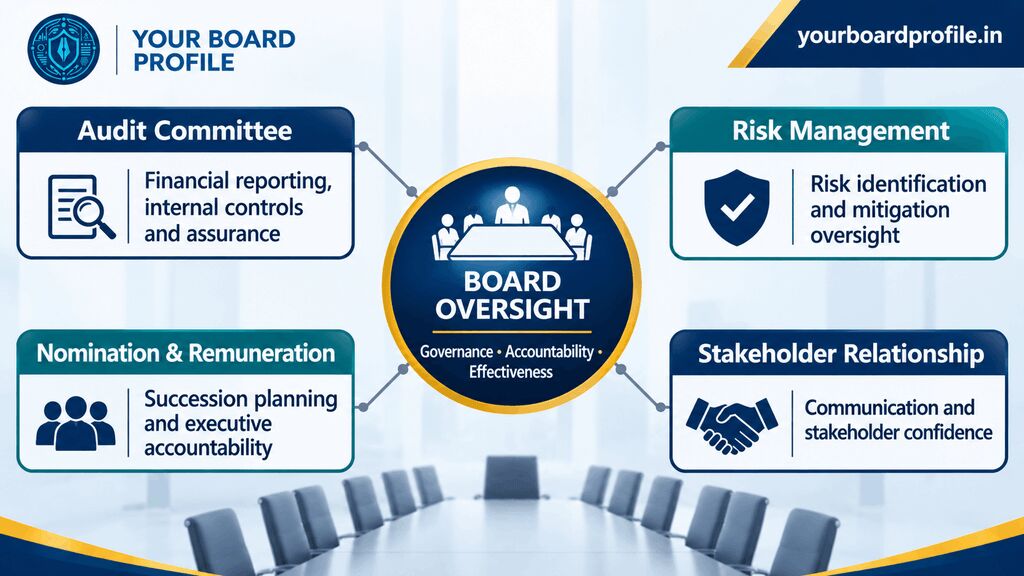
Board committees are instrumental in promoting sound governance practices and strengthening board effectiveness. Audit, Nomination and Remuneration, Risk Management and Stakeholder Relationship Committees may examine specialised matters before relevant recommendations or decisions reach the full board.
Consequently, committee oversight experience can strengthen a candidate’s board profile. Including relevant committee exposure in your board ready CV can help nomination committees understand your familiarity with financial oversight, enterprise risks and leadership accountability.
However, there is an important distinction between attending a committee meeting, supporting a committee’s work and formally serving as a committee member. Your CV should accurately describe the nature of your involvement.
If you have previously served on a board committee, specify the committee, your designation, tenure and relevant contributions. If you have not held a formal committee position, highlight professional experience that demonstrates relevant subject-matter knowledge.
For example, a CFO who regularly presented financial performance and control-related matters to an audit committee may have valuable exposure to financial oversight. A CHRO who contributed to succession planning discussions may possess relevant experience for a Nomination and Remuneration Committee.
| Committee | Relevant experience to highlight | Potential boardroom contribution |
| Audit Committee | Financial reporting, internal controls, audit coordination | Financial transparency and assurance oversight |
| Risk Management Committee | Enterprise risk, business continuity, risk assessment | Risk identification and mitigation oversight |
| NRC | Leadership development, succession planning, remuneration | Executive accountability and leadership continuity |
| Stakeholder Relationship Committee | Investor relations, grievance management, communication | Stakeholder confidence and accountability |
The Financial Reporting Council’s Corporate Governance Code Guidance discusses board and committee effectiveness, including the importance of relevant skills, experience and knowledge.
When presenting committee-related experience, avoid vague descriptions such as “involved in audit matters” or “worked with senior leadership”. Explain what you actually contributed.
For instance:
Limited effectiveness: Oversaw financial reporting and coordinated audit activities.
More governance-focused: Strengthened financial reporting processes, supported internal control improvements and presented financial performance and emerging control concerns to senior governance stakeholders.
The second example communicates the relevance of the experience without claiming formal committee membership.
Remember, boards look for professionals who understand the implications of decisions, not merely individuals who have held impressive corporate titles.
Rule 4 – Demonstrate Risk Management and Strategic Oversight
Risk oversight has become a central element of modern corporate governance. Organisations operate in an environment influenced by geopolitical uncertainty, cybersecurity threats, regulatory developments, technological disruption, changing customer expectations and financial volatility.
A board must understand which risks could materially affect its organisation and whether management has appropriate systems to identify, assess, monitor and respond to them.
This makes a candidate’s understanding of a risk management framework particularly relevant. A strong board ready CV should demonstrate how your experience in identifying business risks and evaluating their consequences can support effective board-level oversight.
Your CV should demonstrate the connection between risk awareness and strategic decision-making. Merely listing “risk management” under your skills section is insufficient. The stronger approach is to provide examples of how you identified significant exposures, evaluated their potential consequences and contributed to stronger organisational controls.
Consider a manufacturing executive who supervised operations across multiple locations. An operational resume might highlight production efficiency, cost optimisation and capacity utilisation. A board-oriented profile could additionally explain experience in supply-chain resilience, industrial safety, regulatory compliance, business continuity and capital investment risk.
Similarly, a technology leader may have managed IT infrastructure. A governance-focused presentation could highlight cybersecurity oversight, data protection, technology investments, digital resilience and third-party technology risks.
The Federal Reserve’s guidance on board effectiveness identifies strategy, risk appetite, management accountability, independent risk management and board composition as important dimensions of effective oversight. Although its supervisory scope is specific to large financial institutions, these concepts offer useful context for understanding board effectiveness.
Presenting Governance Metrics
A board CV becomes more credible when it uses relevant evidence to demonstrate professional impact.
Governance metrics can help communicate the scale, effectiveness and significance of your contributions. The objective is not to overload the document with numbers but to provide meaningful evidence.
| Governance area | Possible evidence or metrics |
| Financial oversight | Improvement in reporting accuracy, audit observations addressed |
| Risk management | Reduction in material risk exposures, closure of risk actions |
| Compliance | Compliance exceptions resolved, reporting improvements |
| Cybersecurity | Incident response improvements, control coverage |
| Human capital | Succession pipeline coverage, leadership retention |
| Business resilience | Recovery readiness, continuity planning improvements |
| Governance effectiveness | Policy reviews completed, evaluation action closure |
Use only figures you can substantiate and disclose appropriately. Do not present confidential company information or imply that a business outcome was solely your achievement when it resulted from collective leadership.
For example, instead of writing “Responsible for risk management”, you could say:
“Contributed to strengthening enterprise risk reporting by improving escalation processes, enhancing management visibility into critical exposures and supporting periodic reviews of mitigation actions.”
This statement explains the contribution and demonstrates an understanding of oversight.
Rule 5 – Convert Operational Achievements into Strategic Contributions
One of the biggest challenges for experienced executives preparing a board ready CV is changing the way they describe their achievements.
Senior professionals often have impressive careers, but their CVs may contain lengthy descriptions of routine responsibilities. These descriptions demonstrate managerial experience without necessarily communicating the individual’s ability to contribute at board level.
The solution is an operational to strategic shift. This shift is essential when developing a board ready CV because board members are expected to evaluate business direction rather than simply demonstrate operational execution.
Instead of describing only what you implemented, explain the strategic context, the decision-making involved, the risks considered and the broader organisational implications.
For example, consider the following transformations:
| Operational achievement | Strategic governance presentation |
| Managed annual budgets | Contributed to financial discipline, capital allocation and resource prioritisation |
| Led digital transformation | Evaluated technology investments, transformation risks and digital resilience |
| Managed employee performance | Supported leadership accountability and performance governance |
| Expanded business operations | Assessed growth opportunities, investment exposure and long-term business sustainability |
| Improved supply-chain efficiency | Strengthened operational resilience and supply-chain risk visibility |
| Reduced business costs | Supported sustainable margins and disciplined financial decision-making |
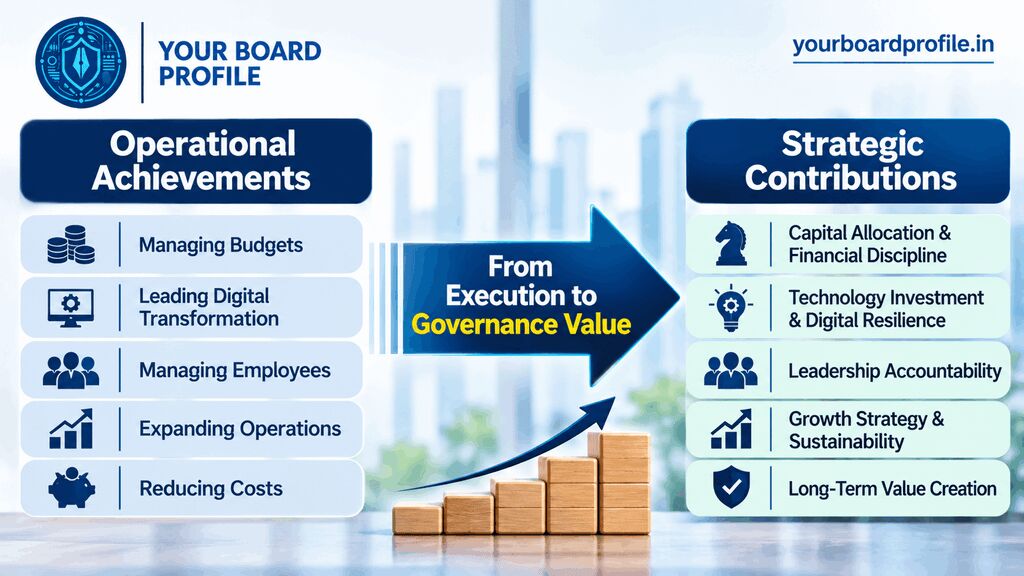
The objective is to show how your experience provides insight into the decisions that directors are expected to oversee.
Imagine a professional who led a major digital transformation programme. A conventional CV might state that the individual implemented new technology across 20 business units. A board-oriented CV could explain how the programme supported enterprise-wide efficiency, required substantial capital investment, introduced cybersecurity considerations and changed the organisation’s operating model.
The underlying experience is the same. The difference lies in how its relevance is communicated.
This approach is particularly valuable for professionals who have never held a formal directorship. Their management experience may provide meaningful exposure to governance-related issues even if they have not previously occupied a board seat.
If you are aspiring to secure your first appointment, read How to Get Your First Board Seat Without Board Experience.
A good CV should never manufacture board experience. Instead, it should identify transferable capabilities and explain how those capabilities could support an organisation’s oversight requirements.
Rule 6 – Use a Board Member Resume Template That Supports Clarity
Even a highly accomplished professional can weaken their positioning through an unnecessarily complicated CV.
A board member resume template should be designed around relevance, readability and governance value. It should allow a reader to understand the candidate’s professional background, boardroom strengths and potential contribution without navigating pages of unrelated operational information.
The right board ready CV format makes governance expertise, strategic achievements and relevant leadership experience easier for recruiters and board evaluators to identify.
A conventional chronological resume may not always be the best solution. A board CV often benefits from a combination of a strong professional summary, governance capabilities, selected leadership achievements and relevant career history.
Advisory Board CV Format and Essential Sections
An effective advisory board CV format can include the following sections:
| Section | What to include | Purpose |
| Name and contact details | Professional contact information and LinkedIn profile | Establish identity |
| Board positioning statement | Expertise, industry experience and governance value | Communicate suitability |
| Boardroom capabilities | Strategy, risk, finance, governance and leadership | Highlight relevant strengths |
| Board and advisory experience | Actual appointments, tenure and responsibilities | Demonstrate governance exposure |
| Committee experience | Committee names and genuine contributions | Establish specialist relevance |
| Selected leadership achievements | Significant strategic and organisational outcomes | Demonstrate impact |
| Professional career history | Relevant roles, organisations and responsibilities | Establish credibility |
| Education and certifications | Qualifications and governance programmes | Support professional competence |
| Industry affiliations | Relevant memberships and professional involvement | Demonstrate engagement |
The length of a board CV should reflect the individual’s career and the requirements of the opportunity. Two to four pages can be a practical starting point for many experienced professionals, but this is a recommendation rather than a universal requirement.
Visual presentation also matters. Use consistent headings, readable typography, clear spacing and a professional layout. Avoid excessive graphics, decorative elements and unnecessary personal details.
Your CV should be easy to scan, but it should not become so compressed that important governance contributions lose their context.
You can explore professional examples and services through the Your Board Profile portfolio and services page.
A board CV is not simply a redesigned executive resume. It is a document that connects professional experience with the responsibilities and expectations of a boardroom.
Board Ready CV Example: Before and After
Understanding the difference between operational and governance-oriented language becomes easier when we compare actual CV statements.
Consider a senior executive with 24 years of experience in the financial services industry.
Before: Conventional executive resume
“Led the finance function, managed budgeting and forecasting, supervised financial reporting, coordinated audits and improved departmental efficiency.”
After: Governance-focused board profile
“Brings 24 years of financial leadership experience, with expertise in financial oversight, capital allocation, internal control environments and enterprise risk considerations. Experienced in supporting financial transparency, evaluating business performance and strengthening accountability through structured reporting and control processes.”
The revised version is more relevant to board opportunities because it connects professional expertise with oversight responsibilities.
Here is another example involving a technology executive.
Before: Conventional executive resume
“Managed IT operations, implemented technology platforms and supervised digital transformation projects.”
After: Governance-focused board profile
“Experienced technology leader with exposure to enterprise digital transformation, cybersecurity considerations, technology investment decisions and operational resilience. Offers an informed perspective on technology-related risks, digital strategy and the governance implications of emerging technologies.”
Notice that neither example invents an appointment or exaggerates the individual’s experience.
The goal is to make professional relevance visible.
For aspiring directors, a well-written board ready CV should also reflect the type of organisation they wish to serve. A technology company may value digital expertise, while a financial institution may require strong financial understanding, risk awareness and regulatory knowledge.
This is why a single generic CV may not communicate the strongest possible positioning for every board opportunity.
Common Mistakes to Avoid When Preparing a Board CV
Preparing a board CV involves more than changing headings and inserting governance-related keywords. Several common mistakes can prevent an otherwise capable professional from communicating their suitability effectively.
1. Treating the board CV as an executive resume with a new title
Changing the document heading does not change its positioning. The content must demonstrate strategic oversight, independent judgement and governance relevance.
2. Overloading the document with operational responsibilities
A long list of departmental activities can obscure the professional’s most valuable experience. Prioritise significant achievements that demonstrate judgement, accountability and strategic contribution.
3. Claiming committee experience without formal involvement
There is a difference between supporting a committee, presenting information to it and serving as one of its members. Describe your involvement accurately.
4. Using generic governance keywords
Terms such as fiduciary responsibility, risk oversight and corporate governance should be supported by relevant examples. A collection of keywords without evidence does little to establish credibility.
5. Ignoring board diversity and complementary expertise
Boards require a combination of capabilities rather than identical professional backgrounds. Explain the industry knowledge, specialist expertise and perspectives you could contribute.
6. Failing to tailor the profile
A CV intended for a financial services organisation may require different emphasis from one prepared for a manufacturing business or technology company. Ensure the presentation addresses the organisation’s priorities and specific risk exposures.
7. Making unsupported claims
Avoid inflated descriptions, unverified achievements and confidential information. Accuracy and professional integrity are essential in a document intended for governance opportunities.
Ultimately, a board profile should demonstrate both professional competence and an understanding of the responsibilities that accompany directorship.
Conclusion – Make Your Governance Experience Visible
A successful board appointment is not determined by professional experience alone. It also depends on how effectively a candidate communicates their ability to contribute to strategic discussions, exercise independent judgement and support responsible organisational oversight.
For senior executives and aspiring Independent Directors, preparing a board ready CV is an opportunity to reposition years of professional experience in a way that reflects boardroom expectations. Your achievements in finance, operations, technology, human resources, business development or entrepreneurship can all be relevant. The key is to explain how those experiences translate into governance capabilities.
The six rules discussed in this article provide a practical foundation:
- Develop a clear board positioning statement.
- Demonstrate boardroom governance capabilities and fiduciary understanding.
- Present relevant committee oversight experience accurately.
- Highlight risk management and strategic oversight.
- Translate operational achievements into strategic contributions.
- Follow a structured board CV format that makes your expertise easy to understand.
Remember that a board CV should not simply tell the story of your career. It should explain the value of your experience in the context of board responsibilities.
A professional who has spent decades leading an organisation may have developed exceptional commercial judgement, financial understanding and strategic insight. However, if these strengths remain hidden behind operational descriptions, a board-level reader may not recognise their relevance.
The goal is to address this disconnect in communication. Ultimately, an effective board ready CV connects your professional achievements with the strategic priorities, governance expectations and oversight responsibilities of the organisations you wish to serve.
Ready to Position Your Profile for Boardroom Opportunities?
At Your Board Profile, we help senior executives, CXOs, entrepreneurs and aspiring Independent Directors communicate their professional value through strategic boardroom positioning.
Our approach focuses on translating executive experience into a governance-oriented professional narrative that reflects what boards, search professionals and Nomination and Remuneration Committees may look for when evaluating potential directors.
Our services include:
- Customised Board CV Development
- LinkedIn Profile Enhancement and Personal Branding
- Board Readiness Assessments
- One-to-One Coaching and Mentorship
- Video Profiles and Thought Leadership Content
Explore our board profile and personal branding services or visit our blog for more insights on board readiness and governance.
Take the next step towards strengthening your boardroom positioning. Book a complimentary discussion with Dr. Amit Nagpal to explore how your experience, expertise and leadership journey can be translated into a compelling board profile.
Your professional experience tells the story of where you have been. Your board profile should reflect where your expertise can create value.
Frequently Asked Questions (FAQs)
1. What is a board ready CV?
A board ready CV is a professionally structured document that presents an individual’s experience, expertise and capabilities in the context of board-level responsibilities. It highlights strategic oversight, corporate governance, financial understanding, risk management, fiduciary responsibility and leadership judgement rather than focusing exclusively on operational achievements.
2. How is a board CV different from an executive resume?
An executive resume primarily demonstrates an individual’s ability to manage teams, execute strategies and deliver business results. A board CV focuses on the ability to oversee management, evaluate strategic decisions, understand organisational risks and contribute to governance effectiveness. Both documents may use the same career history, but their positioning and emphasis are different.
3. What Are the Essential Components of an Effective Board CV?
A comprehensive board CV should generally include a board positioning statement, professional summary, governance capabilities, relevant board or advisory appointments, committee experience, strategic achievements, professional career history, qualifications and relevant certifications. It should also explain how the candidate’s expertise can contribute to an organisation’s governance requirements.
4. How long should a board CV be?
For many experienced professionals, a two-to-four-page document can provide sufficient space to communicate relevant experience. However, the ideal length depends on career history, previous directorships, specialist expertise and the requirements of the target organisation. Clarity and relevance matter more than a fixed page count.
5. Can I prepare a board CV without previous board experience?
Yes. Professionals without previous directorships can highlight transferable capabilities developed through senior leadership positions. Strategic planning, financial oversight, regulatory exposure, risk management, stakeholder engagement and leadership accountability can demonstrate potential boardroom relevance. However, the CV must distinguish management experience from formal board experience.
6. What governance skills should I highlight in my board CV?
Relevant capabilities may include corporate governance, strategic oversight, fiduciary responsibility, financial literacy, enterprise risk management, internal controls, regulatory understanding, cybersecurity awareness, succession planning and stakeholder accountability. Select the capabilities that are supported by your actual experience and relevant to the organisations you wish to serve.
7. How should I demonstrate fiduciary responsibility in my CV?
Demonstrate your understanding through genuine examples of ethical decision-making, compliance oversight, accountability, conflicts-of-interest management, financial transparency and responsible resource allocation. Avoid simply inserting fiduciary responsibility as a keyword without supporting evidence.
8. Should I include committee experience in my board CV?
Yes, if you have relevant experience. Include formal committee appointments, committee responsibilities, tenure and significant contributions. If you have only supported committee discussions or provided subject-matter inputs, describe that involvement accurately rather than presenting it as formal committee membership.
9. What is a board positioning statement?
A board positioning statement is a concise introduction that communicates your professional identity, industry expertise and potential governance contribution. It helps board recruiters and nomination committees understand why your experience may be relevant to a particular organisation.
10. How can a CFO make their executive experience relevant to board positions?
A CFO can highlight financial oversight, capital allocation, financial reporting, internal controls, audit exposure, regulatory understanding and enterprise risk management. The emphasis should move beyond managing the finance function towards demonstrating the financial insight needed for informed board-level decisions.
11. What is the best board member resume template?
The best template is one that presents professional information in a clear, structured and governance-oriented manner. It should include a board profile summary, key competencies, board and advisory experience, selected strategic achievements, professional history and qualifications. Avoid templates that prioritise decorative graphics over meaningful information.
12. Should an aspiring Independent Director include governance certifications?
Yes. Relevant qualifications and governance programmes can strengthen a candidate’s professional profile and demonstrate commitment to director readiness. Include recognised certifications, director development programmes and relevant professional memberships. However, certifications should complement rather than replace practical business experience and governance understanding.
13. How can I convert operational achievements into board-level language?
Explain the strategic significance of your achievements. For example, instead of simply stating that you reduced operating costs, describe how your contribution supported capital efficiency, financial sustainability and resource allocation. Similarly, digital transformation experience can be connected with technology investment, cybersecurity and organisational resilience.
14. Should I customise my board CV for different industries?
Yes. Different industries face different strategic challenges, regulatory requirements and risk exposures. A financial services organisation may prioritise financial oversight and regulatory expertise, while a technology company may value cybersecurity, digital transformation and innovation experience. Tailoring your CV helps communicate your relevance without changing the facts of your professional history.
15. Can a professionally developed board ready CV improve my chances of securing a board position?
A professionally developed board CV can improve how clearly your experience and governance capabilities are communicated to potential recruiters and nomination committees. It can strengthen your professional positioning and make relevant expertise easier to identify. However, a CV alone cannot guarantee an appointment; board opportunities also depend on organisational requirements, professional credibility, relevant expertise, independence, networks and the selection process.