
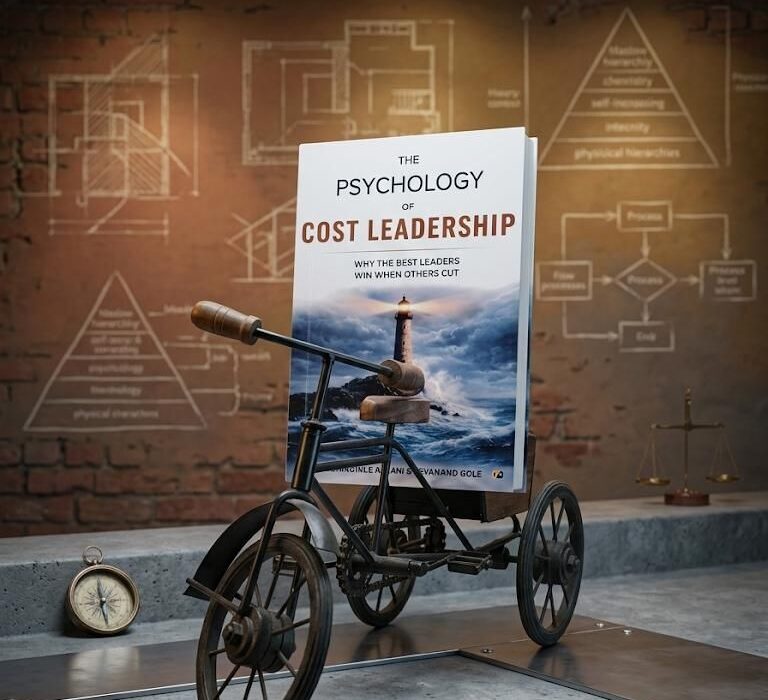
Rushikesh Kulkarni is a Technology and Engineering Leader, Author, and Innovation Strategist with over two decades of experience in engineering, manufacturing, product development, and business transformation. An alumnus of the Indian School of Business (ISB), he has worked across technology-led initiatives, innovation, value engineering, and operational excellence. He has co-authored The Psychology of Cost Leadership: Why the Best Leaders Win When Others Cut with Devanand Gole. The book explores how leadership mindset and smarter resource management can drive sustainable business growth.
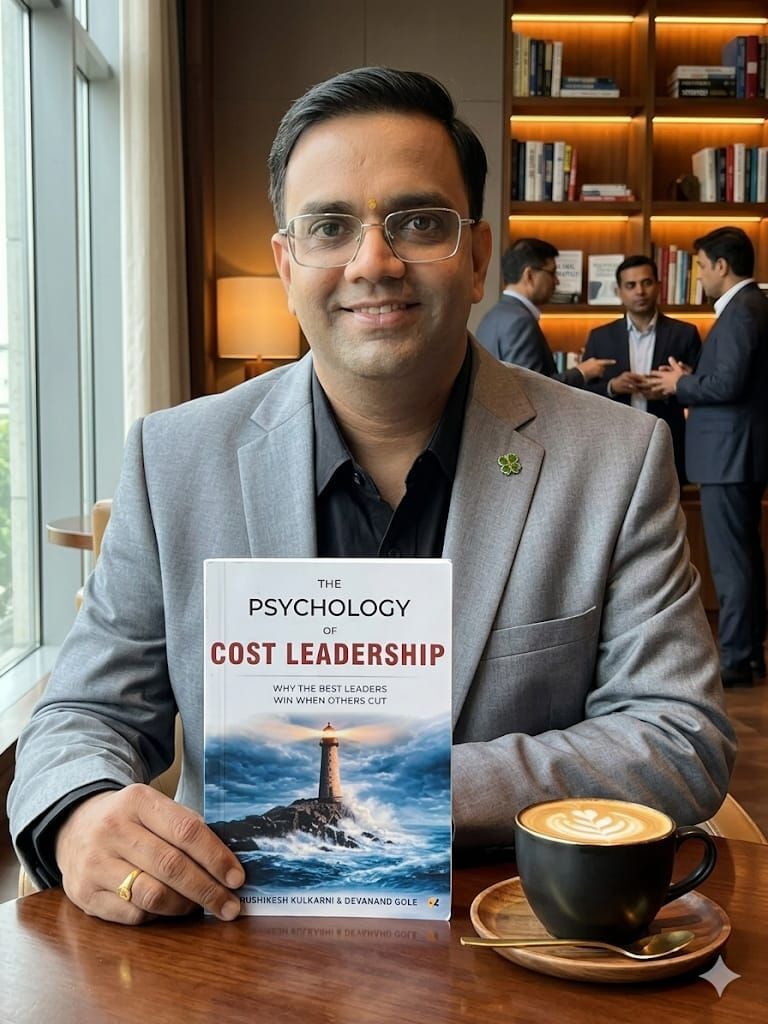
To understand how this shift in thinking can reshape organisational decision-making, leadership and long-term business performance, we invited Rushikesh Kulkarni to share the key insights behind his book, his experiences and his perspective on building a culture of sustainable cost leadership.
1. What inspired you to write The Psychology of Cost Leadership? Was there a particular professional experience or leadership challenge that made you realise that cost management is as much about human psychology as it is about numbers?
The idea for The Psychology of Cost Leadership emerged from more than two decades of working across engineering, R&D, manufacturing, product development and business transformation. I repeatedly observed that organisations often treat cost as a financial problem—something to be addressed when margins come under pressure. But many of the most consequential cost decisions are actually behavioural and psychological.
Leaders respond differently to cost pressure. Some immediately cut budgets, people or projects. Others step back and ask a more fundamental question: How can we create more value with the resources we have?
That distinction stayed with me. I saw that sustainable cost performance depends not only on processes and numbers, but also on leadership mindset, organisational behaviour, decision-making biases and the ability to challenge established assumptions. The book therefore explores cost leadership as a strategic and psychological discipline. My objective was to move the conversation from “How much can we cut?” to “How intelligently can we create value?”
2. Many organisations resort to cost-cutting during economic uncertainty or business pressure. How does cost leadership differ from conventional cost reduction, and why is this distinction important for long-term business success?
Cost reduction and cost leadership are fundamentally different. Cost-cutting is often reactive. It typically begins with a financial target and asks the organisation to reduce expenditure by a certain percentage. It can be necessary in difficult circumstances, but if pursued indiscriminately, it may weaken capabilities, employee engagement, innovation and resilience. Cost leadership is proactive and strategic. It asks how an organisation can continuously improve the relationship between cost, value, quality, speed, innovation and customer outcomes.
A useful way to think about it is:
Cost-cutting reduces expenditure. Cost leadership improves the economics of value creation.
The distinction matters because sustainable competitiveness does not come from simply spending less. It comes from designing better products, processes and operating models; eliminating structural waste; improving productivity; making smarter technology investments; and allocating resources to the areas that create differentiated value.
The best leaders therefore do not ask only, “Where can we cut?” They ask, “Where should we invest, where should we simplify, and where should we stop?”
3. Your book explores how emotions, biases, and leadership behaviour influence cost-related decisions. What are some common psychological traps that leaders fall into, and how can they recognise and overcome them?
One of the biggest lessons from studying cost decisions is that leaders are rarely as objective as they believe they are.
Common psychological traps include anchoring, status-quo bias, loss aversion, sunk-cost thinking and fear-driven decision-making. For example, a leader may continue funding an underperforming initiative simply because the organisation has already invested heavily in it. Another may impose across-the-board cuts because they appear fair and easy to communicate, even though different functions create very different levels of value.
Another trap is equating higher spending with higher value—or lower spending with greater efficiency.
Leaders can overcome these biases by making the assumptions behind major cost decisions explicit. They should ask:
• What problem are we actually trying to solve?
• What value does this expenditure create?
• What are the consequences of not making the investment?
• Are we optimising for the current quarter or the next several years?
• What evidence would change our decision?
Creating a culture where leaders can challenge assumptions without being perceived as challenging authority is equally important. Psychological safety and intellectual honesty are essential to good cost decisions.
4. Organisations often struggle to balance cost efficiency with investments in innovation, technology, and talent. How can leaders build a cost-conscious culture without compromising employee morale, innovation, or future growth?
A cost-conscious culture should never become a cost-obsessed culture. The key is to distinguish between cost and value. An organisation can spend more and create greater value; conversely, a seemingly small saving can destroy significant future value.
Leaders should therefore classify expenditure based on its strategic role. Investments that strengthen differentiation, customer value, technology leadership, talent or future growth should be evaluated differently from structural inefficiencies, duplication and non-value-adding activities.
I also believe employees respond better when cost consciousness is framed as resource responsibility rather than austerity. People should be encouraged to ask, “How can I create more value with this resource?” rather than simply, “How can I spend less?”
Innovation should be subjected to disciplined choices—not indiscriminate cuts. The same applies to talent.
The objective is to create an organisation where efficiency funds innovation, innovation creates differentiation, and differentiation ultimately improves economic value.
5. If a business leader could implement just one principle from your book to improve their organisation’s approach to cost leadership, which principle would you recommend, and what practical first step should they take?
If a leader implemented only one principle from the book, I would recommend this:
Change the question from “What can we cut?” to “What value are we trying to create, and what is the best use of our resources to create it?”
That simple change can fundamentally alter the quality of decision-making.
As a practical first step, I would ask the leadership team to select one major cost category or business process and map it against three dimensions:
Cost → Value → Outcome
Identify what the organisation is spending, understand the value being created, and then examine whether the desired business outcome could be achieved differently, better or more efficiently.
This exercise often reveals that the biggest opportunities are not individual expense reductions. They are hidden in process design, product architecture, specifications, sourcing, complexity, productivity, technology utilisation and organisational behaviour.
Cost leadership begins when leaders start seeing the system rather than isolated expenses.
6. From a board’s perspective, how can Independent Directors evaluate whether an organisation’s cost optimisation initiatives are creating sustainable value rather than delivering short-term savings at the expense of long-term growth, innovation, or resilience?
For Independent Directors, the critical question is not whether management has achieved a cost-saving target. It is what has happened to the organisation’s long-term value-creation capability as a result of that saving.
Boards should therefore look beyond financial metrics and examine indicators such as customer impact, quality, employee capability, innovation pipeline, technology investment, operational resilience and risk exposure.
A few questions can be particularly powerful:
What capability have we strengthened or weakened through this initiative?
Are we removing waste or simply transferring cost and risk elsewhere?
What is the impact on our ability to innovate and compete three to five years from now?
Are the savings structural and sustainable, or are they one-time benefits?
What risks are we accepting in exchange for the savings?
Independent Directors have an important role in challenging short-term optimisation when it compromises long-term resilience.
The board’s responsibility is not to prevent cost reduction. It is to ensure that cost optimisation strengthens the enterprise rather than making the enterprise smaller, weaker or less capable.
7. For professionals aspiring to become Independent Directors, what skills, mindsets, and areas of expertise do you believe are essential to contribute meaningfully to boardroom discussions on strategy, financial discipline, risk management, and long-term value creation?
Aspiring Independent Directors need much more than functional expertise. They need the ability to look at an organisation systemically and independently.
I would highlight five capabilities.
First, strategic thinking. Directors must understand how the organisation creates and sustains competitive advantage—not merely how it reports financial performance.
Second, financial and business acumen. A director should be comfortable questioning capital allocation, margins, cash generation, investments, productivity and value creation.
Third, risk intelligence. Risk should not be viewed only as compliance. Technology, cybersecurity, talent, supply chains, geopolitics, regulation and business-model disruption can materially affect enterprise value.
Fourth, technological literacy. Boards increasingly need to understand AI, digital transformation, data, automation and technology-enabled business models sufficiently to ask the right questions.
Finally, intellectual independence and curiosity. An effective Independent Director should be willing to ask uncomfortable questions, challenge assumptions respectfully and continuously learn. A boardroom is not a place where directors demonstrate how much they know. It is a place where they help the organisation see what it may not be seeing itself. For professionals aspiring to the role, I would therefore recommend developing not just expertise, but judgement, perspective, curiosity and the courage to challenge constructively.
Rushikesh Kulkarni’s insights remind us that true cost leadership is not about spending less, but about thinking smarter, making informed choices and creating greater value with available resources. As organisations navigate an increasingly complex business environment, the ability to balance efficiency, innovation and long-term growth will remain a defining leadership capability.
Get Your Copy of the Book
Interested in exploring the ideas further?
Read The Psychology of Cost Leadership: Why the Best Leaders Win When Others Cut by Rushikesh Kulkarni and Devanand Gole.
Buy the book on Amazon:
https://www.amazon.in/Psychology-Cost-Leadership-Leaders-Others/dp/9371646764
Discover how a shift in leadership mindset can transform cost management into a sustainable competitive advantage.