
Board of directors vacancy are increasingly attracting the attention of senior executives, CXOs, entrepreneurs, and experienced professionals looking to take their careers beyond executive leadership and into the boardroom. However, finding the right board opportunity is not as straightforward as searching for a conventional job opening. Many board appointments happen through professional networks, specialist executive search firms, existing director recommendations, and industry connections rather than publicly advertised vacancies.
For many experienced professionals, joining a company’s board is a natural next step in their leadership journey. Finding a suitable board of directors vacancy requires a different approach from searching for conventional executive positions. After spending years managing businesses, leading teams, handling complex decisions, and creating organisational value, the idea of contributing at the board level becomes increasingly attractive. Yet, there is one question that often creates uncertainty: Where do you actually find your first board opportunity?
Searching for board of directors vacancy is not quite like searching for a CEO, CFO, or business head position. Board appointments follow a different recruitment process. Companies may advertise an Independent Director position publicly, approach candidates through specialist executive search firms, seek recommendations from existing directors, or identify suitable professionals through industry networks. In many cases, the opportunity becomes visible only after a candidate has already established credibility within the right professional circles.
This creates a challenge for first-time board candidates. A senior executive may have an impressive career, a strong professional network, and a record of business achievements but still struggle to get noticed by nomination and remuneration committees. The challenge may not necessarily stem from a lack of experience. It may be that their experience has not been presented in a way that demonstrates boardroom suitability.
The opportunity landscape is also broader than traditional listed-company directorships. Professionals can explore Independent Director openings, non-executive director (NED) vacancies, advisory board opportunities, startup boards, family-owned businesses, and nonprofit governance positions. Each offers a different level of responsibility, selection process, and opportunity to demonstrate governance capability.
In India, the Independent Directors Databank maintained through the Indian Institute of Corporate Affairs (IICA) is an important resource for eligible and willing Independent Director candidates. Its search facility allows companies to identify professionals using criteria such as expertise, qualifications, industry experience, and previous leadership positions.
The real challenge, therefore, is not simply finding an opening. It is becoming visible to the people who influence board appointments, understanding where opportunities emerge, and positioning your professional experience as a valuable contribution to the board. A board of directors vacancy often attracts professionals with diverse leadership backgrounds, making a clear value proposition essential for standing out.
This article explores seven practical strategies to help you identify board of directors vacancy, connect with recruiters, access opportunities that may never appear on conventional job portals, and prepare yourself for your first board appointment.
Table of Contents
1. Build Relationships with Board Search Firms and Executive Recruiters
Board appointments are often highly specialised decisions. Companies are not simply looking for professionals with impressive job titles; they want individuals who can contribute independent judgement, strategic insight, governance discipline, and constructive challenge.
Understanding where a board of directors vacancy originates is the first step towards building an effective board appointment strategy. This is where specialist board search firms and executive search consultants become important. Identifying the right board of directors vacancy requires professionals to look beyond their functional experience and assess where their expertise can contribute to organisational oversight.
Unlike conventional recruitment agencies, firms handling senior leadership and board mandates may work directly with boards, nomination committees, promoters, investors, and shareholders. They assess candidates against specific requirements, including industry expertise, committee suitability, leadership experience, independence, and potential conflicts of interest.
Which Executive Search Firms Should You Know?
Professionals exploring executive search firms for board seats can begin by researching firms with established board advisory and director recruitment practices. Several professional platforms make it easier to identify a relevant board of directors vacancy across industries.
Some recognised international firms operating in the executive search and board advisory space include:
| Search firm | Relevant area | Why aspiring directors should know them |
| Spencer Stuart | Board and director recruitment | Dedicated director recruitment practice |
| Egon Zehnder | Board advisory and leadership assessment | Board composition and succession expertise |
| Korn Ferry | Executive search and leadership consulting | Senior leadership and board-related searches |
| Heidrick & Struggles | Board and executive search | Leadership assessment and board recruitment |
| Russell Reynolds Associates | Board and CEO advisory | Board effectiveness and director appointments |
These firms are examples to research, not a promise that each currently has an open mandate suitable for every aspiring director. Their published board practices demonstrate the importance of specialist recruitment in this market. Many opportunities for a board of directors vacancy emerge through professional recommendations rather than public advertisements.
You can explore the Spencer Stuart Director Recruitment practice to understand how board appointments are approached.
How to Get on a Recruiter’s Radar for Board Roles
Getting noticed by recruiters requires more than sending your CV to multiple firms. Search consultants need to understand what makes you relevant to a particular board requirement.
Start by developing a clear professional introduction that communicates your strongest areas of contribution. Instead of saying, “I have 25 years of corporate experience and am looking for an Independent Director position,” explain the governance value you can bring.
For example:
“I have spent over two decades leading financial and operational transformation in the manufacturing sector, including risk management, capital allocation, and regulatory oversight. I am interested in contributing this experience to boards seeking stronger financial governance and strategic risk oversight.”
This communicates a potential board contribution rather than simply expressing a career aspiration.
A thoughtful approach to recruiter engagement should include:
- Research the recruiter’s board and sector specialisations before making contact.
- Prepare a concise board-focused CV rather than sending an ordinary executive résumé.
- Share your sector expertise, committee suitability, and governance interests.
- Connect professionally through LinkedIn and relevant industry events.
- Follow up periodically with meaningful updates rather than repeated requests for vacancies.
Remember that recruiters work on specific mandates. They may not have an appropriate opportunity when you first contact them. Your objective is to establish professional credibility so that your profile is easier to consider when a relevant requirement arises.
A useful principle: Do not approach a board recruiter only when you need a vacancy. Build the relationship before the vacancy appears.
2. Explore the Best Platforms for Board Openings
Professional platforms have made it easier to discover board opportunities, but not all platforms serve the same purpose. Some publish directorship advertisements, others maintain director databases, and some help professionals develop relationships with people involved in board appointments.
If you are searching for board of directors vacancy, your digital search strategy should include a combination of corporate director job boards, director databases, professional networking platforms, and specialist communities. Specialist recruiters play an important role in connecting experienced professionals with a suitable board of directors vacancy.
Best Platforms for Board Openings
The following platforms are useful starting points, particularly for professionals exploring opportunities in India and internationally.
| Platform | Primary purpose | Potential benefit |
| IICA Independent Directors Databank | Independent Director database in India | Profile visibility for eligible candidates |
| LinkedIn Jobs | Professional job listings | Search for director and advisory positions |
| NEDonBoard Jobs | Non-executive director opportunities | Specialist NED and advisory roles |
| Spencer Stuart | Board and executive search | Understand board recruitment and connect through relevant professional channels |
| Korn Ferry | Executive search and leadership consulting | Explore senior leadership and board-related services |
The IICA database is particularly relevant to the Indian market because companies can search profiles based on professional expertise, industry exposure, educational qualifications.
LinkedIn can help identify publicly advertised positions and create job alerts, although the results should be carefully checked because searches may include roles that are not statutory company directorships.
For international NED opportunities, NEDonBoard offers a specialised jobs section covering non-executive and advisory appointments. Access to certain listings and services may depend on membership. Building relationships with specialist recruiters can improve your visibility when a relevant board of directors vacancy arises.
How to Search These Platforms More Effectively
A common problem with online searches is that candidates use only one keyword. Searching for “Board Director Vacancy” may produce different results from searching for “Independent Director,” “Non-Executive Director,” or “Advisory Board Member.”
Create separate alerts for relevant terms and review them regularly. Also, use filters for your preferred industry, geography, experience level, and appointment type.
However, remember that online platforms are only one part of the opportunity landscape. A strong digital search strategy should complement your recruiter relationships and networking activities rather than replace them.
3. Strengthen Your First-Time Board Candidate Positioning
Having a successful executive career does not automatically make someone an attractive board candidate. The skills required to manage an organisation and the capabilities required to govern one are related, but they are not identical. Digital platforms offer another useful route for discovering a board of directors vacancy in India and international markets.
An executive is generally responsible for implementation, operational performance, people management, and business delivery. A board director, on the other hand, provides oversight, challenges management assumptions, evaluates strategic direction, monitors risk, and protects the long-term interests of the organisation and its stakeholders.
This distinction matters when you are competing for board of directors vacancy. A nomination committee may be impressed by your business achievements, but it will also want to understand whether you can think independently, ask difficult questions, recognise governance concerns, and contribute to collective decision-making.
What Makes a First-Time Board Candidate Attractive?
Your professional experience should be translated into board-relevant capabilities. For example, a CFO should not position themselves only as someone who managed budgets, improved profitability, and prepared financial statements. They should demonstrate their understanding of financial oversight, internal controls, capital allocation, audit committee responsibilities, and enterprise risk.
Similarly, a technology leader should communicate how their experience in digital transformation, cybersecurity, data governance, and technology investments can strengthen board oversight. Not every board of directors vacancy is published on conventional job portals, which is why aspiring directors should monitor specialist networks and industry developments.
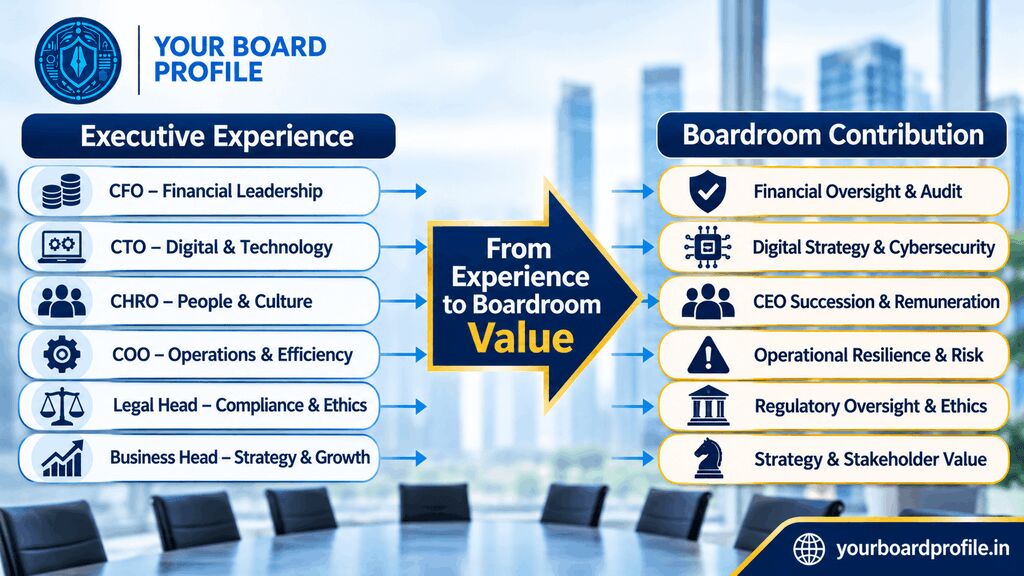
The following table illustrates how executive achievements can be translated into boardroom value.
| Executive background | Traditional positioning | Boardroom positioning |
| Chief Financial Officer | Financial planning and reporting | Financial oversight, audit, capital allocation and risk governance |
| Chief Technology Officer | Technology implementation | Digital strategy, cybersecurity and technology risk oversight |
| Chief Human Resources Officer | Talent acquisition and HR operations | CEO succession, leadership evaluation and remuneration governance |
| Chief Operating Officer | Operational efficiency | Operational resilience, supply-chain risk and performance oversight |
| Legal Head | Legal compliance and contracts | Regulatory oversight, ethics and corporate governance |
| Business Head | Revenue growth and market expansion | Strategy evaluation, business sustainability and stakeholder value |
The objective is to demonstrate how your experience can improve the quality of board discussions and decisions.
Why a Board-Ready CV Matters
Your CV is often the first document through which a recruiter or board stakeholder evaluates your suitability. An executive CV and a board CV should therefore communicate different priorities. A well-positioned board CV helps recruiters understand your suitability when evaluating you for a board of directors vacancy.
An executive résumé usually highlights career progression, responsibilities, reporting structures, team size, and operational achievements. A board-ready CV should give greater attention to strategic contributions, governance exposure, oversight responsibilities, risk management, financial understanding, committee suitability, and independent judgement.
For instance, instead of writing:
“Led a team of 500 employees and achieved 20% revenue growth.”
A board-focused presentation could read:
“Provided strategic leadership during a period of significant business expansion, strengthening performance monitoring, risk identification, and long-term resource allocation.”
The second statement communicates broader leadership and oversight capabilities.
If you are preparing for your first appointment, explore this detailed guide on creating a board-ready CV that demonstrates governance and oversight capabilities.
You can also understand the difference between conventional executive positioning and board-level communication through Board Director CV: Executive vs. Board Language.
A well-structured board CV should generally communicate:
- Your professional summary and board value proposition.
- Industry expertise and areas of strategic contribution.
- Governance education, certifications, and relevant qualifications.
- Risk oversight, financial understanding, and leadership experience.
- Previous board, committee, advisory, or governance exposure.
- Potential conflicts of interest and independence considerations, where relevant.
Do not try to make your career appear more governance-oriented than it actually is. Credibility comes from presenting genuine experience in a way that demonstrates its relevance to board responsibilities.
4. Use Board Seat Networking Strategies to Access Unadvertised Opportunities
A large proportion of board recruitment depends on trust, professional reputation, and relevant introductions. This is understandable because appointing a director is a significant decision. Boards are inviting someone into a position involving confidential information, fiduciary responsibilities, strategic oversight, and potentially sensitive organisational matters.
This makes board seat networking strategies particularly important for professionals searching for their first appointment.
However, networking for board opportunities is different from conventional career networking. Sending connection requests to hundreds of directors or repeatedly asking senior executives about vacancies rarely creates meaningful professional relationships.
The better approach is to build a network around your areas of expertise and the organisations where your contribution may be relevant.
Build Relationships with the Right People
Begin by identifying individuals who understand board requirements and may influence director selection. These could include existing Independent Directors, board chairs, CEOs, promoters, company secretaries, institutional investors, legal advisers, governance professionals, and executive search consultants.
For example, if your experience is in financial services, connect with professionals working in banking, insurance, fintech, and financial regulation. Attend industry conferences, governance seminars, investor forums, and leadership events where these individuals participate.
When you meet someone, focus on exchanging perspectives rather than immediately requesting a board position. Discuss developments affecting the industry, governance challenges, regulatory changes, and emerging risks.
Over time, these interactions can help people understand your professional judgement and areas of expertise. Finding a board of directors vacancy is only half the challenge; presenting yourself as a credible board candidate is equally important.
Make Your Board Aspirations Known Without Sounding Desperate
Many experienced executives keep their board aspirations private because they are unsure how colleagues will interpret their intentions. Others communicate their interest too aggressively, making every professional conversation about securing a board appointment.
Both approaches can be counterproductive.
A more balanced approach is to communicate your interest clearly and professionally. You could explain that you are exploring opportunities to contribute your experience to boards where your industry knowledge, strategic understanding, and governance capabilities may be valuable.
You should also be prepared to explain what types of organisations interest you and what specific contribution you can make.
For a deeper understanding of how professionals can prepare for their first appointment, read How to Get Your First Board Seat with No Board Experience.
Create a Strategic Board Networking Routine
Networking becomes more productive when it is consistent. Instead of attending events randomly, develop a structured approach.
For example, aim to:
- Connect with two or three relevant board professionals each week.
- Participate in one governance or industry discussion regularly.
- Attend selected board leadership and director development events.
- Share thoughtful professional insights on LinkedIn.
- Maintain relationships with former colleagues who have moved into board positions.
The objective is not to collect contacts. It is to build a professional network that understands your capabilities and can recognise where you may add value. Professional relationships can help aspiring directors discover a board of directors vacancy that never reaches conventional job portals.
5. Develop a Visible and Credible Boardroom Personal Brand
Imagine two professionals with almost identical careers. Both have 25 years of leadership experience, strong industry knowledge, and a record of business achievements. One has a clearly articulated governance perspective, a board-focused professional profile, and a visible record of thoughtful industry contributions. The other has a conventional executive profile that focuses almost entirely on operational achievements.
When a recruiter searches for a director with a particular specialisation, which professional is more likely to communicate boardroom relevance immediately?
This is where boardroom personal branding becomes important.
A professional brand is not about becoming popular on social media. It is about ensuring that the right people understand your expertise, judgement, professional values, and potential contribution. Your professional brand can influence how recruiters and board stakeholders perceive your suitability for a board of directors vacancy.
Move Beyond Executive Visibility to Boardroom Credibility
Senior professionals often describe themselves through designations such as CEO, CFO, COO, Managing Director, or Business Head. These titles establish professional seniority, but they do not necessarily explain why someone should be considered for a board appointment.
Your boardroom brand should answer a more meaningful question:
What value can this individual bring to a board beyond their previous executive designation?
For example, a professional with extensive experience in international business could position their expertise around geopolitical risk, market diversification, regulatory exposure, and global expansion oversight.
A technology executive could communicate their understanding of AI governance, cybersecurity preparedness, digital transformation, and technology-related enterprise risks.
A credible boardroom brand develops through several connected activities:
LinkedIn positioning: Your headline, summary, experience, and featured content should reflect your governance interests and professional expertise.
Thought leadership: Share meaningful perspectives on business strategy, governance developments, leadership, regulation, and industry risks.
Professional storytelling: Explain your achievements through the decisions you made, challenges you addressed, and lessons relevant to organisational oversight.
Consistent communication: Ensure that your CV, LinkedIn profile, professional biography, and networking introduction communicate a coherent value proposition.
Use Storytelling to Demonstrate Professional Judgement
A board candidate’s experience becomes more compelling when it is communicated through meaningful examples.
Instead of saying that you have extensive experience in risk management, explain how you identified a major business risk, evaluated alternative approaches, challenged assumptions, and helped leadership make a more informed decision.
Such examples help others understand how you think.
The 5G Model of Boardroom Branding published by Bloggers Alliance explores five dimensions: Generosity, Gratitude, Growth, Gravitas, and Governance. These ideas provide a useful perspective on developing influence through credibility, professional maturity, and a governance-oriented mindset.
Another useful resource is the Board Branding Diamond Model, which discusses the elements of board director branding and the importance of demonstrating governance credibility rather than relying on visibility alone.
For aspiring directors, this distinction is important. A strong professional brand should make it easier for recruiters and board stakeholders to understand your suitability, not simply make your name more recognisable.
6. Consider Advisory Board Opportunities as a Starting Point
One question frequently asked by first-time candidates is whether they need previous board experience to secure their first directorship.
The answer depends on the organisation, the appointment type, the regulatory requirements, and the candidate’s experience. Some companies look for professionals who have already served on boards, while others may consider experienced executives whose expertise fills a specific capability gap.
This is why advisory board opportunities deserve attention.
An advisory board generally provides guidance, specialist knowledge, industry perspectives, and strategic recommendations to an organisation. Its role and authority depend on the organisation’s structure and the terms of appointment. An advisory position should not be confused with a statutory directorship or an Independent Director appointment.
Why Advisory Board Roles Can Be Valuable
For a senior executive who has never served on a formal company board, an advisory position may offer an opportunity to demonstrate strategic thinking and contribute beyond day-to-day management.
Consider a growing technology company preparing to expand into international markets. It may need an experienced professional who understands regulatory challenges, market entry, enterprise partnerships, and international operations.
A former business leader with relevant experience could contribute as an adviser. Through this engagement, the professional may develop a deeper understanding of board-level discussions, strategic oversight, and the expectations of business owners and investors.
However, advisory experience does not automatically qualify someone for a statutory Independent Director position. It should be treated as complementary experience, not a substitute for meeting legal eligibility and governance requirements.
Where Can You Find Advisory Board Opportunities?
Look beyond traditional corporate recruitment platforms. Startup communities, venture capital networks, incubators, entrepreneurship programmes, industry associations, and professional communities can be useful starting points.
You can also explore organisations where your expertise addresses a clear strategic requirement.
Before accepting an advisory role, understand its scope, responsibilities, confidentiality obligations, remuneration, potential liabilities, and any conflicts of interest. Clarify whether the position is advisory or involves formal board membership.
The most important consideration is whether the opportunity allows you to contribute meaningfully and develop relevant governance experience. Exploring advisory positions can help experienced executives prepare for a future board of directors vacancy.
7. Understand Where Board of Directors Vacancy Actually Appear
One of the biggest mistakes aspiring directors make is assuming that all board opportunities are advertised publicly. They regularly check LinkedIn, recruitment websites, and company career pages but overlook the networks and professional relationships through which many board appointments originate.
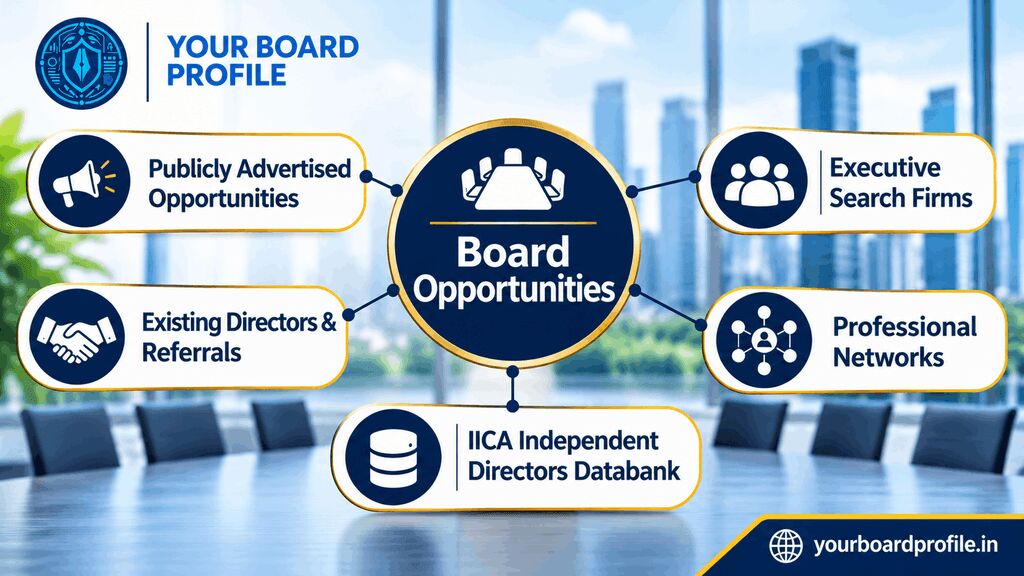
The board recruitment process is fundamentally different from conventional executive hiring. When a company needs a new director, it usually starts by identifying a gap in its board composition. Perhaps the organisation needs someone with cybersecurity experience, financial expertise, international business exposure, regulatory knowledge, or an understanding of digital transformation. The nomination and remuneration committee (NRC), existing directors, promoters, and external search consultants may then help identify suitable candidates. This means that board of directors vacancy can emerge through several channels, and a candidate who depends on only one source may miss valuable opportunities.
Publicly Advertised Board Opportunities
Some companies publish board openings through professional platforms, recruitment websites, corporate announcements, and specialised director networks. These opportunities are easier to identify because candidates can review the requirements and submit their profiles.
For professionals looking for Independent Director openings in India, the IICA Independent Directors Databank is particularly relevant. It provides a searchable database through which companies can identify eligible and willing candidates. Registration and inclusion in the databank should not, however, be mistaken for an appointment or a guarantee of shortlisting. Companies remain responsible for their own due diligence and assessment of suitability.
Publicly available opportunities may also appear through LinkedIn job listings, specialist governance communities, industry associations, and executive recruitment firms. The important point is to look beyond the conventional job title. Search for terms such as:
- Independent Director
- Non-Executive Director
- Board Member
- Board Advisor
- Advisory Board Member
- Startup Board Director
- Governance Committee Member
Different organisations use different terminology, so a narrow search can easily overlook relevant opportunities.
Hidden Board Opportunities and the Informal Appointment Market
Some of the most interesting hidden board of directors jobs never reach public recruitment websites. A company may approach an existing director for recommendations, consult its investors, seek referrals from professional advisers, or ask a search consultant to identify a small group of suitable candidates.
Consider a hypothetical example. An Indian manufacturing company wants to strengthen its board’s understanding of technology-led operational risks. Its existing directors have substantial financial and manufacturing experience but limited exposure to digital transformation and cybersecurity. Rather than publishing a general vacancy, the company may ask its professional network to recommend an experienced technology leader who understands enterprise risk and board-level oversight.
A senior executive with the right expertise could be an excellent candidate. However, if that professional has never communicated their interest in board appointments, maintained a board-focused profile, or developed relationships with relevant stakeholders, their name may never enter the discussion.
This is why discovering board of directors vacancy requires two parallel approaches: monitoring advertised opportunities and building relationships that make you visible when an unadvertised requirement emerges.
Your 90-Day Action Plan for Finding Your First Board Seat
Knowing where to look is useful, but turning that knowledge into action requires consistency. Many professionals spend months reading about directorships without building the materials, relationships, and visibility necessary to become credible candidates.
A structured 90-day plan can make your search for a board of directors vacancy more focused and measurable.
| Timeline | Priority | Practical actions | Expected outcome |
| Days 1–15 | Define board positioning | Identify target sectors, expertise, and suitable appointment types | Clear board value proposition |
| Days 16–30 | Prepare professional documents | Develop a board CV, biography, and LinkedIn profile | Stronger candidate presentation |
| Days 31–45 | Identify recruitment channels | Research search firms, IICA, job portals, and board networks | Targeted opportunity pipeline |
| Days 46–60 | Build professional relationships | Connect with directors, recruiters, and governance professionals | Relevant professional visibility |
| Days 61–75 | Demonstrate thought leadership | Share insights and participate in governance discussions | Stronger professional credibility |
| Days 76–90 | Review and refine | Follow up, evaluate opportunities, and improve positioning | More focused board search strategy |
At the end of this period, evaluate your progress using practical indicators. Have you identified the sectors where your expertise is most relevant? Is your board CV ready? Have you established meaningful conversations with recruiters and existing directors? Are your professional profiles communicating the same boardroom value proposition?
Do not measure success only by the number of applications submitted. Board recruitment is often a relationship-driven process, and building credibility may take longer than a conventional job search.
A Few Important Considerations Before Accepting a Board Appointment
Securing an opportunity is just one step in the larger journey. You must also determine whether the appointment is appropriate.
In India, Independent Director appointments are governed by the Companies Act, 2013, including the relevant eligibility and independence requirements under Section 149 and Schedule IV. Listed entities also need to consider applicable SEBI Listing Obligations and Disclosure Requirements.
Before accepting an appointment, assess the following:
- Whether you satisfy the relevant statutory eligibility and independence requirements.
- Whether your expertise matches the company’s needs.
- Whether you can commit sufficient time to board and committee responsibilities.
- Whether any existing professional or financial relationships create conflicts.
- Whether the organisation has appropriate governance practices and disclosure standards.
- Whether the financial, legal, regulatory, and reputational risks are acceptable.
A board appointment should be a considered professional commitment, not simply another designation to add to your LinkedIn profile.
Conclusion – Turn Your Executive Experience into Boardroom Opportunity
Finding your first board appointment is rarely about discovering one perfect vacancy. It is about creating the conditions under which the right opportunities can find you. Securing your first appointment requires more than simply searching online for a board of directors vacancy.
The search for board of directors vacancy should combine several approaches: identifying public opportunities, understanding specialist recruitment channels, developing relationships with board search firms, exploring director databases, strengthening your board, developing a compelling CV and cultivating a professional network that recognises your governance expertise.
For experienced executives, the transition from management to governance also requires a shift in professional positioning. Your achievements matter, but boards want to understand how those achievements translate into strategic judgement, independent thinking, risk oversight, accountability, and long-term organisational value.
Start by identifying what you can contribute to a board. Then communicate that contribution consistently through your professional profile, networking conversations, and thought leadership.
You do not need to wait until a vacancy appears to begin preparing. The strongest candidates often start building their boardroom credibility well before a formal appointment opportunity emerges.
Ready to Position Yourself for Your First Board Appointment?
At Your Board Profile, we help senior professionals and aspiring directors strengthen their boardroom presence and communicate their professional value in alignment with board expectations.
Our services include customised Board CVs, LinkedIn profile enhancement, board readiness assessments, one-to-one coaching and mentorship, and thought leadership positioning.
If you are exploring board of directors vacancy but are unsure how to position your experience for nomination committees, recruiters, and board stakeholders, a structured assessment can help you identify the gaps and build a focused action plan.
Your professional experience tells the story of where you have been. Your board profile should reflect where your expertise can create value.
Book a complimentary discussion with Dr. Amit Nagpal to explore how your experience, expertise, and leadership journey can be translated into a compelling board profile and positioned for relevant boardroom opportunities.
Explore our Board Profile and professional portfolio, discover our board readiness and personal branding services, and read more practical insights on the Your Board Profile blog.
You can also visit Dr. Amit Nagpal’s website for perspectives on personal branding, leadership, and strategic storytelling.
Your next board opportunity may begin long before the vacancy is advertised. Make sure your expertise is visible, your credibility is established, and your boardroom value is clearly communicated.
Frequently Asked Questions (FAQs)
1. Where can I find board of directors vacancy in India?
You can explore the IICA Independent Directors Databank, LinkedIn Jobs, specialist executive search firms, professional governance networks, and corporate recruitment announcements. Networking with existing directors and industry leaders is equally important because many appointments are sourced through professional referrals rather than public advertisements.
2. How can I get my first board position without previous board experience?
Start by identifying the expertise you can contribute at board level. Prepare a board-focused CV, strengthen your governance knowledge, build relationships with existing directors, and explore suitable advisory opportunities. Demonstrating strategic judgement, risk awareness, financial understanding, and independent thinking can help establish your suitability.
3. Which are the best executive search firms for board positions?
Some internationally recognised firms with board recruitment and advisory practices include Spencer Stuart, Egon Zehnder, Korn Ferry, Heidrick & Struggles, and Russell Reynolds Associates. Research their sector coverage and board practices before approaching them. Remember that inclusion in a recruiter’s database does not guarantee consideration for a particular mandate.
4. What is the IICA Independent Directors Databank?
The Independent Directors Databank is a platform maintained through the Indian Institute of Corporate Affairs (IICA). It provides companies with access to profiles of individuals who are eligible and willing to act as Independent Directors. Companies can search profiles using professional qualifications, expertise, industry experience, and other criteria.
5. Are all board vacancies advertised publicly?
No. Some board appointments are publicly advertised, while others originate through recommendations, professional networks, existing directors, investors, and executive search consultants. Building relationships and maintaining a credible professional profile can help candidates access opportunities that are not widely advertised.
6. What qualifications are required to become an Independent Director in India?
The applicable requirements depend on the Companies Act, 2013, relevant rules, and the circumstances of the appointment. Section 149 and Schedule IV are important provisions. Candidates must meet the applicable eligibility and independence requirements. Listed companies may also need to consider relevant SEBI regulations. Professional expertise, integrity, judgement, and governance understanding are important considerations.
7. How do board search firms select candidates?
Board search firms generally assess candidates against the company’s board composition requirements. They may consider industry experience, functional expertise, leadership exposure, governance knowledge, independence, conflicts of interest, diversity, and the ability to contribute to board discussions. The exact assessment process varies by mandate.
8. Can a CEO or CFO become an Independent Director?
Yes, an experienced CEO or CFO may be considered for an Independent Director appointment if they satisfy the applicable legal eligibility and independence requirements. Their expertise across strategy, finance, risk, operations, and leadership can offer significant value. However, holding a senior executive designation alone does not establish eligibility or suitability.
9. What is the difference between an Independent Director and a Non-Executive Director?
An Independent Director is a non-executive director who must satisfy specific statutory independence criteria. A Non-Executive Director is generally not involved in the company’s day-to-day executive management, but may or may not qualify as independent. The distinction is important when evaluating board appointments and regulatory requirements.
10. Are advisory board opportunities useful for aspiring directors?
Yes. Advisory positions can help experienced professionals demonstrate strategic expertise, develop relationships with business leaders, and gain exposure to governance-related discussions. However, an advisory role is not automatically equivalent to a statutory directorship and does not replace applicable legal eligibility requirements.
11. How should I approach a board recruiter for the first time?
Research the recruiter’s specialisation and prepare a concise introduction explaining your industry expertise, leadership experience, and potential board contribution. Share a professionally prepared board CV and communicate the types of organisations where your experience may be relevant. Focus on establishing a professional relationship rather than immediately asking for vacancies.
12. What should a board-ready CV include?
A board-ready CV should include a professional summary, sector expertise, strategic contributions, governance exposure, financial understanding, risk oversight experience, leadership achievements, relevant qualifications, and potential committee suitability. It should communicate how your experience can support board oversight and long-term organisational performance.
13. How can LinkedIn help me find board opportunities?
LinkedIn can help you identify advertised positions, create job alerts, research board search consultants, connect with directors, and demonstrate thought leadership. Use relevant search terms such as Independent Director, Non-Executive Director, Board Advisor, and Advisory Board Member. A governance-oriented profile can also improve how your expertise is understood.
14. What is the typical timeline for securing a first board appointment?
There is no fixed timeline. It depends on your experience, industry demand, governance readiness, professional network, eligibility, and the specific requirements of companies seeking directors. Building meaningful relationships and establishing boardroom credibility may take considerable time, so candidates should approach the process as a long-term professional development journey.
15. How can Your Board Profile help me find my first board appointment?
Your Board Profile helps senior professionals strengthen their boardroom positioning through customised Board CVs, LinkedIn profile enhancement, board readiness assessments, one-to-one coaching, mentorship, and thought leadership development. These services can help candidates communicate their expertise more effectively to recruiters, nomination committees, and relevant professional networks. The focus is on enhancing board readiness and professional visibility rather than promising a board appointment.