
The boardroom is no longer just a venue for human debate; it is the ultimate control tower for autonomous decision-making. As organizations rapidly deploy agentic AI systems capable of executing complex tasks without continuous human prompting, the traditional boundaries of corporate governance are being tested. For senior executives, CXOs, and aspiring board directors, understanding AI agent board accountability is no longer a futuristic concept—it is an immediate strategic imperative.
When an autonomous system makes a flawed financial trade, breaches data privacy, or triggers a reputational crisis, the question of liability does not stop at the software. It escalates directly to the board. This article provides a comprehensive, executive-level blueprint for establishing robust board oversight of AI agents, ensuring that your organization’s leap into autonomy is matched by equally rigorous governance.
Table of Contents
The Imperative of AI Agent Board Accountability in Modern Governance
The deployment of autonomous systems has shifted the risk paradigm. Unlike traditional software, which operates within strict, predefined parameters, agentic AI can adapt, learn, and make independent decisions. This capability drives immense value but simultaneously introduces unprecedented volatility. Consequently, AI agent board accountability has emerged as a cornerstone of modern fiduciary responsibility.
Redefining Fiduciary Duty and AI Agents
Historically, a board’s fiduciary duty centered on overseeing human management and tangible assets. Today, that duty explicitly extends to the digital workforce. Directors must ensure that fiduciary duty and AI agents are conceptually linked. If an autonomous agent acts negligently or outside its intended scope, the board can be held liable for failing to establish adequate guardrails. Proactive governance is the only viable defense against claims of oversight failure. To build this capability, boards must actively engage with specialized resources, such as the tailored solutions found in our specialized board advisory services.
Executive Accountability for AI Decisions
The buck stops at the top. Executive accountability for AI decisions means that C-suite leaders cannot delegate moral or legal responsibility to an algorithm. Boards must mandate that executives clearly define the boundaries of AI autonomy. This requires a cultural shift where leaders view AI not merely as an IT project, but as a core business function requiring the same rigorous scrutiny as financial reporting or mergers and acquisitions. For boards looking to align their leadership teams with these emerging realities, reviewing modern CEO succession planning and NRC agendas is a critical first step.
Core Components of a Robust AI Agent Liability Framework
To govern autonomous systems effectively, organizations must construct a deliberate AI agent liability framework. This framework serves as the legal and operational backbone, clarifying who is responsible when things go wrong and how the organization will respond.
Establishing Board-Level AI Risk Frameworks
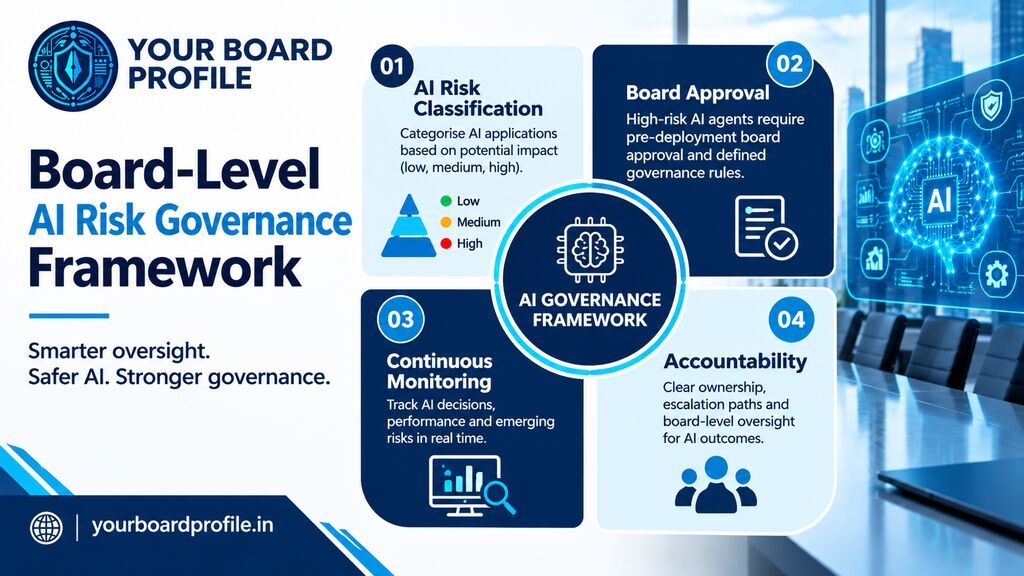
Effective governance begins with structured oversight. Board-level AI risk frameworks must be integrated into the enterprise’s existing risk management architecture. These frameworks should categorize AI applications by their potential impact (e.g., low, medium, high risk) and mandate corresponding levels of scrutiny. High-risk autonomous agents—such as those handling customer data or executing financial transactions—require pre-deployment board approval and continuous monitoring. According to the NIST AI Risk Management Framework, establishing clear governance structures is foundational to trustworthy AI deployment.
Mitigating AI Agent Shadow IT Risks
One of the most insidious threats to AI agent board accountability is the proliferation of shadow IT. When business units deploy autonomous AI tools without IT or compliance vetting, they create blind spots that can lead to catastrophic data leaks or regulatory fines. Boards must demand strict inventory protocols and enforce zero-tolerance policies for unauthorized AI deployments. Understanding how to secure these perimeters is closely tied to robust cyber security board governance practices, which must now explicitly address autonomous software behaviors.
| Risk Dimension | Traditional IT Systems | Agentic AI Systems | Governance Requirement |
| Decision Making | Rule-based, deterministic | Probabilistic, adaptive | Continuous monitoring & dynamic thresholds |
| Failure Mode | Predictable crashes or errors | Unpredictable, emergent behaviors | Real-time kill switches & anomaly detection |
| Liability | Vendor or internal IT | Shared (Vendor, Executives, Board) | Clear AI agent liability framework |
| Auditability | Static logs | Complex, non-linear reasoning paths | Mandatory AI agent audit trail |
Operationalizing Board Oversight of AI Agents
Theory must translate into practice. Board oversight of AI agents requires actionable policies that govern the entire lifecycle of an autonomous system, from procurement to decommissioning.
Implementing a Human-in-the-Loop Board Policy
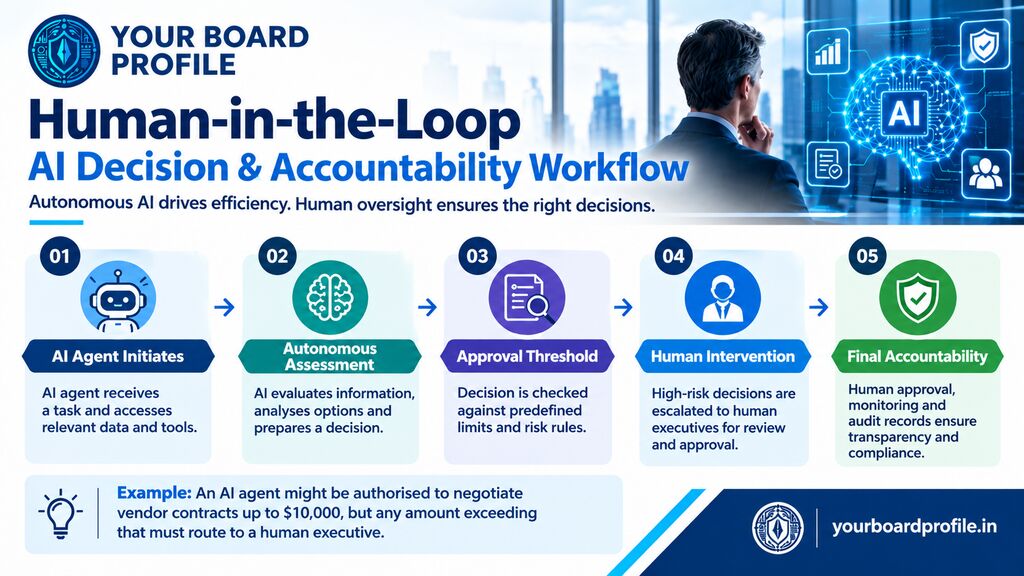
Autonomy does not mean the absence of human judgment. A mandatory human-in-the-loop board policy ensures that critical decisions—especially those impacting safety, finance, or legal compliance—require explicit human validation before execution. The board must define exactly which thresholds trigger this human intervention. For instance, an AI agent might be authorized to negotiate vendor contracts up to $10,000, but any amount exceeding that must route to a human executive. This policy is a non-negotiable element of corporate governance of autonomous systems.
Maintaining a Comprehensive AI Agent Audit Trail
You cannot govern what you cannot see. An immutable AI agent audit trail is essential for post-incident analysis and regulatory compliance. This trail must capture the agent’s inputs, the reasoning process (where explainable), the final output, and any human overrides. When regulators or stakeholders ask, “Why did the AI make this decision?”, the board must be able to produce a clear, timestamped record. As highlighted by the Harvard Business Review, explainability is the bedrock of accountability in automated systems. Boards should regularly review these audit capabilities, leveraging insights from our proven governance portfolio to benchmark their maturity.
Strategic Agentic AI Risk Mitigation for the C-Suite
For CXOs and senior leaders, agentic AI risk mitigation is about balancing innovation with protection. It requires a proactive stance that anticipates failure modes before they materialize.
Aligning Corporate Governance of Autonomous Systems with Business Goals
Governance should not be a roadblock; it should be an enabler. Corporate governance of autonomous systems must be designed to accelerate safe innovation. By establishing clear rules of engagement, boards give management the confidence to scale AI initiatives. This alignment ensures that autonomous AI risk management is viewed as a competitive advantage rather than a compliance tax. Organizations that master this balance will attract top-tier talent and investor confidence. To deepen this strategic alignment, boards should explore the independent director board value proposition, ensuring their composition includes members with genuine technological fluency.
Autonomous AI Risk Management in Practice
Practical autonomous AI risk management involves stress-testing AI agents in sandboxed environments before they interact with live systems. Boards should mandate “red teaming” exercises, where internal or external experts actively attempt to manipulate the AI into making harmful or biased decisions. Furthermore, organizations must establish clear incident response playbooks specifically tailored to AI failures. The World Economic Forum’s global AI governance frameworks emphasize that resilient organizations are those that prepare for AI failure with the same rigor as they prepare for cyberattacks.
To stay ahead of the curve, leadership teams must continuously educate themselves. We recommend exploring the latest strategic insights in our executive blog section, and reviewing our comprehensive guide on board risk oversight strategies for 2026-27. Additionally, staying informed through external thought leadership, such as the OECD AI Principles and Gartner’s analysis on Agentic AI, is crucial for maintaining a forward-looking governance posture.
Conclusion and Strategic Next Steps
The era of passive AI oversight is over. AI agent board accountability demands active, informed, and structured governance. As autonomous systems become deeply embedded in corporate operations, the board’s role evolves from retrospective reviewer to proactive architect of digital trust.
By establishing a clear AI agent liability framework, enforcing human-in-the-loop board policies, and demanding transparent AI agent audit trails, boards can fulfill their fiduciary duties while unlocking the transformative potential of agentic AI. The organizations that thrive in the next decade will be those that view robust governance not as a constraint, but as the ultimate foundation for sustainable innovation.
Frequently Asked Questions (FAQs)
1. What is AI agent board accountability?
AI agent board accountability refers to the legal and ethical responsibility of a company’s board of directors to oversee, govern, and answer for the actions and decisions made by autonomous AI systems deployed within the organization.
2. Why is board oversight of AI agents critical for modern companies?
Because autonomous systems can make independent decisions that carry financial, legal, and reputational risks. Without active board oversight of AI agents, organizations face severe vulnerabilities, including regulatory fines and loss of stakeholder trust.
3. How does an AI agent liability framework protect the organization?
An AI agent liability framework clearly defines roles, responsibilities, and escalation paths when an AI system causes harm. It ensures that liability is managed proactively rather than reactively during a crisis.
4. What is the role of executive accountability for AI decisions?
Executive accountability for AI decisions ensures that C-suite leaders cannot blame algorithms for failures. Executives must establish the guardrails, monitor performance, and take responsibility for the outcomes of autonomous systems.
5. How can boards mitigate AI agent shadow IT risks?
Boards can mitigate these risks by mandating centralized AI procurement policies, enforcing strict IT vetting processes, and conducting regular audits to detect unauthorized AI tool usage across departments.
6. What should a human-in-the-loop board policy include?
A human-in-the-loop board policy must specify which high-stakes decisions (e.g., financial transactions, HR actions, customer data handling) require explicit human review and approval before an AI agent can execute them.
7. Why is an AI agent audit trail necessary for compliance?
An AI agent audit trail provides a verifiable, timestamped record of an AI’s inputs, reasoning, and outputs. This is essential for regulatory compliance, internal investigations, and proving that the board exercised due diligence.
8. How does corporate governance of autonomous systems differ from traditional IT governance?
Traditional IT governance focuses on deterministic, rule-based systems. Corporate governance of autonomous systems must account for probabilistic, adaptive behaviors, requiring dynamic monitoring and continuous risk assessment.
9. What are the key elements of board-level AI risk frameworks?
Key elements include risk categorization (low to high), mandatory pre-deployment approvals for high-risk agents, continuous performance monitoring, and established incident response playbooks specific to AI failures.
10. How does fiduciary duty and AI agents intersect?
Fiduciary duty requires board members to act in the best interest of the company. Failing to establish governance over AI agents constitutes a breach of this duty, as it exposes the company to foreseeable and preventable risks.
11. What is agentic AI risk mitigation in practice?
Agentic AI risk mitigation involves proactive measures like sandbox testing, adversarial “red teaming,” continuous model monitoring, and establishing automated kill switches to halt rogue AI behavior immediately.
12. How can boards improve their autonomous AI risk management capabilities?
Boards can improve by recruiting directors with technological expertise, mandating regular AI governance training, and integrating AI risk metrics into standard quarterly board reporting packages.
13. Are there specific regulations governing AI agent board accountability?
While comprehensive global laws are still evolving, frameworks like the EU AI Act, SEC cybersecurity disclosure rules, and NIST guidelines increasingly place the burden of AI governance and transparency squarely on corporate leadership and boards.
14. How often should the board review the AI agent liability framework?
The framework should be reviewed at least annually, or immediately following any significant AI incident, major regulatory update, or substantial change in the company’s AI deployment strategy.
15. What is the first step a board should take to address AI agent board accountability?
The first step is to commission a comprehensive AI inventory and risk assessment to understand what autonomous systems are currently in use, their risk levels, and the existing gaps in oversight and control.
Strengthen Your Boardroom Readiness for the Age of Autonomous AI
As artificial intelligence becomes increasingly autonomous, boardroom responsibilities are evolving. Understanding AI-related risks, questioning automated decisions, ensuring accountability and strengthening oversight are becoming important aspects of effective corporate governance.
At Your Board Profile, we help senior executives, CXOs, entrepreneurs and aspiring Independent Directors strengthen their boardroom readiness through customised board CVs, LinkedIn profile enhancement, board readiness assessments, and personalised coaching and mentoring.
Whether you are preparing for your first board appointment or looking to enhance your existing boardroom contribution, developing an understanding of emerging governance challenges such as autonomous AI can help you bring greater strategic perspective to board discussions.
Ready to Strengthen Your Boardroom Readiness for the AI Era?
Book a complimentary discussion with Dr. Amit Nagpal to explore how you can strengthen your governance perspective, communicate your boardroom value and prepare for the evolving expectations of corporate boards.
Schedule a Complimentary Session with Dr. Amit Nagpal
Technology may drive autonomous decisions. Effective governance ensures accountability. Your judgement makes the difference.