
By Dr Amit Nagpal
Why Leadership Needs More Than Powerful Words
In leadership, everyone communicates, but only a few leaders genuinely shape how people think, feel and act. Two executives may present the same business strategy, use equally impressive vocabulary and share identical performance numbers. Yet one inspires confidence, while the other struggles to secure stakeholder commitment. What creates this difference? It is rarely the choice of words alone. More often, it is the underlying structure of the message.
This is where Story Architecture becomes important. It is the deliberate design of ideas, experiences, evidence and emotions into a coherent narrative that people can understand, remember and act upon. Think of it as the architectural blueprint of a building. The visible structure may attract attention, but its strength comes from the foundation, framework, connections and careful planning underneath. Leadership communication works in much the same way. Without a strong foundation, even an impressive message can collapse under scrutiny.
For a CEO, an effective narrative can connect business strategy with organisational purpose. For an Independent Director, it can translate governance responsibilities into meaningful stakeholder conversations. For an aspiring board member, it can turn years of professional experience into a compelling board-level value proposition. The objective is not to make every communication sound dramatic. It is to make every important communication purposeful, consistent and credible.
The central idea is simple: architecture matters more than vocabulary. Leaders need more than communication skills; they need a design system that connects what they say with what they believe, decide and deliver. This approach creates the foundation for strategic narrative design, stronger stakeholder relationships and a lasting narrative dividend in business.
Table of Contents
Why Story Architecture Matters in Modern Leadership
Business leaders operate in an environment where information is abundant but attention is limited. Employees receive multiple messages about priorities, investors evaluate management credibility, customers question organisational commitments, and boards must assess whether strategy is supported by evidence and responsible decision-making. A collection of disconnected announcements cannot address these expectations effectively.
A well-designed narrative gives different communications a common purpose. It helps an organisation explain not only what it is doing but also why the decision matters, what challenges it must overcome and what outcomes stakeholders should expect. Research published by the Academy of Management in 2025 examines how leadership storytelling supports organisational sensemaking, dialogue and stakeholder engagement. This reinforces the importance of treating stories as a leadership capability rather than simply a presentation technique. Read the research on leadership storytelling.
Consider a company undergoing digital transformation. Management could communicate a technology investment plan, announce new systems and share implementation timelines. However, employees may still wonder whether their roles will change, customers may question service continuity, and investors may want evidence of long-term value creation. A coherent narrative connects these different concerns to one strategic direction.
Story Architecture helps leaders achieve five important outcomes:
- Converting information into insight: Numbers and reports explain performance, but a structured narrative explains their strategic significance.
- Maintaining consistency: Different leaders can communicate the same organisational priorities without delivering contradictory messages.
- Building stakeholder confidence: Transparency about challenges, decisions and expected outcomes makes leadership communication more credible.
- Connecting purpose with action: Organisational values become meaningful when people can see how they influence everyday decisions.
- Creating a narrative dividend: Repeated, credible and consistent communication builds reputational value over time.
The last outcome deserves particular attention. The narrative dividend in business is the cumulative benefit an organisation receives when its communication consistently reinforces credibility, purpose and performance. It is not an accounting measure or guaranteed financial return. It is a way of understanding how trust and reputation can strengthen through repeated evidence-backed communication.
The Seven Pillars of Strategic Narrative Design
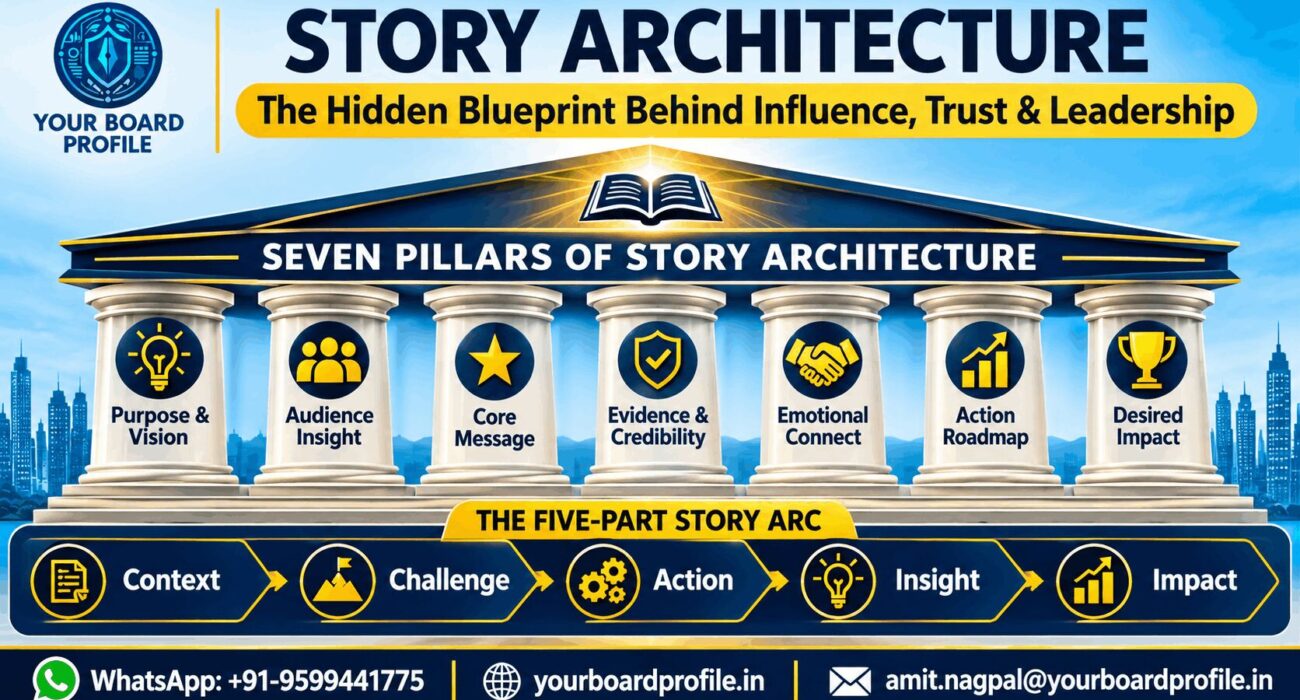
Effective leadership communication needs a structure that can support different situations without losing its central meaning. The framework presented in my reference document identifies seven interconnected pillars. Together, these pillars provide a practical foundation for strategic narrative design.
1. The Strategic Spine: Establishing the Governing Idea
Every strong narrative needs a central idea. This is its strategic spine: the governing thought that gives direction to the entire communication. Without it, a presentation can become a collection of interesting observations without a clear message.
A CEO discussing expansion, for example, might establish the governing idea as: “Sustainable growth must strengthen customer trust.” Every subsequent argument, investment decision and operational priority should connect with that principle.
For a board director, the strategic spine could be: “Long-term organisational value depends on responsible oversight and strategic resilience.” This statement creates a reference point for discussions about risk, succession, capital allocation and corporate culture.
The most effective governing ideas are simple enough to remember but substantial enough to guide decisions. Leaders should be able to explain their central message in one sentence before developing the supporting narrative.
2. The Structural Arc: Moving from Context to Impact
A strong narrative needs progression. The audience should understand where the organisation started, what challenge emerged, what action followed, what was learned and what changed as a result.
A practical structure is:
Context → Challenge → Action → Insight → Impact
This five-part sequence helps leaders move beyond describing activities and explain their significance. For instance, a CFO presenting a financial restructuring initiative should not simply list cost reductions. The narrative should explain the original financial situation, the underlying challenge, the corrective measures, the lessons from implementation and the resulting organisational impact.
This approach is equally valuable in interviews, board presentations, annual reports and leadership profiles. It turns professional experience into evidence of judgement, accountability and results.
3. The Emotional Curve: Creating Meaningful Connection
Facts establish credibility, but human experiences help audiences understand why those facts matter. The emotional curve gives a narrative its movement. It introduces the situation, establishes tension, builds understanding and reaches a meaningful resolution.
This does not mean exaggerating difficulties or manipulating emotions. Responsible leadership communication should remain grounded in evidence. A CEO explaining a difficult restructuring decision, for example, should acknowledge the human consequences while clearly explaining the business rationale and the support being provided to affected employees.
My reference document connects this pillar with the 7E Storytelling Framework: Engage, Empathize, Educate, Elevate, Enrich, Empower and Endure. The framework encourages leaders to move audiences from initial attention towards understanding, action and lasting recall.
4. Role Mapping: Giving Every Stakeholder a Place
A narrative becomes more effective when leaders understand who is involved and what each stakeholder needs to understand.
A board may focus on accountability, strategic direction and risk. Employees may want clarity about priorities and job implications. Investors may examine performance, capital allocation and future prospects. Customers may care about service quality, reliability and responsible conduct.
The central message should remain consistent, but its explanation must reflect the audience.
| Stakeholder | Primary concern | Narrative emphasis |
| Board directors | Oversight and long-term value | Strategic rationale, risks and accountability |
| Investors | Performance and confidence | Evidence, capital discipline and outlook |
| Employees | Purpose and direction | Change, opportunities and expectations |
| Customers | Trust and reliability | Service, quality and commitments |
| Regulators | Compliance and transparency | Controls, responsibilities and disclosures |
| Communities | Social and environmental impact | Responsibility and measurable outcomes |
Role mapping prevents leaders from assuming that one presentation will answer every stakeholder’s questions.
5. Narrative Environment: Understanding the Context
No leadership message exists in isolation. Industry conditions, economic uncertainty, regulatory developments, technology disruption and social expectations influence how audiences interpret communication.
For example, an organisation announcing artificial intelligence investments in a period of heightened concern about data privacy must address more than productivity benefits. Stakeholders may also expect explanations about data governance, cybersecurity, employee capability and accountability.
The narrative environment helps leaders anticipate these questions before communicating. It also ensures that corporate governance storytelling reflects the organisation’s actual operating context rather than relying on generic statements about innovation, sustainability or excellence.
6. Symbolic Anchors: Making Leadership Messages Memorable
A symbolic anchor is a distinctive phrase, principle, metaphor or recurring theme that helps audiences remember a larger idea.
Examples from my reference document include:
- Enlarge–Excel–Evolve
- Narrative Dividend
- Governance Guardian
These expressions can become useful communication assets when they consistently represent real leadership behaviours and organisational priorities.
A company that uses “customer trust drives our growth” as a recurring message must demonstrate that commitment through service standards, transparent policies and responsible decisions. Otherwise, the phrase becomes a slogan rather than a credible symbolic anchor.
The strongest anchors are memorable because people can connect them with actual organisational experiences.
7. Scalability and Continuity: Maintaining Consistency
A leadership narrative must work across different communication channels. The same strategic idea may appear in a board presentation, annual report, investor discussion, LinkedIn article, employee town hall or leadership interview.
The language and level of detail may change, but the underlying message should remain coherent.
This is particularly important for CXOs and board directors whose professional reputation is shaped by repeated interactions with different stakeholders. A leader who communicates one philosophy publicly but demonstrates contradictory behaviour internally weakens credibility.
Scalable Story Architecture creates continuity without making every communication sound identical. It provides a common foundation while allowing each message to suit its audience and purpose.
The Five-Part Story Architecture Framework for Leaders
The seven pillars explain how to design a narrative. The five-part story arc explains how to use that design in a real leadership situation.
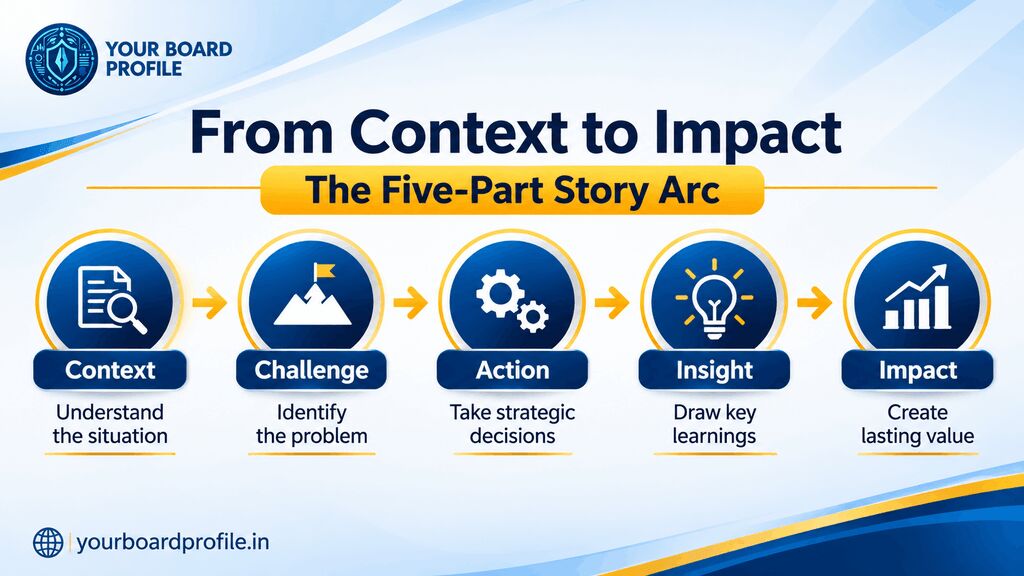
| Stage | Key question | Leadership application |
| Context | Where are we now? | Explain the situation and background |
| Challenge | What needs attention? | Identify the problem, risk or opportunity |
| Action | What did we do? | Describe decisions and interventions |
| Insight | What did we learn? | Demonstrate judgement and understanding |
| Impact | What changed? | Present outcomes and future implications |
Consider an executive presenting a business transformation to the board.
Context: The organisation has experienced fragmented reporting systems and inconsistent operational information.
Challenge: Leadership cannot obtain timely insights for effective decision-making.
Action: Management initiates systems integration and invests in employee capability development.
Insight: Technology implementation alone cannot deliver transformation without behavioural and cultural alignment.
Impact: The organisation establishes a stronger foundation for informed decisions and more consistent reporting.
The value of this structure lies in its completeness. It does not simply celebrate action; it explains the reasoning behind action and the evidence of its impact.
For aspiring Independent Directors, this framework can also improve interview responses. Instead of saying, “I led several transformation projects,” a candidate can explain a particular challenge, the decisions involved, the governance considerations and the lessons learned.
That difference can make a professional profile considerably more persuasive.
Corporate Governance Storytelling: Bringing Narrative into the Boardroom
Corporate governance is often associated with regulations, committees, policies, reporting and compliance obligations. These structures are essential, but effective governance also requires the ability to explain decisions, connect organisational values with conduct and maintain stakeholder confidence.
The OECD’s corporate governance framework highlights the importance of trust, transparency and accountability in effective corporate governance. Its principles provide a useful foundation for understanding why board communication must be clear, consistent and responsible.
The board’s role extends beyond reviewing financial performance. Directors must consider strategic risks, organisational culture, leadership succession, stakeholder expectations and long-term sustainability. These discussions often involve complex information that needs to be translated into meaningful strategic questions.
This is where corporate governance storytelling becomes a valuable boardroom capability.
For example, a board reviewing cybersecurity investments should examine more than the technology budget. Directors need to understand the organisation’s exposure, potential consequences, management preparedness, accountability arrangements and the implications for stakeholder trust.
A structured narrative helps connect these elements.
The G20/OECD Principles of Corporate Governance 2023 specifically address board responsibilities relating to disclosure and communication. This underlines why communication quality is relevant to board oversight, not merely a public relations activity.
Boards can use Story Architecture to:
- Connect strategic decisions with organisational purpose.
- Translate complex risks into understandable business implications.
- Examine whether leadership messages match organisational behaviour.
- Improve discussions around CEO evaluation and succession.
- Strengthen transparency during organisational change or crisis.
- Identify gaps between policy commitments and stakeholder experience.
A useful boardroom question is: What story are our numbers really telling?
Financial results may show growth, but the narrative behind that growth could reveal rising customer concentration, weakening controls or unsustainable operating practices. Directors must look beyond the headline and examine the underlying reality.
This is the difference between communicating performance and exercising meaningful stewardship.
Practical Applications Across Leadership and Business
The value of Story Architecture becomes clearer when applied to real leadership situations. It can support executive communication, professional positioning, organisational transformation and stakeholder engagement.
Executive Branding and Building Leadership Trust
For senior executives and aspiring board directors, professional credibility is not established by listing qualifications alone. Boards and nomination committees need to understand what a candidate brings to the table, how that experience supports strategic oversight and what distinctive value the individual can contribute.
A well-designed professional narrative connects experience with judgement, leadership outcomes and governance relevance.
For example, a CFO aspiring to an Independent Director position should move beyond presenting financial expertise as a technical capability. The narrative could demonstrate how financial oversight, capital allocation, risk assessment and strategic decision-making have contributed to organisational resilience.
This is also why a conventional executive CV may not always communicate board readiness effectively.
Professionals preparing for their first appointment can explore how to secure a first board seat without prior board experience. Those refining their professional documents can also learn how to create a board-ready CV that highlights governance oversight.
Similarly, understanding the difference between executive CV language and board director CV language can help professionals communicate their contribution in terms of oversight, strategic thinking and long-term value creation.
Building leadership trust requires consistency between professional claims and demonstrated behaviour. A powerful narrative should therefore be supported by specific examples, measurable outcomes and credible leadership experiences.
Organisational Change and Managing Organizational Meaning
Organisational change creates uncertainty. Employees may understand what management wants to implement but remain unclear about why it is necessary and how it affects their work.
Leaders who communicate only targets, timelines and implementation instructions risk overlooking the human dimension of transformation.
A change narrative should explain three things: where the organisation is heading, why the current situation requires action and how people will contribute to the transition.
McKinsey’s research on the science of organisational transformations discusses the importance of role modelling, understanding and conviction, capability building and reinforcement in changing organisational mindsets and behaviours.
This supports a crucial leadership lesson: communication must be reinforced through visible action.
If a CEO speaks about collaboration but continues to reward isolated departmental performance, employees will believe the behaviour they observe rather than the story they hear.
Managing organizational meaning therefore requires alignment between communication, leadership decisions, organisational systems and everyday experiences.
The same principle applies during mergers, leadership transitions, restructuring and crisis management. People need a consistent explanation of what is changing, what remains important and how the organisation intends to move forward.
The Board-Level Story Architecture Toolkit
A useful framework becomes more valuable when leaders can apply it repeatedly. My reference document introduces a Board-Level Story Architecture Toolkit designed for board directors, aspiring Independent Directors and CXOs.
Its purpose is to transform narrative thinking into practical governance tools.
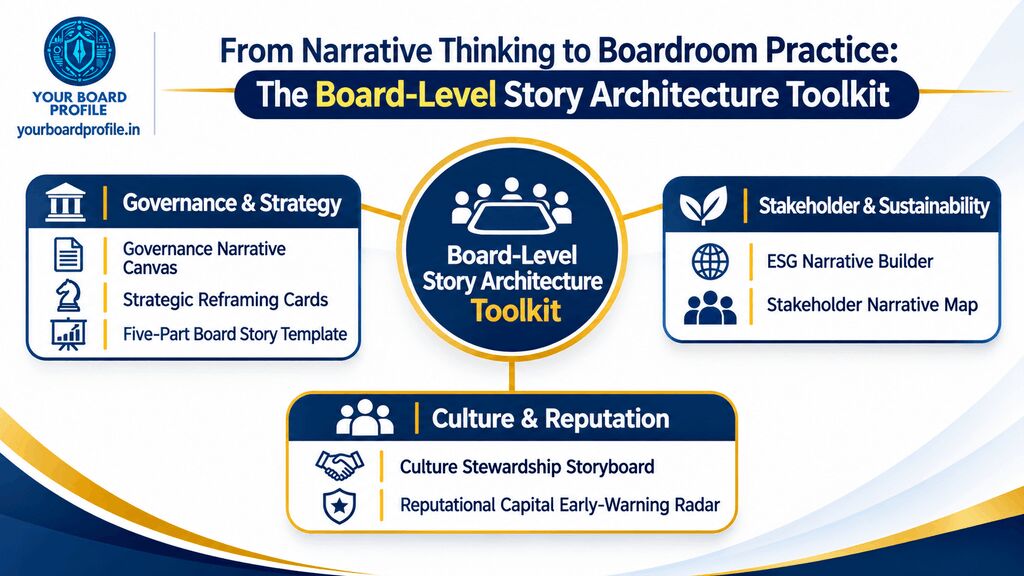
| Boardroom tool | Purpose | Practical application |
| Governance Narrative Canvas | Structure major strategic conversations | Strategy reviews and board presentations |
| Culture Stewardship Storyboard | Connect desired culture with leadership behaviour | Culture oversight |
| Reputational Capital Radar | Identify emerging narrative and reputation risks | Risk committee discussions |
| ESG Narrative Builder | Connect sustainability commitments with long-term value | ESG oversight and reporting |
| Strategic Reframing Cards | Encourage deeper board-level questions | Board discussions and strategic reviews |
| Stakeholder Narrative Map | Understand stakeholder expectations | Investor and stakeholder communication |
| Five-Part Board Story Template | Present decisions through a coherent sequence | CEO reviews and transformation updates |
1. Governance Narrative Canvas
This one-page tool helps directors structure important strategic discussions around eight elements:
- Governing idea
- Stakeholder impact
- Risks and trade-offs
- Moral imperative
- Evidence and data
- Story arc
- Symbolic anchors
- Desired behavioural change
It encourages directors to examine not only what management proposes but also the consequences, supporting evidence and intended outcomes.
2. Culture Stewardship Storyboard
Boards are custodians of organisational culture, not merely observers of it.
This storyboard helps directors examine the desired cultural shift, signature behaviours, CEO communication, management alignment, recurring organisational symbols and counter-narratives that may indicate resistance or inconsistency.
3. Reputational Capital Early-Warning Radar
Reputation risks often emerge before they become visible in financial results.
The radar encourages boards to monitor stakeholder tensions, inconsistent leadership messages, social media sentiment, gaps between policy and perception, and emerging reputational concerns.
A monthly narrative risk dashboard can help bring these signals into structured board discussions.
4. ESG Narrative Builder
Sustainability communication must connect organisational commitments with credible actions.
The ESG Narrative Builder considers purpose, people and planet, long-term value, materiality, transparency and stewardship commitments.
It helps directors distinguish meaningful sustainability progress from statements that lack evidence or measurable accountability.
5. Strategic Reframing Cards
Directors can use carefully framed questions to deepen strategic discussions.
Examples include:
- What story are our numbers really telling?
- Which stakeholder narrative are we underestimating?
- If our employees wrote our organisational story today, what would it say?
- What narrative gap could become a future business risk?
- Does our leadership communication reflect our actual organisational culture?
These questions move the boardroom conversation from routine reporting towards deeper inquiry.
Common Leadership Storytelling Mistakes and How to Avoid Them
Even experienced leaders can weaken their communication by focusing too heavily on presentation and too little on structure.
One common mistake is confusing storytelling with promotional language. Repeatedly describing an organisation as innovative, ethical or customer-centric does not establish credibility. These claims require evidence from actual decisions and organisational conduct.
Another mistake is overwhelming audiences with information. A board presentation containing dozens of charts may be comprehensive but still fail to communicate the central strategic issue. Leaders should distinguish essential evidence from supporting detail and establish a clear governing idea before presenting the numbers.
A third mistake is using the same narrative for every stakeholder. Investors, employees, regulators and customers may need different explanations, even when the underlying organisational commitment remains unchanged.
Leaders also make the mistake of separating their narrative from their behaviour. If a company communicates accountability but avoids responsibility when something goes wrong, stakeholder trust can deteriorate quickly.
Finally, many executives treat communication as a one-time event. A powerful speech may attract attention, but a lasting leadership narrative requires reinforcement across meetings, decisions, reporting and everyday interactions.
A useful discipline is to review every major communication against five questions:
- Is the central message clear?
- Is the supporting evidence credible?
- Does the narrative address stakeholder concerns?
- Are the proposed actions consistent with organisational values?
- Can the message be reinforced through measurable behaviour?
These checks make Story Architecture a repeatable leadership practice rather than an occasional communication exercise.
Conclusion: Leaders Who Design Narratives Build Legacies
Leadership influence is not created by vocabulary alone. It develops through the consistent alignment of ideas, decisions, behaviour and stakeholder expectations. A compelling message may attract attention, but a well-designed narrative gives people a reason to understand, believe and act.
Story Architecture provides the underlying design system for this process. Its seven pillars establish a strategic foundation, its five-part story arc creates clarity and progression, and its board-level tools help translate narrative thinking into practical governance conversations.
For CXOs, this means communicating strategy with greater clarity and purpose. For board directors, it means connecting oversight with stewardship and stakeholder confidence. For aspiring Independent Directors, it means presenting professional experience as a credible contribution to board-level decision-making.
The narrative dividend in business emerges when an organisation repeatedly demonstrates that its words and actions belong to the same story. That consistency strengthens reputation, supports organisational alignment and helps build leadership trust.
As my framework suggests, boards that only check compliance perform administration, while boards that shape organisational stories contribute to stewardship.
The question every leader should consider is this:
Is your communication simply a collection of messages, or does it reflect a coherent architecture?
Because leaders who design meaningful narratives do more than communicate their vision. They shape organisational identity, influence stakeholder perceptions and build foundations for lasting leadership legacies.
Frequently Asked Questions About Story Architecture
1. What is Story Architecture in leadership?
Story Architecture is the strategic design of leadership communication around a central idea, a logical sequence, stakeholder relevance and meaningful outcomes. It helps leaders connect facts, experiences, decisions and organisational purpose into a coherent narrative. Rather than focusing only on persuasive vocabulary, it establishes a structure that makes communication credible, memorable and actionable.
2. Why is Story Architecture important for CEOs and CXOs?
CEOs and CXOs communicate with employees, investors, customers, board members and other stakeholders. Story Architecture helps them maintain a consistent strategic message across these audiences while addressing their different concerns. It also improves their ability to explain complex decisions, lead organisational change and demonstrate accountability.
3. What are the seven pillars of Story Architecture?
The seven pillars are the Strategic Spine, Structural Arc, Emotional Curve, Role Mapping, Narrative Environment, Symbolic Anchors, and Scalability and Continuity. Together, they provide a framework for designing leadership narratives that remain coherent across different audiences and communication channels.
4. How does Story Architecture help build leadership trust?
It helps build leadership trust by aligning communication with evidence, decisions and visible behaviour. When leaders explain their intentions clearly, acknowledge challenges and demonstrate consistency, stakeholders have stronger reasons to trust their judgement. Trust depends on actions, not storytelling alone.
5. What is strategic narrative design?
Strategic narrative design is the process of organising an organisation’s purpose, priorities, challenges and future direction into a consistent communication framework. It ensures that important messages support the organisation’s strategy rather than becoming disconnected announcements.
6. How is corporate governance storytelling different from traditional business storytelling?
Traditional business storytelling often focuses on products, customers, achievements or brand identity. Corporate governance storytelling focuses more closely on accountability, oversight, risk, transparency, ethical conduct and long-term organisational value. Its purpose is to make complex governance matters understandable without weakening their accuracy or seriousness.
7. Can aspiring Independent Directors use Story Architecture to strengthen their board profiles?
Yes. Aspiring Independent Directors can use it to present professional achievements through governance-relevant experiences. By explaining the context, challenge, decisions, insights and outcomes behind their work, candidates can demonstrate strategic judgement, oversight capability and the value they may bring to a board.
8. What is the five-part leadership story arc?
The five-part story arc consists of Context, Challenge, Action, Insight and Impact. It helps leaders explain the situation, identify the central problem, describe their response, demonstrate learning and establish the resulting outcomes. It is useful for board presentations, interviews and leadership communication.
9. What is the narrative dividend in business?
The narrative dividend in business refers to the cumulative reputational and relationship benefits that result from consistent, credible and purpose-led communication. When an organisation repeatedly supports its messages with responsible decisions and evidence, it can strengthen stakeholder confidence and long-term credibility.
10. How can Story Architecture improve boardroom communication?
It helps directors structure complex discussions, connect strategic decisions with stakeholder expectations and identify gaps between management communication and organisational performance. It also supports better questions during strategy reviews, CEO evaluations, risk discussions and succession planning.
11. What are CXO communication tools, and how does Story Architecture support them?
CXO communication tools include board presentations, executive briefings, investor communications, leadership interviews, annual reports and employee town halls. Story Architecture provides a common narrative foundation for these formats, helping executives maintain strategic consistency while adapting their messages to different audiences.
12. How can leaders use storytelling during organisational transformation?
Leaders can explain why transformation is necessary, what challenges the organisation faces, how the proposed changes will work and what outcomes are expected. They should also address employee concerns and reinforce their messages through visible leadership behaviour. This makes transformation communication more meaningful and credible.
13. What is the difference between storytelling and strategic narrative design?
Storytelling generally refers to presenting information through a structured account or experience. Strategic narrative design is a broader leadership discipline that connects multiple stories, messages and organisational actions to a common purpose. It provides continuity across communication rather than treating every story as an independent event.
14. How can boards identify reputational risks through organisational narratives?
Boards can monitor stakeholder feedback, employee sentiment, inconsistent management messages, gaps between public commitments and actual practices, and emerging concerns across communication channels. These signals can help directors identify reputational vulnerabilities and ask management to address them before they escalate.
15. How can professionals develop their Story Architecture capabilities?
Professionals can begin by identifying their central leadership message, organising important experiences through the five-part story arc and mapping their communication to stakeholder expectations. They should practise using evidence-backed examples across presentations, interviews and professional profiles. Regular feedback and alignment between words and actions help strengthen the capability over time.
Ready to Build a Leadership Narrative That Strengthens Your Boardroom Presence?
Your professional experience tells a story. But does that story communicate your strategic value, leadership credibility and governance readiness?
At Your Board Profile, we help senior executives, CXOs, entrepreneurs and aspiring Independent Directors translate their professional journeys into compelling board-level narratives.
Through customised Board CVs, LinkedIn profile optimisation, personal branding, board readiness assessments and one-to-one mentoring, we help professionals communicate their value with greater clarity and credibility.
Take the next step towards strengthening your boardroom positioning.
- Explore our Board Profile Portfolio.
- Discover our Professional Services.
- Explore more insights on Your Board Profile Blog.
Book a complimentary discussion with me:
https://calendly.com/dramitnagpal