

Why Every Board Appointment Needs Careful Evaluation
A board appointment can be an important milestone in a professional’s career. After years of building expertise, leading teams, managing business challenges and contributing to organisational growth, getting an opportunity to join a company’s board can feel like a natural next step. It offers a chance to influence strategic decisions, contribute to governance, guide leadership and create long-term institutional value. However, there is another side to this opportunity that aspiring directors should never overlook: the responsibility and risk that come with accepting a board position.
A prestigious company name, an impressive founder or an attractive board fee does not automatically make an appointment the right choice. Behind an organisation’s public image, there may be financial pressures, unresolved legal matters, weak internal controls, leadership disagreements or governance practices that do not match the standards expected of a responsible board. Once you accept the appointment, you are not simply adding another designation to your professional profile. You are accepting fiduciary responsibilities that require independent judgement, informed decision-making and continuous oversight.
This is where board due diligence becomes essential. Just as investors examine a business before committing capital, professionals should examine a company before committing their reputation, experience and time to its board. The process should go beyond reading an annual report or speaking with the CEO. It should involve understanding financial performance, evaluating the leadership team, examining the company’s culture, reviewing regulatory compliance and assessing whether the board has the independence and information needed to function effectively.
A well-planned board due diligence exercise allows prospective directors to look beyond the company’s public image and assess whether its governance practices support responsible leadership.
For aspiring independent directors and senior executives, the real question is not simply whether a company wants them on its board. It is whether the company offers an environment in which they can contribute meaningfully while fulfilling their responsibilities with confidence.
This guide presents a practical checklist to help you evaluate a board opportunity, identify warning signs and make a more informed decision before accepting an appointment.
Table of Contents
What Is Board Due Diligence and Why Does It Matter?
Understanding Pre-Board Due Diligence
Board due diligence is the process of examining a company’s financial position, governance framework, leadership quality, legal compliance, business strategy and organisational culture before accepting a board appointment. It helps a prospective director understand what they are stepping into, what responsibilities they will carry and whether the organisation is prepared to support effective board oversight.
Think of it as looking beneath the surface before making a long-term professional commitment. A company may have impressive revenue figures, a well-known promoter and an attractive growth story. However, these factors do not necessarily indicate that its internal governance is strong. What happens when the company faces a cash-flow crisis? How does management respond when the board challenges a strategic decision? Are financial disclosures reliable? Does the organisation encourage independent thinking, or does it expect directors to approve decisions without meaningful discussion?
These questions matter because a director’s responsibility extends beyond attending meetings and offering professional opinions. In India, Section 166 of the Companies Act, 2013 requires directors to act in good faith, exercise reasonable care, skill and diligence, and use independent judgement. The statutory framework also addresses conflicts of interest and undue personal gain.
For independent directors, Schedule IV of the Companies Act provides additional guidance on professional conduct, board responsibilities, access to information and the importance of recording unresolved concerns in board meeting minutes.
Therefore, pre-board due diligence should be treated as a professional responsibility rather than an optional administrative exercise. It gives you an opportunity to identify concerns before your name becomes associated with the organisation.
The Difference Between a Promising Company and a Suitable Board Seat
A growing company is not automatically the right company for every director. An organisation may have excellent market potential but operate with a leadership style that does not value constructive disagreement. Another company may have a slower growth trajectory but demonstrate strong governance, transparent reporting and a genuinely collaborative board.
The distinction is important. When vetting a board seat, you should assess both the organisation and your ability to contribute effectively within its governance structure.
This is why board due diligence should assess not only business performance but also the quality of the boardroom environment in which a director will be expected to contribute.
Consider the following comparison:
| Evaluation factor | Promising but potentially unsuitable | Suitable board opportunity |
| Financial position | Growth supported by excessive borrowing | Sustainable growth and manageable debt |
| Leadership | Decisions concentrated around one individual | Clear accountability and balanced authority |
| Governance | Formal compliance without meaningful oversight | Transparent and effective governance |
| Board culture | Limited discussion and unquestioned approvals | Constructive debate and independent judgement |
| Information sharing | Incomplete or delayed reports | Timely and reliable information |
| Risk management | Reactive approach to emerging threats | Clearly defined risk oversight |
| Director protection | Unclear D&O insurance arrangements | Appropriate and understood protection |
A board appointment should strengthen your professional contribution, not expose you to avoidable risks. The right organisation is one where your experience is valued and your responsibilities can be discharged responsibly.
The Essential Board Due Diligence Checklist
A structured checklist makes the evaluation process more objective. Instead of relying on a few conversations or the company’s reputation, examine the following seven areas before accepting a board offer.
1. Evaluate the Company’s Financial Health
Financial performance is one of the first areas to investigate. A company can present attractive revenue growth while experiencing declining profitability, increasing debt or weakening cash flows. For a prospective director, understanding these patterns is essential because the board is expected to oversee financial performance and the integrity of financial reporting.
Begin by examining the company’s annual reports and audited financial statements for at least the previous three financial years, preferably five where information is available. Look at revenue growth, operating margins, profitability, working capital, borrowings and cash generation. Do not limit your assessment to the profit and loss statement. A business can report accounting profits while struggling to collect payments from customers or meet its immediate financial obligations.
Financial statement analysis should focus on the relationship between reported earnings and actual cash generation. If revenue is rising but operating cash flow remains consistently negative, ask why. Are customers delaying payments? Is inventory accumulating? Is the business offering unusually long credit periods to maintain sales? These details can reveal pressures that headline financial results may not communicate.
As part of board due diligence, prospective directors should examine whether reported financial performance reflects the company’s actual financial position.

A practical financial review should include:
| Financial indicator | What to examine | Potential warning sign |
| Revenue growth | Consistency over three to five years | Sudden growth without a clear business explanation |
| EBITDA margin | Operating profitability | Repeated margin deterioration |
| Net profit | Quality and sustainability of earnings | Profits dependent on exceptional income |
| Operating cash flow | Cash generated through operations | Persistent negative operating cash flow |
| Debt-to-equity ratio | Borrowing compared with shareholder funds | Rapidly increasing leverage |
| Interest coverage | Ability to service borrowing costs | Weak or declining coverage |
| Receivables | Collection efficiency | Receivables growing faster than sales |
| Related-party transactions | Commercial rationale and approvals | Unusual or poorly explained transactions |
Pay particular attention to the debt and cash flow review. Understand repayment schedules, loan covenants, security interests, contingent liabilities and any significant guarantees. If the company depends heavily on refinancing or fresh capital to meet existing obligations, the board must understand the implications.
Also examine the auditor’s report, including qualifications, emphasis-of-matter paragraphs and observations about internal financial controls. Repeated auditor resignations or changes deserve careful investigation, although they should not be treated as proof of misconduct without examining the circumstances.
The objective is not to conduct an entire statutory audit yourself. It is to understand whether the company’s financial information provides a credible foundation for board-level decisions.
2. Examine Corporate Governance Standards
A company’s governance framework reveals how decisions are made, monitored and challenged. Strong corporate governance standards provide clarity about accountability, ethical conduct, disclosure, stakeholder protection and the relationship between management and the board.
Start by examining the company’s Articles of Association, board charter, committee structures, code of conduct and related-party transaction policy. For a listed company, review its annual corporate governance disclosures and applicable SEBI Listing Obligations and Disclosure Requirements (LODR).
The Companies Act, 2013 and the G20/OECD Principles of Corporate Governance provide useful reference points for understanding directors’ responsibilities, accountability and effective board oversight.
During board due diligence, examine whether the organisation follows governance practices in substance rather than simply maintaining documents for regulatory purposes. For example, does the audit committee receive adequate information? Are internal auditors given access to the board? Are whistleblower complaints investigated independently? Does the board review related-party transactions carefully?
Effective board due diligence requires directors to examine whether these governance mechanisms work in practice rather than simply exist in company documents.
For Indian companies, the Ministry of Corporate Affairs portal can also help you examine available company master data, director details and statutory filings. Review the company’s filing history and registered charges instead of relying entirely on information supplied during recruitment discussions.
A particularly useful exercise is to compare what the company’s governance policies promise with what its annual reports and actual disclosures demonstrate.
3. Assess Leadership Quality and Board Dynamics
Even a financially sound company can face serious challenges if its leadership team lacks accountability or its boardroom relationships are dysfunctional.
The relationship between the chairperson, CEO, promoters and independent directors deserves particular attention. Does the chairperson encourage different perspectives? Can independent directors question management decisions without facing resistance? Does the CEO communicate difficult information honestly, or are only positive developments presented during meetings?
The CEO and board relationship should be based on mutual respect, clearly defined responsibilities and constructive challenge. The CEO is responsible for managing the business, while the board provides strategic direction, oversight and accountability. Confusing these roles can create governance weaknesses.
Try to understand how board meetings operate in practice. Ask whether directors receive meeting papers sufficiently in advance, whether discussions allow time for difficult subjects and whether management responds meaningfully to questions. Review board evaluation practices and understand how disagreements are recorded and resolved.
You should also investigate whether board members possess complementary experience. A board dominated by individuals with similar professional backgrounds may lack the diversity of thought required to challenge complex business decisions.
4. Investigate Legal, Regulatory and Compliance Risks
Legal and regulatory exposure can affect both the organisation and its directors. Before accepting an appointment, examine ongoing litigation, regulatory investigations, tax disputes, statutory notices, labour-related matters and significant contractual disagreements. A comprehensive board due diligence review should establish whether these matters could create financial, operational or reputational exposure for the company and its directors.
In India, review the company’s available MCA filings and relevant regulatory disclosures. Depending on its industry, you may also need to consider matters involving SEBI, the RBI, the Competition Commission of India, environmental regulators, tax authorities or sector-specific regulators.
Do not restrict the review to cases involving the company itself. Understand whether key promoters, senior executives or related entities have been involved in significant disputes that could affect the organisation’s reputation or governance.
A useful compliance review includes:
- Pending material litigation and regulatory proceedings.
- Statutory audit and secretarial audit observations.
- Tax demands and unresolved assessments.
- Related-party transaction disclosures.
- Labour, workplace safety and environmental compliance.
- Data privacy and cybersecurity obligations.
- Whistleblower complaints and internal investigations.
- Previous regulatory penalties or enforcement actions.
Ask the company secretary or general counsel to explain material unresolved issues. If an issue is complex, obtain independent legal advice before proceeding.
The purpose of board due diligence is not to assume that every dispute indicates wrongdoing. It is to understand the nature of the exposure, its financial implications and the adequacy of management’s response.
5. Review D&O Insurance and Director Personal Liability
This is one of the most important areas that aspiring directors sometimes overlook.
Directors and Officers (D&O) insurance is designed to protect eligible directors and officers against specified claims arising from their management-related responsibilities. However, the existence of a policy does not automatically mean that every legal expense, allegation or liability will be covered.
Before accepting an appointment, ask for the policy schedule, wording, endorsements and relevant exclusions. Do not settle for a verbal assurance that the company has adequate insurance.
Examine these aspects:
| D&O insurance consideration | What you should verify |
| Policy limit | Is the total coverage appropriate for the company’s risk profile? |
| Individual protection | How are independent and non-executive directors covered? |
| Defence costs | Are legal defence expenses covered or advanced? |
| Exclusions | What types of claims or conduct are excluded? |
| Prior acts | Are earlier events or claims covered or excluded? |
| Policy period | When does the policy begin and expire? |
| Reporting provisions | What are the notification requirements? |
| Run-off cover | Is protection available after retirement or resignation? |
The National Association of Corporate Directors’ D&O insurance guidance offers useful insights into exclusions and coverage considerations.
In India, Schedule IV of the Companies Act specifically identifies D&O insurance, if any, as a matter to be addressed in the appointment terms of independent directors. SEBI’s LODR framework also contains D&O insurance requirements for specified categories of listed entities; check the latest applicable provisions rather than assuming that the requirement applies identically to every company.
Remember that insurance is not a substitute for diligence. Fraud, intentional misconduct and other excluded conduct may not be covered, depending on the policy wording. Your responsibility to act carefully and exercise independent judgement remains.
6. Understand Business Strategy and Future Risks
A company may have strong financial performance today but face significant challenges over the next three to five years. A prospective director should therefore understand not only where the business stands but also where it intends to go.
Examine the company’s business model, competitive position, customer concentration, market opportunities and expansion plans. If the company intends to enter new markets, acquire another business or undertake substantial capital expenditure, understand the assumptions supporting those decisions.
Consider the risks associated with technology disruption, artificial intelligence, cybersecurity, geopolitical uncertainty, supply-chain dependencies, talent availability and changing regulations.
Ask management how it identifies emerging risks and whether the board regularly reviews the company’s risk appetite. Has the company established a formal enterprise risk management framework? Are major risks assigned to accountable executives? Does the board receive meaningful updates on mitigation plans?
The OECD Principles emphasise the board’s role in guiding strategy, overseeing risk management and monitoring governance practices.
Your contribution as a director becomes more valuable when you can connect business strategy with risk oversight. A company should be able to explain not only its growth ambitions but also the risks it is prepared to accept to achieve them.
7. Assess Board Cultural Alignment and Transparency
Financial statements and compliance records tell only part of the story. The company’s culture often determines how effectively its governance framework works in practice.
Board cultural alignment does not mean that every director must share the same opinions or management philosophy. Healthy boards need different perspectives. What matters is whether directors can disagree professionally, challenge assumptions and raise uncomfortable questions without being discouraged.
Observe how the organisation treats transparency. Are material issues communicated promptly? Are bad results discussed openly? Does management welcome questions about internal controls, employee concerns and customer complaints?
You should also understand the organisation’s approach to ethics, diversity, succession planning and stakeholder engagement.
Two companies with similar financial performance may offer very different board experiences. One may encourage independent thinking and constructive debate, while another may treat the board as a formal approval body.
Before accepting a board offer, consider whether your values, professional judgement and working style are compatible with the organisation’s governance culture.
Important Documents to Review Before Accepting a Board Offer
A professional board appointment should never be based entirely on conversations or informal assurances. Request relevant documents and allow sufficient time to review them. These records form an important part of board due diligence because they help verify the company’s disclosures, governance arrangements and outstanding obligations.
The following table provides a practical document checklist.
| Document | Why it matters |
| Last three to five annual reports | Financial performance and governance disclosures |
| Audited financial statements | Profitability, assets, liabilities and cash flows |
| Auditor reports | Qualifications and financial control observations |
| Articles of Association | Powers, procedures and governance framework |
| Board charter | Responsibilities and decision-making processes |
| Committee charters | Scope of audit, risk and nomination committees |
| Board meeting minutes | Quality of discussion and unresolved matters, subject to lawful access |
| Litigation summary | Material legal and regulatory exposure |
| Related-party transaction policy | Conflict management and transaction oversight |
| D&O insurance policy | Coverage, exclusions and director protection |
| Risk management framework | Key risks and mitigation processes |
| Appointment letter | Tenure, duties, fees, committee roles and liabilities |
You should also examine the terms of appointment carefully. For independent directors in India, Schedule IV provides guidance on the appointment letter, including the term, expectations, committee responsibilities, fiduciary duties, accompanying liabilities, D&O insurance provisions and remuneration.
If the company hesitates to provide relevant documents, ask why. Certain records may be confidential or restricted, but a prospective director should receive sufficient information to make an informed decision through an appropriate and secure process.
Red Flags That Should Make an Aspiring Director Pause
Not every concern should lead to immediate rejection. Some companies operate in challenging industries or may be undergoing legitimate restructuring. However, certain patterns deserve closer examination. Identifying these warning signs is a critical part of board due diligence, particularly when evaluating companies with complex ownership structures or unresolved governance concerns.
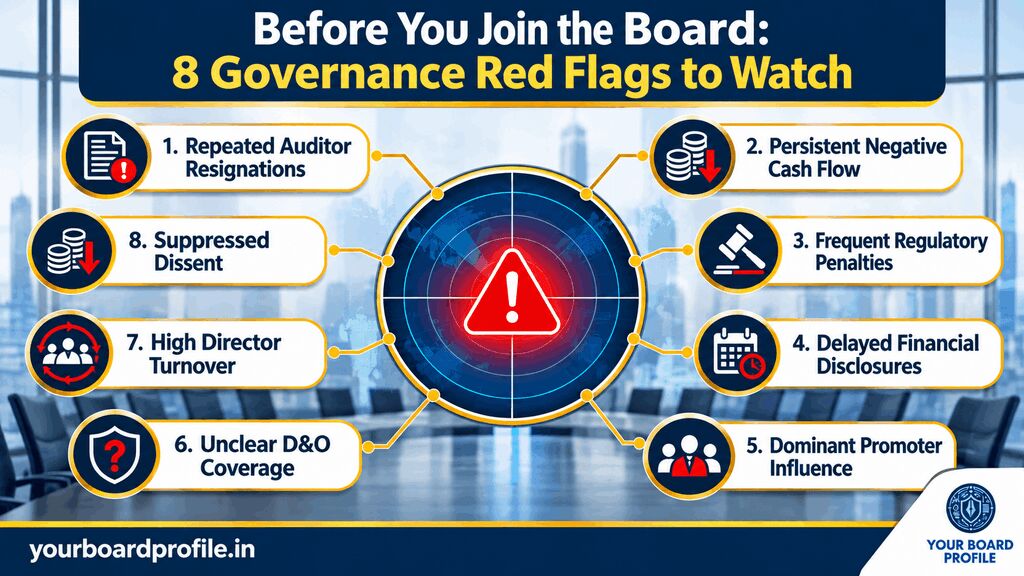
| Red flag | Why it matters | Recommended response |
| Repeated auditor resignations | May indicate unresolved reporting or governance concerns | Request explanations and supporting disclosures |
| Persistent negative cash flow | May create liquidity pressure | Review cash forecasts and funding arrangements |
| Frequent regulatory penalties | May indicate weak compliance systems | Examine corrective action |
| Delayed financial disclosures | Can weaken transparency | Seek reasons and remediation plans |
| Dominant promoter influence | May restrict independent judgement | Understand board independence |
| Unclear D&O coverage | May leave directors exposed | Obtain policy documents |
| High director turnover | May indicate boardroom friction | Speak with appropriate stakeholders |
| Suppressed dissent | Weakens oversight | Assess board culture carefully |
| Unexplained related-party transactions | May create conflicts of interest | Request detailed review |
| Incomplete meeting information | Limits informed decision-making | Clarify reporting expectations |
One of the strongest warning signs is pressure to accept an appointment quickly without adequate information. A responsible organisation should understand that a prospective director needs time to evaluate the opportunity.
You should also be cautious if the company expects you to approve decisions that have effectively been finalised by management. A director is not a ceremonial participant. Board director responsibilities require meaningful participation, informed judgement and accountability.
For further perspective on evaluating opportunities, read these discussions on a 10-point checklist before taking an independent director position and why all independent director positions are not the same.
Questions to Ask the Chairperson and CEO Before Joining
Documents are important, but direct conversations can reveal aspects of the organisation that formal disclosures may not capture.
Use discussions with the chairperson, CEO, company secretary and, where appropriate, existing independent directors to understand the board’s expectations.
Here are some questions worth asking:
About strategy and performance
- What are the company’s three most important strategic priorities over the next three years?
- What are the biggest challenges that could prevent the company from achieving these objectives?
- How does the board evaluate management performance?
About governance and transparency
- How does the board handle disagreements between directors and management?
- How frequently does the board review financial and operational risks?
- What information is provided to directors before each meeting?
- How are whistleblower complaints and internal investigations escalated?
About board culture and expectations
- What specific expertise are you expecting me to contribute?
- What are the current board’s biggest capability gaps?
- How does the chairperson encourage independent judgement?
- How would you describe the working relationship between the CEO and independent directors?
About responsibilities and protection
- Which board committees will I be expected to join?
- What is the expected time commitment beyond scheduled board meetings?
- What D&O insurance coverage is currently available?
- Are there any significant unresolved legal, financial or regulatory matters I should understand before accepting?
Pay attention not only to the answers but also to how they are delivered. Clear, thoughtful responses usually indicate that the organisation respects the importance of governance. Defensive reactions, vague explanations or reluctance to discuss material concerns should prompt further investigation.
How to Make an Informed Final Decision
After completing your review, bring the findings together and evaluate the opportunity objectively.
A simple scoring framework can help you compare different board opportunities without allowing the company’s reputation or the prestige of the appointment to dominate your judgement.
| Evaluation area | Suggested weight |
| Financial health | 20% |
| Corporate governance and compliance | 20% |
| Leadership quality and board dynamics | 15% |
| Legal and regulatory exposure | 15% |
| D&O insurance and director protection | 10% |
| Business strategy and future risks | 10% |
| Cultural alignment and transparency | 10% |
| Total | 100% |
This is an illustrative personal evaluation framework, not a statutory or regulatory scoring model.
Rate each area on a scale of 1 to 5. A low score should trigger additional questions rather than being ignored because other areas perform well.
Some matters should be treated as essential conditions rather than ordinary scoring factors. For example, unresolved serious allegations, material information withheld from a prospective director, unmanaged conflicts of interest or inadequate clarity about legal responsibilities may justify postponing or declining the appointment regardless of the overall score.
Before making the final decision:
- Seek independent legal or financial advice where required.
- Disclose potential conflicts of interest.
- Confirm the appointment terms and committee responsibilities.
- Clarify remuneration, meeting frequency and time commitment.
- Review the D&O policy and relevant indemnification arrangements.
- Ensure that you can access timely and accurate board information.
- Keep a record of material clarifications and representations.
Remember that accepting a board appointment is a continuing commitment. Your responsibilities do not end when the appointment letter is signed. You must remain informed, participate actively, exercise independent judgement and raise concerns when necessary.
If you are preparing for your first appointment, our guide on getting your first board seat without prior board experience can help you understand the journey. You can also explore how to prepare a board-ready CV that demonstrates governance oversight and understand the difference between executive and board-level CV language.
Conclusion: Make Your Next Board Appointment a Strategic Decision
A board appointment should represent more than professional recognition. It should provide an opportunity to contribute to meaningful decisions, strengthen corporate governance and help an organisation build sustainable long-term value. However, these opportunities come with responsibilities that require preparation, independent judgement and a clear understanding of the organisation you are joining.
A thorough board due diligence process helps aspiring directors look beyond a company’s reputation and evaluate what truly matters: financial stability, ethical leadership, transparent reporting, effective risk management and a board culture that encourages constructive challenge. It also helps identify potential liabilities, governance weaknesses and areas where the organisation may need stronger oversight. Ultimately, board due diligence helps professionals distinguish between an attractive board designation and an appointment that offers genuine opportunities for responsible contribution.
The most important lesson is simple: do not evaluate a board opportunity only by what it offers you. Evaluate what it expects from you and whether the company provides the right environment for you to fulfil those expectations.
For senior executives, CXOs and aspiring independent directors, preparation should begin well before the appointment letter arrives. Understand the organisation, ask difficult questions, examine the available information and seek professional advice whenever necessary.
At Your Board Profile, we believe that effective boardroom leadership begins with credibility, preparation and a clear understanding of the value a director brings to the table.
If you are preparing for your next board appointment, explore our board readiness and personal branding services, review our professional portfolio and discover more insights through our governance and boardroom leadership blogs.
Ready to Prepare Yourself for Your Next Board Appointment?
A strong board profile is built on more than professional achievements. It reflects your governance understanding, strategic thinking, leadership judgement and ability to contribute at the board level.
Connect with Dr. Amit Nagpal at Your Board Profile for guidance on strengthening your board value proposition, developing a compelling board CV and preparing for boardroom opportunities.
Book a complimentary discussion: https://calendly.com/dramitnagpal
Frequently Asked Questions About Board Due Diligence
1. What is board due diligence?
Board due diligence is the process of evaluating a company before accepting a board appointment. It involves reviewing financial performance, governance practices, legal compliance, leadership quality, business risks and organisational culture to understand the responsibilities and potential exposure associated with the position.
2. Why is pre-board due diligence important for independent directors?
Pre-board due diligence helps independent directors make informed decisions before accepting fiduciary responsibilities. It allows them to identify financial weaknesses, governance concerns, potential conflicts of interest and legal risks before becoming associated with the organisation.
3. What financial documents should I examine before joining a company’s board?
You should examine at least three years of annual reports, audited financial statements, auditor observations, cash flow statements, balance sheets, profit and loss statements, debt schedules and contingent liabilities. Reviewing these documents helps assess financial stability and the sustainability of business performance.
4. How can I evaluate a company’s financial health before accepting a board offer?
Examine revenue growth, profitability, operating cash flow, debt levels, working capital, receivables and interest coverage. Compare financial performance across multiple years and investigate unusual fluctuations, persistent cash shortages or increasing borrowing.
5. What are the biggest red flags during board due diligence?
Important warning signs include repeated auditor resignations, unexplained financial adjustments, unresolved regulatory investigations, poor cash flow, delayed disclosures, excessive promoter influence, weak internal controls, unclear D&O insurance and a board culture that discourages independent opinions.
6. What is D&O insurance, and why should directors review it?
Directors and Officers insurance provides coverage for specified claims arising from directors’ and officers’ management-related responsibilities, subject to policy terms and exclusions. Directors should review coverage limits, defence costs, exclusions, reporting conditions and post-retirement protection before accepting an appointment.
7. What potential personal liabilities can independent directors face in connection with company-related matters?
Yes. Independent directors may face personal liability under applicable laws in circumstances where the relevant legal conditions are satisfied. Under Section 149(12) of the Companies Act, 2013, an independent director’s liability is limited to specified acts or omissions involving knowledge attributable through board processes and consent or connivance, or where the director has not acted diligently. Legal advice should be sought for specific circumstances.
8. How do I assess boardroom culture before joining a company?
Speak with the chairperson, CEO and existing directors where appropriate. Understand how board meetings are conducted, whether dissenting opinions are encouraged, how information is shared and whether management responds transparently to difficult questions. Review board evaluation processes and committee functioning.
9. What questions should I ask the CEO before accepting a board appointment?
Ask about the company’s strategic priorities, financial challenges, key business risks, leadership succession, regulatory exposure and governance practices. Also clarify how the CEO interacts with the board, how disagreements are handled and what contribution is expected from you.
10. How many years of financial statements should I review?
Reviewing at least three financial years is a useful starting point. Five years can provide a better understanding of long-term trends, cyclical performance, debt accumulation and changes in profitability, where the information is available.
11. What is the difference between corporate due diligence and board due diligence?
Corporate due diligence is generally conducted to assess a company’s overall legal, financial, operational and commercial position, often before an investment or acquisition. Board due diligence focuses on evaluating the suitability and risks of accepting a board appointment, including director responsibilities, governance standards, board culture and personal exposure.
12. Should I accept a board position if the company has pending litigation?
Not necessarily. Pending litigation does not automatically make a company unsuitable for a board appointment. You should understand the nature of the dispute, its financial implications, potential reputational impact and the company’s legal response before making a decision.
13. What documents should be included in an independent director’s appointment letter?
For an independent director in India, the appointment terms should address the tenure, expectations, committee responsibilities, fiduciary duties, associated liabilities, D&O insurance provisions, business ethics requirements and remuneration, in accordance with the applicable provisions of the Companies Act and Schedule IV.
14. How can aspiring directors prepare for their first board appointment?
Aspiring directors should strengthen their understanding of corporate governance, financial statements, risk management, board responsibilities and regulatory requirements. They should also develop a board-ready CV that highlights strategic contributions, oversight experience, leadership judgement and relevant industry expertise.
15. How does board due diligence help build a successful boardroom career?
It helps professionals choose appointments that align with their expertise, values and long-term career objectives. By evaluating organisations carefully, directors can avoid unsuitable opportunities, protect their professional credibility and focus on companies where they can make a meaningful contribution.