
A board appointment represents a significant professional milestone. However, getting selected for a board position requires a different approach from securing a senior executive role. Your professional achievements, leadership experience and industry knowledge may get you shortlisted, but the quality of your questions can influence how the board chair, CEO and nomination committee perceive your readiness for the position.
A board interview is not simply an opportunity to explain what you have accomplished throughout your career. It is an opportunity to demonstrate how you think about organisational success, long-term sustainability, corporate governance, risk management and leadership accountability. The people interviewing you want to understand whether you can contribute beyond operational discussions and participate in decisions that influence the organisation’s future.
An effective board interview is ultimately a conversation about how your professional judgement, experience and strategic understanding can contribute to the organisation’s long-term success.
Consider this situation: You are meeting the chairperson of a growing organisation. You have already discussed your professional background, leadership experience and understanding of the industry. The conversation is progressing well. Then comes the opportunity to ask questions. Preparation for a board interview should therefore include understanding the questions that can reveal the organisation’s strategic priorities and governance expectations.
You could ask about the organisation’s growth plans, but a more thoughtful question would be: How does the board balance its growth ambitions with the organisation’s risk appetite and long-term resilience?
The difference is important. The second question demonstrates that you understand the relationship between strategy, governance and risk. It also encourages a meaningful discussion rather than a routine exchange of information.
For senior executives, CXOs, entrepreneurs and aspiring independent directors, developing this ability is essential. The right questions demonstrate that you understand what it means to act as a fiduciary, challenge management constructively and protect the organisation’s long-term interests. Remember, a board interview is also an opportunity to evaluate whether the organisation’s leadership philosophy and governance culture align with your professional values.
This article explores 15 strategic questions to ask during a board interview, explains what each question communicates and shows how you can use them to demonstrate genuine boardroom readiness.
Table of Contents
Why Asking the Right Questions Matters in a Board Interview
A board appointment involves responsibilities that extend well beyond professional expertise. Directors are expected to contribute independent judgement, exercise oversight, evaluate strategic decisions and ensure that management remains accountable. The questions you prepare for a board interview should reflect your ability to understand business challenges from an oversight perspective.
The G20/OECD Principles of Corporate Governance 2023 emphasise the board’s responsibility for providing strategic guidance, monitoring management performance and overseeing risk management. These responsibilities offer an important foundation for understanding what an organisation expects from its directors.
A strong candidate therefore approaches an interview differently from someone seeking an executive position. Instead of focusing exclusively on what they can deliver personally, they demonstrate an understanding of how the board collectively creates value.
Moving Beyond Executive-Level Thinking
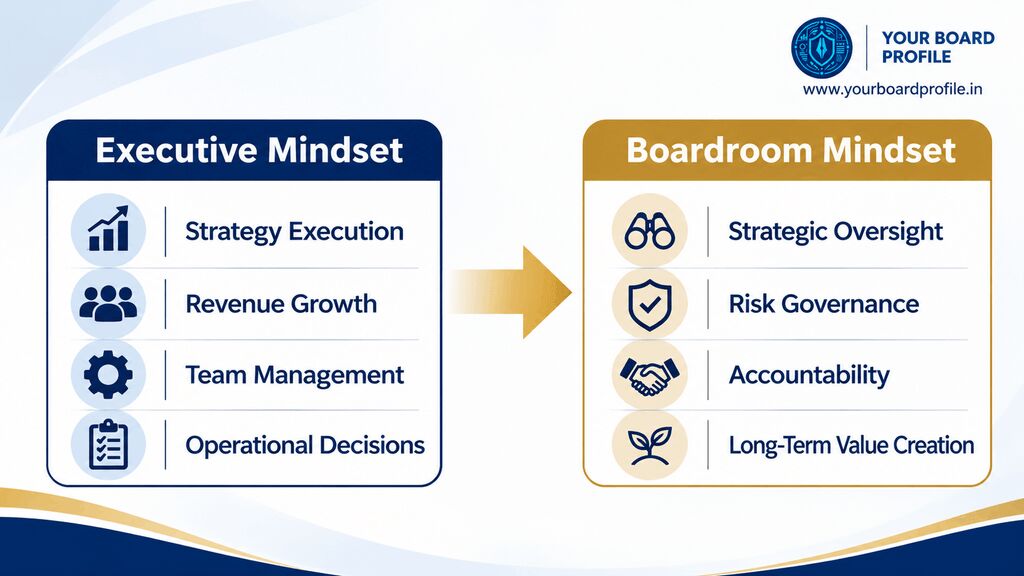
Executives are generally responsible for implementing strategy, managing teams, achieving business targets and delivering operational results. Board directors, on the other hand, provide direction, monitor performance and challenge assumptions without taking over management’s responsibilities. One of the biggest challenges in a board interview is demonstrating that you can move beyond operational achievements and contribute to strategic decision-making
This distinction should influence the questions you ask.
For example, an executive candidate might ask, “What are the company’s immediate expansion targets?” A board candidate could ask, “How does the board evaluate whether the company’s expansion strategy creates sustainable long-term value?”
Both questions concern growth, but they approach the subject from different perspectives.
The second question demonstrates an understanding of strategic oversight. It encourages discussion about capital allocation, competitive positioning, execution risks and long-term organisational priorities.
A successful board interview should communicate that you can move comfortably between commercial understanding and governance responsibilities. You must demonstrate that you can support management while remaining sufficiently independent to challenge decisions when necessary.
What Board Chairs and Nomination Committees Expect
A board chair or nomination committee is not simply looking for another experienced professional. It is evaluating whether your capabilities, judgement and professional temperament complement the existing board. During a board interview, the chairperson is interested in understanding how your experience can strengthen the board’s collective capabilities.
They may consider several factors:
- Your understanding of corporate governance and fiduciary responsibilities.
- Your ability to adopt a strategic perspective rather than focus on operational execution.
- Your independence of judgement.
- Your understanding of financial performance and organisational risk.
- Your ability to question management constructively.
- Your contribution to board diversity and collective expertise.
- Your willingness to devote sufficient time to board responsibilities.
The Financial Reporting Council’s UK Corporate Governance Code 2024 highlights the importance of constructive challenge, open debate, effective board leadership and clear divisions between board and executive responsibilities. Its relevant provisions have applied from 1 January 2025, with Provision 29 applying from 1 January 2026.
These principles provide useful preparation benchmarks, although candidates should always understand the applicable laws and governance framework of the organisation’s jurisdiction.
15 Essential Questions to Ask During a Board Interview
The questions you ask should reflect your understanding of the organisation, its strategic priorities and the responsibilities attached to the position. You do not need to ask all 15 questions in one meeting. Instead, select those that are most relevant to the organisation and the discussion.
Approaching a board interview with well-researched questions allows you to demonstrate preparation, professional maturity and a genuine understanding of directorial responsibilities. The following questions are organised around five important areas: strategy, governance, risk, leadership relationships and board effectiveness.
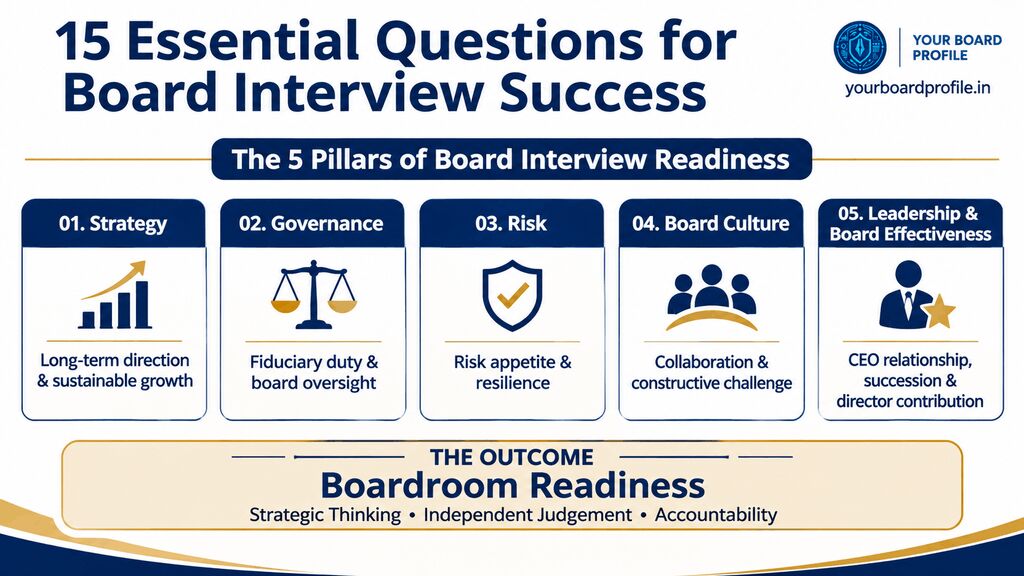
1. Questions About Strategy and Long-Term Direction
Your approach to a board interview should begin with questions about the organisation’s future rather than simply its current financial performance.
Question 1: What are the most important strategic priorities for the organisation over the next three to five years?
This is one of the most valuable questions to ask the board chair. It demonstrates that you are interested in understanding the organisation’s long-term direction rather than concentrating only on immediate business performance.
The discussion may reveal the organisation’s expansion plans, market positioning, digital transformation priorities, capital requirements or international ambitions. Listen carefully to how the chair explains these priorities and whether they are supported by measurable objectives.
As a prospective director, you should be thinking about how the board monitors strategic execution, evaluates changing market conditions and ensures that management remains aligned with agreed priorities.
What this question demonstrates: Long-term thinking, strategic awareness and an understanding of the board’s role in guiding organisational direction.
Question 2: How does the board evaluate whether the current business strategy remains relevant in a changing market environment?
A business strategy that works today may become ineffective tomorrow. Technological disruption, geopolitical uncertainty, regulatory developments, changing customer expectations and competitive pressures can quickly alter an organisation’s operating environment.
This question allows you to understand how frequently the board reviews its strategic assumptions and what information it uses to evaluate changing circumstances.
You may also discover whether the organisation uses scenario planning, external market intelligence, independent expert advice or strategic performance indicators to assess its direction.
A good board does not simply approve a strategy and wait for the next annual review. It continuously evaluates whether the assumptions supporting that strategy remain valid.
What this question demonstrates: Strategic flexibility, commercial awareness and the ability to think beyond short-term financial performance.
Question 3: How does the board balance growth ambitions with sustainable value creation?
These strategic questions can make your board interview more meaningful because they demonstrate your ability to connect business growth with governance and sustainability. Growth can create opportunities, but pursuing expansion without adequate consideration of financial stability, governance standards and operational capacity can expose an organisation to unnecessary risks.
By asking this question, you demonstrate that you understand the difference between rapid growth and sustainable growth.
You can explore how the board evaluates major investments, acquisitions, new market entry, innovation and capital allocation. You may also discuss whether environmental, social and governance considerations are incorporated into long-term strategic decisions.
The question is particularly useful when interviewing with organisations undergoing transformation, entering new markets or considering significant investments.
What this question demonstrates: Commercial judgement, financial understanding and an appreciation of sustainable business performance.
2. Questions About Governance, Fiduciary Duty and Oversight
Governance-related discussions are particularly important in a board interview because they reveal whether a candidate understands the responsibilities associated with board membership.
Question 4: What are the most significant governance challenges currently facing the board?
Every organisation operates within a different governance environment. Some may be dealing with rapid expansion, promoter influence, regulatory scrutiny or complex stakeholder relationships. Others may need to strengthen internal controls, succession planning or board independence.
This question helps you understand where the board believes its governance framework needs greater attention.
It also gives you an opportunity to connect your experience with the organisation’s priorities. For example, if the chair identifies weaknesses in governance processes, you may be able to explain how your previous experience in audit, compliance, risk management or organisational transformation could contribute.
Avoid immediately presenting yourself as the solution to every challenge. First understand the issue, its underlying causes and the board’s expectations.
What this question demonstrates: Governance awareness, professional judgement and an ability to identify areas where board oversight can create value.
Question 5: How does the board ensure that directors receive sufficient information to fulfil their fiduciary responsibilities?
Candidates who understand fiduciary responsibilities are better positioned to demonstrate their suitability during a board interview. Directors cannot exercise sound judgement without receiving accurate, relevant and timely information.
This question demonstrates that you understand the importance of informed decision-making. It also opens a discussion about board papers, management reporting, financial information, risk dashboards, committee reports and access to independent advice.
The OECD principles emphasise that directors should act on a fully informed basis, in good faith, with due diligence and care.
You can explore whether board materials provide meaningful analysis or simply present operational updates. You may also ask how the company secretary supports directors in understanding their responsibilities.
What this question demonstrates: Fiduciary awareness, accountability and a commitment to informed board decisions.
Question 6: How does the board maintain effective oversight without becoming involved in day-to-day management?
A thoughtful response during your board interview should reflect an understanding of the boundaries between management accountability and board oversight. This is an especially valuable question because it addresses one of the most important distinctions in board governance.
Directors must challenge management, evaluate performance and ensure accountability. However, they should not undermine management by becoming involved in routine operational decisions.
The chair’s response can help you understand how the organisation maintains appropriate boundaries between oversight and execution.
For example, you might discover whether the board has clearly defined reserved matters, delegated authorities, committee responsibilities and escalation procedures.
A well-functioning board knows when to question, when to guide and when to allow management to execute its responsibilities.
What this question demonstrates: Governance maturity, role clarity and an understanding of effective fiduciary oversight.
3. Questions on Risk Appetite and Organisational Resilience
Question 7: How does the board define and periodically review the organisation’s risk appetite?
Every strategic decision carries a certain level of uncertainty. The important issue is not whether an organisation can eliminate risk, but whether it understands which risks it is willing to accept in pursuit of its objectives.
This question can lead to a discussion about financial exposure, operational vulnerabilities, cyber threats, regulatory risks, reputational concerns and emerging technologies.
You can also explore how the organisation ensures that its risk appetite is communicated throughout management and reflected in business decisions.
The OECD principles specifically connect risk appetite with corporate strategy and the board’s responsibility for overseeing risk management.
For an aspiring director, this question demonstrates that you understand risk as a strategic consideration rather than simply a compliance requirement.
What this question demonstrates: Risk awareness, strategic judgement and an understanding of organisational resilience.
Question 8: Which emerging risks does the board believe could have the greatest impact on the organisation over the next few years?
Organisations increasingly face interconnected risks. Artificial intelligence, cyber security, geopolitical developments, supply chain disruptions, climate-related challenges and data privacy concerns can influence business performance simultaneously.
Asking this question demonstrates that you are looking beyond the organisation’s current risk register.
You may also ask how the board identifies emerging risks that have not yet become immediate business threats.
For example, an organisation might have strong financial controls but limited preparedness for an AI-related data breach or a critical technology supplier failure. Such gaps can become significant board-level concerns.
This is an opportunity to demonstrate your understanding of emerging business risks without appearing to question the competence of the existing leadership.
What this question demonstrates: Forward-looking judgement, awareness of emerging threats and an appreciation of enterprise-wide risk oversight.
4. Questions About Board Dynamics and Board Culture
Question 9: How would you describe the board’s culture, particularly when directors have differing opinions on important decisions?
The cultural dimension of a board interview deserves equal attention because board effectiveness depends on trust, mutual respect and constructive disagreement. An organisation’s formal governance structure may look impressive on paper, but its effectiveness also depends on the quality of discussions taking place in the boardroom.
A strong board encourages independent thinking, constructive disagreement and respectful debate.
This question helps you understand whether directors feel comfortable challenging management and whether alternative perspectives are genuinely considered before major decisions are made.
It can also reveal how the chair manages disagreements, encourages participation and prevents individual personalities from dominating discussions.
Remember, effective boardroom culture does not mean that every director agrees with every decision. It means that differences of opinion are handled professionally and that decisions are reached through informed deliberation.
What this question demonstrates: Emotional intelligence, independence of thought and an understanding of collaborative governance.
Question 10: How does the chair ensure that every director’s expertise and perspective contribute to board discussions?
A board may include professionals with backgrounds in finance, technology, law, operations, human resources, entrepreneurship and industry leadership. However, having diverse experience does not automatically guarantee effective contribution.
The chair plays an important role in creating an environment where every director can participate meaningfully.
This question helps you understand whether the board makes effective use of individual expertise, encourages quieter members to contribute and ensures that committee discussions benefit from the wider board’s collective knowledge.
It also provides an opportunity to understand where your own professional experience could complement the existing composition.
What this question demonstrates: Team orientation, appreciation of board diversity and an understanding of collective decision-making.
Question 11: What does constructive challenge look like in this boardroom?
Constructive challenge is one of the defining characteristics of effective independent oversight. Your answers in a board interview should communicate that you can challenge assumptions without damaging professional relationships.
Directors should be willing to question assumptions, request additional information and examine whether management proposals adequately address potential risks.
However, challenging management should never become personal or confrontational.
This question helps you understand the board’s expectations regarding questioning, disagreement and accountability. It also communicates that you are comfortable participating in difficult discussions when organisational interests require it.
A thoughtful candidate understands that independence is not about opposing management. It is about exercising objective judgement while supporting decisions that serve the organisation’s long-term interests.
What this question demonstrates: Independent judgement, professional confidence and the ability to balance support with accountability.
5. Questions About the CEO-Board Relationship and Board Effectiveness
Question 12: How does the board maintain a productive relationship with the CEO while preserving independent oversight?
Understanding this relationship can help you demonstrate the leadership maturity expected from a candidate in a board interview. The relationship between the CEO and the board is fundamental to organisational performance.
The CEO is responsible for leading the business and implementing the agreed strategy, while the board provides oversight, strategic guidance and accountability.
An effective relationship requires trust, transparency and clear responsibilities. However, trust should never prevent directors from questioning management decisions or examining performance concerns.
This question allows you to understand how the board approaches communication with the CEO, how disagreements are handled and how the chair ensures that executive leadership remains accountable.
The Financial Reporting Council also identifies the chair-CEO relationship and clarity in the division of responsibilities as important elements of effective governance.
What this question demonstrates: Leadership maturity, governance understanding and the ability to maintain professional independence.
Question 13: How does the board evaluate its own effectiveness and the contribution of individual directors?
An effective board should periodically assess whether it is performing its responsibilities well.
Board evaluations can examine the quality of discussions, committee performance, director participation, information flows, strategic oversight and the effectiveness of the chair.
This question demonstrates that you understand governance as an ongoing improvement process rather than a one-time compliance exercise.
You can also explore whether the organisation uses external facilitators, independent evaluations or structured feedback mechanisms.
For a prospective director, the response offers useful insight into how the board approaches accountability and continuous development.
What this question demonstrates: Accountability, self-awareness and a commitment to improving board effectiveness.
Question 14: What are the board’s current priorities regarding CEO succession planning and leadership continuity?
CEO succession is a strategic responsibility, not simply an administrative exercise.
An unexpected leadership departure can disrupt organisational stability, stakeholder confidence and the execution of long-term plans.
This question helps you understand whether the board has identified potential successors, considered emergency succession arrangements and developed a long-term leadership pipeline.
It also opens a broader discussion about talent development, leadership capability and the organisation’s ability to adapt to future business requirements.
The OECD principles identify executive selection, performance monitoring and succession planning among the board’s important responsibilities.
What this question demonstrates: Long-term organisational thinking, leadership oversight and an appreciation of business continuity.
Question 15: What specific contribution would the board expect from a new independent director during the first 12 months?
This is an excellent question to ask towards the end of a board interview.
It demonstrates that you are already thinking about how you can contribute after appointment.
The answer may reveal expectations concerning committee membership, strategic priorities, governance improvements, stakeholder engagement or particular areas of expertise.
It also helps you assess whether the organisation has realistic expectations of a new director and whether your capabilities match its immediate requirements.
You can use the response to connect your professional experience with the board’s needs without turning the conversation into a sales pitch.
What this question demonstrates: Commitment, practical readiness and a clear understanding of the responsibilities attached to the appointment.
Quick Reference: 15 Questions and the Competencies They Demonstrate
| Area | Question focus | Competency demonstrated |
| Strategy | Three-to-five-year priorities | Strategic thinking |
| Strategy | Relevance of business strategy | Adaptability |
| Strategy | Sustainable value creation | Commercial judgement |
| Governance | Current governance challenges | Governance awareness |
| Governance | Information for directors | Fiduciary responsibility |
| Governance | Oversight versus management | Role clarity |
| Risk | Organisational risk appetite | Risk oversight |
| Risk | Emerging business threats | Forward thinking |
| Board culture | Handling differing opinions | Emotional intelligence |
| Board culture | Contribution of directors | Collaboration |
| Board culture | Constructive challenge | Independent judgement |
| Leadership | CEO-board relationship | Governance maturity |
| Effectiveness | Board evaluation | Accountability |
| Succession | Leadership continuity | Long-term thinking |
| Contribution | First 12-month expectations | Board readiness |
How to Demonstrate a Corporate Governance Mindset During a Board Interview
Knowing the right questions is important, but the way you ask them matters just as much.
A strong performance in a board interview depends on demonstrating how governance principles influence your approach to strategic decisions. A candidate can memorise 15 impressive questions and still fail to demonstrate boardroom readiness if the questions sound rehearsed or disconnected from the organisation’s actual challenges.
A genuine corporate governance mindset comes from understanding how organisations are directed, how decisions are challenged and how long-term interests are protected.
Here are five ways to demonstrate that mindset.
1. Connect Questions With Your Professional Experience
Your executive experience is valuable, but you need to explain how it translates into board-level contribution. Use examples from your professional journey to explain how your experience can add value during board discussions, particularly when a board interview focuses on specific organisational challenges.
For example, if you have spent 20 years in finance, do not limit your discussion to budgeting, financial reporting and cost optimisation.
Explain how your experience can help the board evaluate capital allocation, financial sustainability, internal controls and investment decisions.
Similarly, a technology leader should demonstrate an understanding of technology strategy, cyber resilience, digital transformation and the governance of emerging technologies.
The objective is to show how your expertise strengthens collective board judgement.
2. Demonstrate Independence of Thought
Independent directors should not automatically agree with management or follow the majority opinion. Independence of thought is an important quality to communicate throughout your board interview, particularly when discussing complex business decisions.
They must evaluate information objectively, ask relevant questions and be willing to express a different view when necessary.
During your board interview, demonstrate that you can challenge assumptions without creating unnecessary conflict.
A useful way to express this approach is:
“I believe effective board oversight requires a balance between supporting management and independently examining the assumptions behind important decisions.”
This communicates professional maturity without sounding confrontational.
3. Understand the Organisation Before the Interview
A serious candidate should never enter a board interview without researching the organisation. Researching the organisation thoroughly before a board interview enables you to ask questions that are relevant rather than generic.
Study its annual reports, financial performance, corporate governance disclosures, leadership structure, business model and strategic priorities.
For listed Indian companies, relevant information may include annual filings, board composition, committee structure and regulatory disclosures.
The following resources can help:
- SEBI – Securities and Exchange Board of India for regulatory updates and listed-company governance requirements.
- Ministry of Corporate Affairs for company law and corporate governance resources.
- OECD Corporate Governance Principles for international governance guidance.
Your questions should reflect this research. If the organisation is undergoing a major acquisition, for example, asking about post-acquisition integration and risk oversight will be more relevant than asking a generic question about growth.
4. Understand the Difference Between Oversight and Intervention
One of the most common challenges for experienced executives entering boardrooms is shifting from an operational mindset to an oversight mindset. This distinction is particularly important when preparing for a board interview, as experienced executives must demonstrate their ability to transition into an oversight-oriented role.
As an executive, you may be accustomed to solving problems directly. As a director, your responsibility is to evaluate whether management has appropriate processes, resources and accountability to address those problems.
| Executive mindset | Board-level mindset |
| How do we execute this strategy? | Is this the right strategy? |
| How do we achieve the target? | Are the targets realistic and sustainable? |
| How do we resolve this operational issue? | Does management have an effective control framework? |
| How can we increase revenue? | Does growth create sustainable stakeholder value? |
| How do we manage this risk? | Is the organisation operating within its approved risk appetite? |
Understanding this distinction can significantly strengthen your performance in a board interview.
5. Demonstrate Awareness of Board Diversity and Collective Expertise
A board should function as a collective decision-making body.
Your professional contribution matters, but so does your ability to work with directors whose backgrounds, experiences and opinions may differ from yours.
You should demonstrate an appreciation of different perspectives and explain how your expertise complements the existing board.
For example, a former technology executive joining a manufacturing company’s board might bring valuable insight into automation, digital infrastructure, cybersecurity and technology-related operational risks.
The goal is not to prove that you possess all the answers. It is to show that you understand where your knowledge adds value and where you should seek additional expertise.
Questions to Avoid During a Board of Directors Interview
While asking thoughtful questions can strengthen your candidacy, asking the wrong questions can create an unfavourable impression. An unsuccessful board interview can sometimes result from questions that focus too heavily on personal benefits instead of the organisation’s governance requirements.
A board interview is a professional discussion about governance, leadership, organisational direction and accountability. Your questions should reflect these priorities.
Consider avoiding the following:
| Avoid asking | Ask instead |
| How much time will I need to spend on this position? | What are the board’s expectations regarding director preparation, meeting participation and committee responsibilities? |
| What benefits will I receive as a director? | How does the organisation structure director remuneration in accordance with its governance framework? |
| Does the CEO usually accept the board’s recommendations? | How does the board maintain constructive dialogue and independent oversight of management? |
| Will I have the freedom to make business decisions? | How are decision-making responsibilities divided between the board and executive management? |
| How quickly can I become committee chair? | What capabilities and contributions does the board expect from directors serving on its committees? |
| Is the organisation financially stable? | What are the principal financial and strategic risks that the board currently monitors? |
There is nothing inherently wrong with understanding remuneration, time commitments or committee responsibilities. These are legitimate aspects of board due diligence. The difference lies in how and when you raise them.
Avoid questions that suggest you are primarily interested in the title, status or personal benefits associated with the appointment.
Instead, demonstrate that you are interested in understanding the responsibilities, expectations and contribution required from a director.
How to Prepare for a Successful Board Interview
Asking good questions is only one part of preparation. A strong candidate must also understand the organisation, communicate a clear board value proposition and demonstrate the ability to contribute to collective decision-making.
Preparing systematically for a board interview gives you an opportunity to connect your professional achievements with the organisation’s board-level requirements. A structured preparation process can help you approach the discussion with greater confidence.
1. Conduct Thorough Board Due Diligence
Before the meeting, research the organisation from a director’s perspective.
Good preparation for a board interview requires understanding the organisation beyond its public image and published business achievements. Do not restrict your research to its website or marketing materials. Examine publicly available information that helps you understand its governance, financial position and strategic direction.
Focus on:
- Business model: Understand how the organisation generates revenue and creates value.
- Financial performance: Review revenue, profitability, cash flows, debt and capital allocation.
- Board composition: Understand the experience, independence and professional backgrounds of existing directors.
- Governance structure: Review committee responsibilities, board policies and governance disclosures.
- Leadership: Understand the CEO’s background, leadership priorities and succession considerations.
- Risk exposure: Identify major industry, regulatory, financial, technological and reputational risks.
- Stakeholder relationships: Consider the interests of shareholders, employees, customers, suppliers and regulators.
For an Indian listed company, review the relevant provisions of the Companies Act, 2013, applicable SEBI regulations and the company’s latest annual report.
The OECD Principles of Corporate Governance and the UK Corporate Governance Code can also provide useful comparative perspectives.
2. Prepare Your Board Value Proposition
One of the most important questions you should be able to answer is:
Why should this organisation appoint you as a director?
Your answer should go beyond your designation, years of experience or professional achievements.
It should explain the specific value you can bring to the board.
For example, a former CFO may bring expertise in financial oversight, capital allocation, audit committee matters and risk management. A former business head may contribute experience in strategic transformation, market expansion and organisational leadership.
A strong board value proposition should connect three elements:
- Your professional experience and distinctive expertise.
- The organisation’s strategic and governance requirements.
- The contribution you can make through independent judgement and collective decision-making.
If you are preparing for your first appointment, read our guide on how to secure your first board seat without prior board experience.
It explains how experienced professionals can translate their existing leadership capabilities into boardroom readiness.
3. Develop Your Board-Level Communication Skills
Boardroom communication is different from executive presentations.
Directors must communicate complex issues clearly, ask relevant questions and express independent views without dominating discussions.
Practise explaining your professional experience through the lens of governance and oversight.
For example, instead of saying:
“I successfully implemented a digital transformation project that reduced operating costs.”
You could explain:
“My experience in digital transformation enables me to evaluate technology investments, assess implementation risks and question whether digital initiatives are delivering sustainable business value.”
The second statement demonstrates how your experience can support board-level discussions.
4. Prepare Your Board CV
Your CV should communicate your suitability for a directorship rather than simply summarising your executive career.
A board-focused CV should highlight strategic leadership, governance exposure, financial understanding, risk oversight, stakeholder management and significant organisational contributions.
It should also demonstrate your ability to contribute to board committees and exercise independent judgement.
Explore these resources to strengthen your positioning:
- Board Ready CV: Governance and Oversight explains how to present relevant capabilities for board appointments.
- Board Director CV: Executive Language vs Board Language explains how to translate executive achievements into board-relevant language.
- Board of Directors Vacancy: Opportunities and Preparation offers additional guidance on identifying and preparing for board opportunities.
You can also explore the Your Board Profile portfolio to understand how board-level professional positioning can be developed.
5. Understand the Nomination Committee’s Perspective
The nomination and remuneration committee, where applicable, plays an important role in identifying suitable candidates and assessing board composition, skills and succession requirements.
During a nominating committee interview, you may be assessed on more than your professional experience.
The committee may consider whether you:
- Bring expertise that complements the existing board.
- Understand the legal and ethical responsibilities of directors.
- Can devote sufficient time to the appointment.
- Demonstrate independence and sound judgement.
- Have the ability to work constructively with other directors.
- Understand the organisation’s strategic and governance priorities.
- Can contribute to board committees where required.
Your preparation should therefore address both your individual capabilities and the collective requirements of the board.
6. Prepare a Strong Closing Statement
The final moments of an interview offer an opportunity to reinforce your suitability.
Avoid repeating your entire professional history. Instead, summarise the value you believe you can contribute.
For example:
“I appreciate the opportunity to understand the organisation’s priorities and the board’s expectations. Based on our discussion, I believe my experience in strategic leadership, organisational transformation and risk oversight could contribute meaningfully to the board’s deliberations. I would welcome the opportunity to support the organisation through independent judgement, constructive challenge and a long-term perspective.”
This approach communicates confidence without appearing overly promotional.
A Practical Framework: What Your Questions Should Communicate
Before attending your next board interview, review the following framework. It can help you evaluate whether your questions reflect the qualities expected of an effective director.
| Boardroom capability | What you should communicate | Example question |
| Strategic thinking | Ability to assess long-term priorities | What strategic assumptions should the board review regularly? |
| Governance understanding | Awareness of director responsibilities | How does the board evaluate governance effectiveness? |
| Fiduciary responsibility | Commitment to informed judgement | How are directors provided with independent information? |
| Risk oversight | Understanding of risk appetite | Which emerging risks require greater board attention? |
| Financial acumen | Understanding of financial sustainability | How does the board evaluate capital allocation decisions? |
| Board culture | Ability to collaborate constructively | How are differing viewpoints encouraged in discussions? |
| Leadership oversight | Understanding of accountability | How does the board evaluate CEO performance? |
| Independence | Ability to challenge objectively | How does the board approach constructive disagreement? |
The central principle is simple: your questions should demonstrate that you understand the responsibilities of a director, not just the prestige of holding a board position.
Conclusion: Let Your Questions Demonstrate Your Boardroom Readiness
A successful board interview is not about asking the largest number of impressive questions. It is about demonstrating that you understand the organisation, appreciate the responsibilities of directors and can contribute meaningfully to strategic and governance discussions.
For senior executives, CXOs, entrepreneurs and aspiring independent directors, the transition into the boardroom requires a shift in perspective. You must move from managing business operations to evaluating organisational direction, monitoring management performance, questioning strategic assumptions and protecting long-term interests.
The 15 questions discussed in this article can help you initiate meaningful conversations with the board chair, CEO and nomination committee. However, their effectiveness depends on preparation, relevance and the ability to connect your experience with the organisation’s actual requirements.
Remember, boards do not simply need accomplished professionals. They need individuals who can exercise sound judgement, demonstrate independence, understand fiduciary responsibilities and contribute to collective decision-making.
Your professional achievements may open the door. Your governance mindset, thoughtful questions and ability to demonstrate board-level value can help establish why you belong in the boardroom.
Ready to Strengthen Your Boardroom Readiness?
Positioning yourself for a board appointment requires more than an impressive executive profile. It requires a compelling board value proposition, a governance-oriented CV, strong professional visibility and the ability to communicate your contribution in the language of the boardroom.
At Your Board Profile, we help senior executives, CXOs, entrepreneurs and aspiring independent directors strengthen their boardroom positioning through customised Board CVs, LinkedIn profile optimisation, personal branding, board readiness assessments and one-to-one mentoring.
Explore our professional services or visit our blog for more insights on board governance, director readiness and boardroom positioning.
Take the next step towards your boardroom journey.
Book a complimentary discussion with Dr. Amit Nagpal to understand how you can strengthen your professional positioning and communicate your board value proposition more effectively.
Schedule a conversation with Dr. Amit Nagpal.
Frequently Asked Questions (FAQs)
1. What questions should I ask during a board interview?
Ask questions about the organisation’s strategic priorities, governance challenges, risk appetite, board culture, CEO-board relationship and succession planning. Focus on questions that demonstrate independent judgement and an understanding of fiduciary responsibilities.
2. How do I impress a board chair during an interview?
Demonstrate that you understand the organisation’s business model, strategic priorities and governance framework. Ask thoughtful questions, communicate your professional value proposition clearly and show that you can balance constructive challenge with collaborative decision-making.
3. What does a board chair expect from an aspiring independent director?
A board chair generally looks for sound judgement, independence, relevant expertise, strategic thinking, financial understanding and the ability to contribute constructively to board discussions. The candidate should also understand the legal and ethical responsibilities associated with the appointment.
4. How is a board interview different from an executive interview?
An executive interview primarily evaluates leadership and operational execution, whereas a board interview focuses on strategic oversight, governance, risk management, accountability and independent judgement. Board candidates must demonstrate their ability to guide and challenge management rather than manage daily operations.
5. What should I research before attending a board interview?
Research the organisation’s annual reports, financial performance, business model, board composition, committee structure, governance disclosures, strategic priorities and major risks. Understanding the industry and regulatory environment is equally important.
6. How can I demonstrate a corporate governance mindset?
Demonstrate awareness of fiduciary responsibilities, transparency, accountability, risk oversight and ethical decision-making. Ask questions that connect business strategy with governance effectiveness and long-term organisational sustainability.
7. What questions should I ask the board chair specifically?
Ask about board effectiveness, strategic priorities, board culture, constructive challenge, director expectations and the relationship between the chair and CEO. These questions help you understand how the board operates and where your experience could add value.
8. What questions should I ask the CEO during a board interview?
You can ask about the organisation’s strategic execution, major business challenges, management priorities, emerging risks and expectations from non-executive directors. Focus on understanding how the board and management can work effectively while maintaining appropriate independence.
9. What is a nominating committee interview?
A nominating committee interview is part of the process of evaluating potential board candidates. The committee may assess professional experience, independence, governance understanding, board composition requirements, leadership capabilities and suitability for the organisation.
10. How important is fiduciary duty during a board interview?
Fiduciary duty is fundamental because directors are expected to act responsibly, exercise appropriate care and judgement, and fulfil their legal responsibilities. Demonstrating an understanding of these obligations communicates that you appreciate the seriousness of a board appointment.
11. How can I demonstrate independent judgement during an interview?
Explain situations where you evaluated competing perspectives, challenged assumptions or made difficult decisions based on evidence. Show that you can disagree respectfully and prioritise the organisation’s interests over personal preferences.
12. Should I ask about board remuneration during the interview?
Yes, but timing and presentation matter. First establish your understanding of the role, responsibilities and expected contribution. You can then discuss remuneration, time commitments, committee responsibilities and other appointment terms as part of the due diligence process.
13. Can senior executives without previous board experience become independent directors?
Yes. Senior executives can bring valuable expertise in finance, technology, operations, strategy, human resources and organisational transformation. However, they must demonstrate an understanding of governance, fiduciary responsibilities and the distinction between executive management and board oversight.
14. How many questions should I ask during a board interview?
There is no fixed number. Generally, three to five well-researched and relevant questions can create a meaningful discussion, depending on the time available. Prioritise quality, relevance and thoughtful follow-up rather than asking every prepared question.
15. How can I improve my chances of securing a board appointment?
Develop a board-focused CV, strengthen your LinkedIn presence, understand corporate governance, build relevant professional relationships and prepare a clear board value proposition. Board readiness assessments and professional mentoring can also help identify gaps and improve your positioning.