
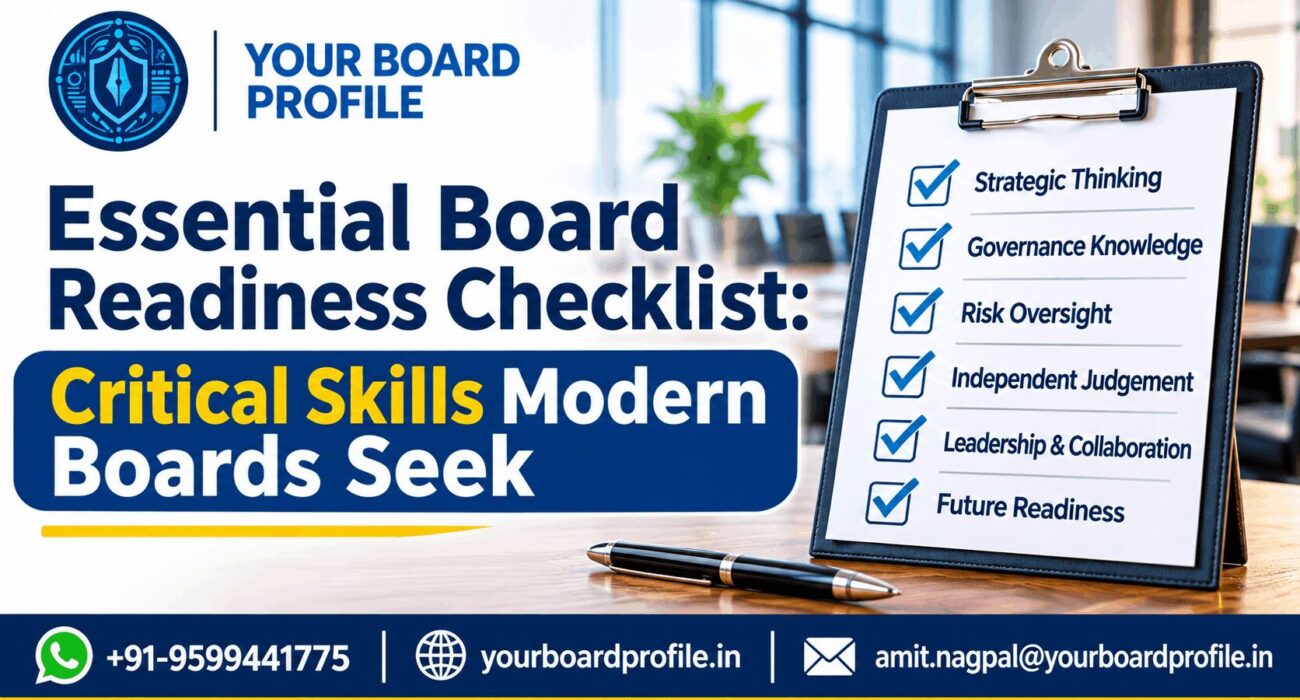
Why Board Readiness Matters More Than Ever
A successful career in business does not automatically translate into readiness for a boardroom position. A senior executive may have spent 25 years leading business operations, managing large teams, improving profitability and delivering organisational transformation. Yet, when that professional considers an Independent Director opportunity, a different question emerges: can their experience help a board make better decisions, strengthen governance and protect long-term business value?
This distinction is becoming increasingly important. Corporate boards are operating in an environment shaped by artificial intelligence, cybersecurity threats, regulatory developments, geopolitical uncertainty, sustainability expectations and changing stakeholder demands. Directors are no longer expected to understand only financial performance and business strategy. They must also recognise emerging risks, challenge management assumptions and understand how decisions made today could affect an organisation several years into the future.
The changing expectations are visible in recent research. PwC’s 2026 Annual Corporate Directors Survey reports that 71% of directors believe their boards need to strengthen AI skills to provide more effective oversight. The same survey highlights that 55% believe at least one colleague should be replaced, with insufficient expertise becoming an increasingly important reason. These findings demonstrate why professional experience alone may not be enough to establish board readiness.
For aspiring directors, this creates both a challenge and an opportunity. Your background in finance, technology, human resources, operations, law, sustainability or business transformation could be valuable to a board. However, the real question is whether you can translate that experience into effective board-level oversight.
This essential board readiness checklist examines the capabilities modern boards seek, explains how nominating committees evaluate potential directors and provides a practical framework to assess your own preparedness. Whether you are a CXO, entrepreneur, senior professional or aspiring Independent Director, understanding these expectations can help you build a more credible boardroom profile.
Table of Contents
Understanding Board Readiness in Today’s Corporate Environment
What Does Board Readiness Really Mean?
Board readiness refers to a professional’s ability to contribute meaningfully to the governance, strategic direction, risk oversight and long-term performance of an organisation as a board member.
It is not simply a measure of seniority, professional qualifications or the number of years spent in leadership positions. Instead, it reflects the combination of knowledge, judgement, independence, governance understanding and the ability to ask meaningful questions.
Consider two professionals with similar career backgrounds. One has successfully managed a company’s financial operations for 20 years. The other has comparable experience but also understands audit committee responsibilities, internal controls, financial reporting risks and how to challenge management forecasts.
Both have valuable professional experience. However, the second individual may demonstrate stronger board-level preparedness because they understand how their expertise translates into oversight responsibilities.
In practical terms, board readiness involves three important dimensions:
- Professional credibility: Demonstrable achievements, specialist knowledge and leadership experience.
- Governance understanding: Knowledge of board responsibilities, fiduciary duties, risk oversight and regulatory expectations.
- Boardroom contribution: The ability to exercise independent judgement, challenge constructively and participate in collective decision-making.
The Companies Act, 2013, particularly Schedule IV, provides an important reference point for independent directors in India. It emphasises integrity, objective judgement, informed decision-making, strategic oversight and the protection of stakeholder interests.
How Board Expectations Have Changed
Earlier, many board appointments were strongly influenced by established leadership credentials, industry reputation and financial experience. These qualities remain important, but modern board composition priorities are becoming broader.
A manufacturing company, for example, may need directors who understand supply-chain resilience, automation, cyber risks and environmental compliance. A financial services company may prioritise digital transformation, data protection, regulatory developments and technology-related risk. A technology business may require directors who understand AI governance, intellectual property, customer trust and responsible innovation.
This does not mean every director must become an expert in every emerging subject. Rather, boards need a collective combination of expertise that enables them to understand the organisation’s opportunities and vulnerabilities.
The OECD’s G20/OECD Principles of Corporate Governance highlight the board’s responsibility for strategic guidance, monitoring management, overseeing risk management and considering material sustainability matters. These responsibilities illustrate why modern board readiness must extend beyond an individual’s previous job description.
The Essential Board Readiness Checklist: 10 Critical Skills Modern Boards Seek
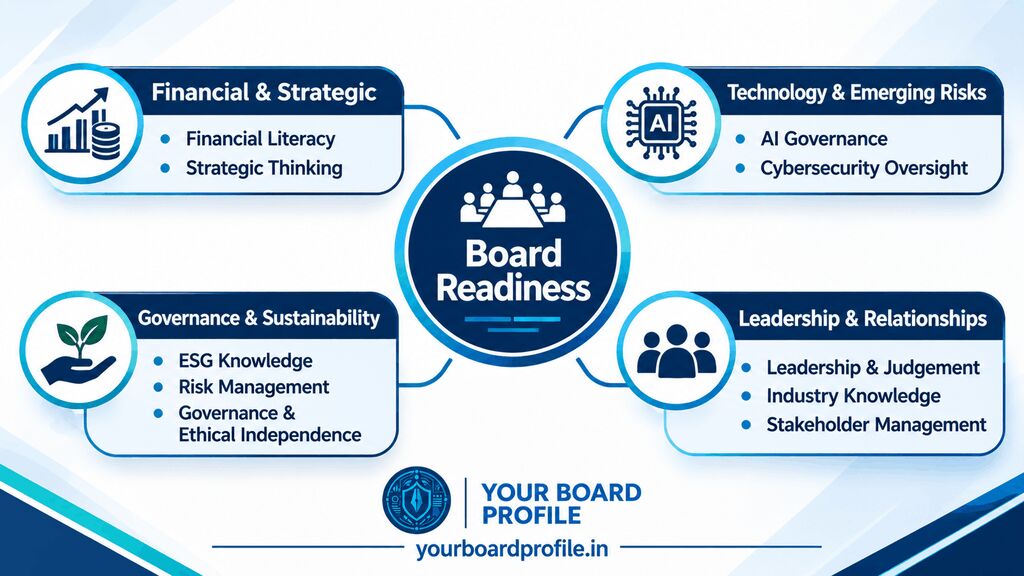
A useful way to evaluate your board readiness is to examine whether your experience aligns with the capabilities that organisations increasingly require. The following ten areas provide a practical starting point.
1. Financial Literacy and Business Acumen
Financial understanding is one of the foundations of effective board participation. Even if you are not a finance professional, you should be comfortable interpreting financial statements, understanding business performance and identifying issues that deserve further examination.
Board financial literacy requirements go beyond recognising revenue, expenses and profitability. Directors should understand cash flows, working capital, capital allocation, debt exposure, liquidity, financial controls and the assumptions behind management forecasts.
Imagine a company reporting impressive revenue growth while its operating cash flow continues to decline. An executive might focus on sales performance, but a board member should investigate whether the growth is sustainable, whether receivables are increasing and whether the organisation is facing collection challenges.
This ability to connect financial information with business risks is particularly important for audit committee participation. Professionals with experience in financial planning, banking, investment, treasury, accounting or corporate restructuring may have an advantage, but other senior executives can also develop these capabilities.
A financially literate director should be able to:
- Interpret balance sheets, income statements and cash flow statements.
- Understand audit reports and internal control weaknesses.
- Evaluate capital expenditure and investment proposals.
- Recognise related-party transaction risks.
- Question financial assumptions and performance projections.
- Understand the relationship between financial performance and organisational strategy.
Board readiness question: Can you examine a company’s financial performance and identify questions that management should answer before the board approves a major decision?
2. Strategic Thinking and Long-Term Value Creation
Boards exist to guide organisations towards sustainable success. Therefore, strategic thinking is a critical element of board readiness.
Senior executives often demonstrate excellent operational execution. They know how to achieve quarterly targets, manage budgets, improve productivity and deliver projects. However, board-level strategy requires a wider perspective.
Directors must consider whether the organisation is investing in the right markets, whether its business model remains competitive and whether management has prepared for changes in customer behaviour, technology and economic conditions.
For instance, a company operating successfully in traditional retail may face disruption from digital commerce. The board should not simply ask management how many stores opened during the year. It should examine the organisation’s long-term positioning, technology investments, customer retention and future revenue opportunities.
Strategic boardroom contribution involves connecting short-term performance with long-term organisational value. It also requires the confidence to challenge an established business strategy when external conditions change.
The OECD corporate governance principles specifically identify reviewing strategy, major business plans, budgets, acquisitions and capital expenditure as important board responsibilities.
Board readiness question: Can you challenge a business strategy constructively while understanding its commercial, financial and operational consequences?
3. AI Governance for Board Members
Artificial intelligence has moved beyond the technology department. It now influences customer experience, recruitment, financial forecasting, cybersecurity, operational efficiency and business decision-making.
As a result, AI governance for board members is becoming an important capability. Directors do not necessarily need programming expertise or advanced technical qualifications. They do need sufficient understanding to evaluate how AI is being deployed and whether its associated risks are being managed responsibly.
Consider a financial services company using AI to assess loan applications. The technology may improve processing speed, but what happens if its training data creates discriminatory outcomes? Who reviews incorrect decisions? How is sensitive customer information protected? Does management understand the consequences of relying on automated recommendations?
These are governance questions rather than purely technical questions.
Board members should understand:
- AI opportunities and their relationship with business strategy.
- Data privacy, security and intellectual property exposure.
- Bias, fairness and accountability in automated decisions.
- Human oversight and escalation procedures.
- Third-party AI vendor risks.
- The measurement of AI investments and business outcomes.
PwC’s 2026 survey found that 82% of directors rated information connecting AI outcomes, risks and business performance as fair, poor or not provided. This highlights a practical gap: boards need better information to oversee AI, not simply more presentations about technology.
Board readiness question: Can you evaluate the commercial opportunity of AI while asking meaningful questions about accountability, risk and responsible implementation?
4. Cybersecurity Oversight on Boards
Cybersecurity has evolved beyond a standalone IT issue to become a critical organisational and boardroom priority. A significant cyber incident can disrupt operations, compromise confidential information, affect customer confidence and create regulatory or financial consequences.
This makes cybersecurity oversight on boards an important responsibility for directors across industries.
A professional with a technology background may bring specialist expertise. However, directors from finance, operations, legal, risk management and business leadership can also contribute by understanding the wider consequences of cyber threats.
For example, imagine a manufacturing company experiencing a ransomware attack that interrupts production for several days. The immediate technical problem may involve compromised systems, but the board must also consider business continuity, customer commitments, insurance coverage, financial exposure and communication with stakeholders.
Effective oversight requires directors to understand whether management has appropriate controls, incident response plans, accountability structures and recovery arrangements.
Important areas include:
- Cyber risk identification and reporting.
- Data protection and privacy controls.
- Incident response and business continuity.
- Third-party and supply-chain technology risks.
- Cloud security and access management.
- Cybersecurity investment and resilience metrics.
The OECD’s corporate governance principles identify digital security and data privacy as matters that should be integrated into wider corporate risk management.
Board readiness question: Can you evaluate the business impact of a cyber incident without attempting to take over the responsibilities of the CISO or technology team?
5. ESG Experience for Corporate Boards
Environmental, Social and Governance considerations have become increasingly connected with business resilience, reputation, capital allocation and long-term value creation.
ESG experience for corporate boards is not limited to sustainability specialists. Professionals with experience in operations, supply chains, human resources, finance, manufacturing, compliance and stakeholder management may also offer valuable perspectives.
For example, a company expanding its manufacturing operations may face environmental compliance requirements, water availability challenges, emissions-related exposure and workforce safety concerns. These issues can affect operating costs, expansion plans, reputation and investor confidence.
A board member should be able to evaluate whether sustainability commitments are supported by credible processes and measurable outcomes.
The relevant capabilities include:
- Understanding environmental and social risks.
- Evaluating sustainability disclosures and reporting.
- Understanding climate-related business exposure.
- Reviewing supply-chain responsibility.
- Monitoring workforce diversity, safety and culture.
- Identifying greenwashing and reputational risks.
The objective is not to turn every director into an ESG consultant. It is to ensure that material sustainability issues receive appropriate attention when the board evaluates strategy and risk.
Board readiness question: Can you connect ESG considerations with financial performance, operational resilience and long-term organisational value?
6. Risk Management and Regulatory Awareness
Every strategic decision involves uncertainty. A company entering a new market, acquiring another business, launching a product or investing in technology must understand the risks associated with that decision.
Directors need to appreciate the relationship between risk appetite, internal controls, regulatory compliance and organisational strategy.
For aspiring directors in India, familiarity with the Companies Act, SEBI regulations where applicable, disclosure requirements, related-party transactions and corporate governance practices can strengthen board readiness.
However, regulatory awareness should not become a narrow exercise in memorising legal provisions. A director must understand how compliance failures can affect the organisation’s financial position, reputation and stakeholder relationships.
For example, an acquisition may appear commercially attractive, but inadequate due diligence could expose the organisation to undisclosed liabilities, litigation, compliance failures or operational weaknesses.
A board-ready professional should understand how to examine such risks, identify missing information and seek expert advice when necessary.
7. Leadership, Judgement and Boardroom Communication
A boardroom is not simply another senior management meeting. Directors are expected to bring independent perspectives, exercise sound judgement and contribute to collective decisions.
Professionals who have led large teams may initially find this distinction challenging. Executive leadership often involves directing teams and driving execution. Board leadership requires asking the right questions, evaluating management’s recommendations and maintaining an appropriate distance from day-to-day operations.
Effective boardroom communication is therefore an essential component of board readiness.
A capable director should be able to disagree without becoming confrontational, challenge assumptions without undermining management and communicate complex issues clearly.
Consider a situation where management recommends a significant investment. Rather than rejecting the proposal immediately, a director might ask about alternative scenarios, expected returns, downside exposure, execution capabilities and the consequences of delaying the decision.
This approach demonstrates constructive challenge and informed judgement.
8. Governance Knowledge and Ethical Independence
Professional success does not automatically establish governance competence. Directors must understand fiduciary responsibilities, conflicts of interest, confidentiality, accountability and ethical decision-making.
For independent directors in India, Schedule IV of the Companies Act, 2013, is particularly relevant. It describes expectations around integrity, objectivity, independent judgement and the protection of stakeholder interests.
A board-ready professional must recognise that independence is not merely a designation. It is demonstrated through the ability to evaluate decisions objectively, disclose potential conflicts and place the company’s legitimate interests above personal considerations.
9. Industry Knowledge and Business Transformation
Boards value professionals who understand the commercial realities of their industry. Sector knowledge helps directors identify emerging opportunities, evaluate competitive threats and recognise operational challenges that may not be immediately visible in financial reports.
However, industry experience should not become a limitation. Professionals who have successfully led digital transformation, mergers and acquisitions, international expansion or organisational restructuring may bring capabilities that transfer across sectors.
For example, a senior executive from the automotive industry may offer valuable insights to a manufacturing or mobility business because of their understanding of supply chains, automation, operational efficiency and capital-intensive business models.
The key is to demonstrate how your experience can contribute to the strategic challenges of the organisation you wish to serve.
10. Stakeholder Management and Crisis Leadership
Modern boards must consider the interests of shareholders, employees, customers, regulators, suppliers and wider communities.
A director should understand how management decisions affect these different stakeholders and how conflicts between their interests should be addressed.
Crisis leadership is particularly relevant. Whether the organisation faces a product recall, financial difficulty, regulatory investigation, leadership transition or reputational challenge, directors must maintain perspective and support effective oversight.
This requires emotional maturity, discretion, clear communication and the ability to make decisions under uncertainty.
Board readiness question: Can you contribute objectively when an organisation faces competing stakeholder interests or a difficult business situation?
Board Readiness Checklist: A Quick Skills Assessment
The following table summarises the ten capabilities discussed above and the evidence an aspiring director should be able to demonstrate.
| Critical capability | What boards expect | Evidence to demonstrate |
| Financial literacy | Understanding financial performance and controls | P&L, cash flow and audit exposure |
| Strategic thinking | Long-term value creation | Strategy development and execution |
| AI governance | Responsible AI oversight | AI adoption and risk evaluation |
| Cybersecurity | Digital risk awareness | Cyber resilience and incident oversight |
| ESG knowledge | Sustainability oversight | ESG initiatives and measurable outcomes |
| Risk management | Enterprise risk understanding | ERM and compliance experience |
| Leadership | Independent judgement | Senior leadership decisions |
| Governance | Ethical and fiduciary understanding | Board training and governance exposure |
| Industry knowledge | Commercial understanding | Sector-specific achievements |
| Stakeholder management | Balanced decision-making | Crisis and stakeholder leadership |
This checklist should be treated as a development framework rather than a rigid qualification test. No individual needs to be an expert in all ten areas. The objective is to identify your strongest capabilities, recognise gaps and understand how your experience complements the needs of a particular board.
Board Skill Matrix Evaluation: How Nominating Committees Assess Candidates
A board skill matrix is a structured framework that helps organisations understand the collective capabilities available within their board and identify areas requiring additional expertise.
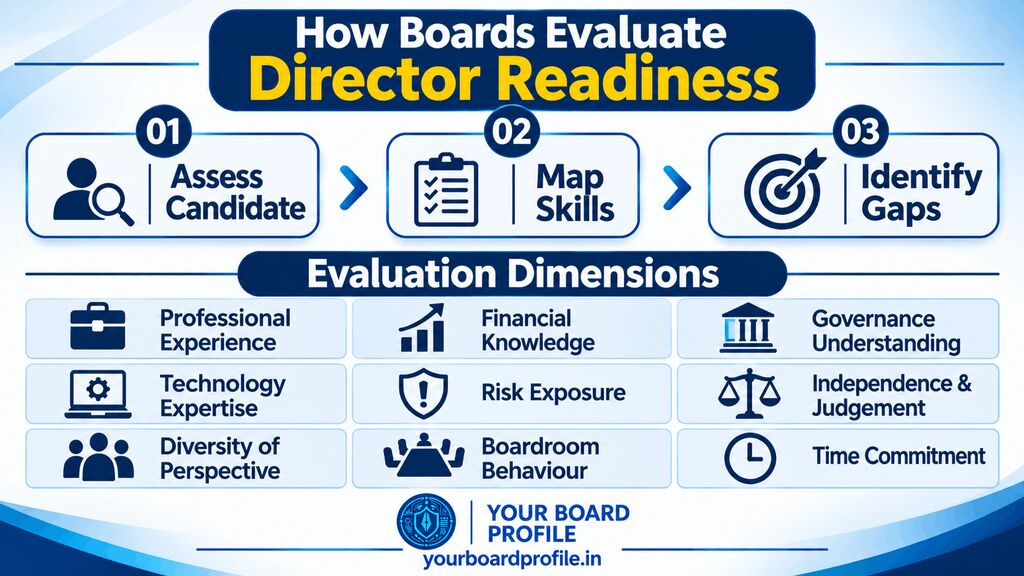
Rather than evaluating directors only through their job titles, a board skill matrix evaluation considers professional experience, specialist knowledge, industry exposure and the organisation’s future strategic requirements.
For instance, a company planning international expansion may need expertise in global operations, cross-border compliance, finance and geopolitical risk. An organisation investing heavily in digital transformation may prioritise technology leadership, cybersecurity, data governance and AI understanding.
The nominating and remuneration committee may examine several dimensions when evaluating a prospective candidate.
| Evaluation area | Questions a nominating committee may consider |
| Professional experience | Has the candidate handled significant business responsibilities? |
| Financial knowledge | Can the candidate understand financial statements and business performance? |
| Governance understanding | Does the candidate understand board responsibilities? |
| Technology expertise | Can the candidate contribute to digital and AI oversight? |
| Risk exposure | Has the candidate managed complex business risks? |
| Independence | Can the candidate exercise objective judgement? |
| Diversity | Does the candidate bring a valuable perspective? |
| Boardroom behaviour | Can the candidate challenge constructively and work collectively? |
| Time commitment | Can the candidate devote adequate attention to board responsibilities? |
What Nominating Committees Look For Beyond a Job Title
A prestigious designation may attract attention, but a strong board candidate must demonstrate the value behind that designation.
A former CFO, for example, should be able to explain how their experience in capital allocation, financial controls, restructuring or acquisitions can strengthen board oversight. Similarly, a former technology leader should demonstrate an understanding of digital strategy, cybersecurity, data governance and technology-related business risks.
The Conference Board’s 2026 research illustrates the changing composition challenge. Its analysis found that AI expertise was disclosed for only 2.7% of S&P 500 directors in 2025, compared with 27% for cybersecurity expertise. It also reported that only 23% of surveyed executives considered their boards highly fluent in AI.
These findings suggest that specialist capabilities can create opportunities for professionals who understand how to translate their expertise into governance contributions.
However, committees also assess cultural alignment, independence, judgement and the ability to work effectively with other directors. The strongest candidate is not necessarily the person with the longest CV. It is often the person whose experience fills a genuine capability gap.
Qualifications for Independent Directors: Beyond Professional Experience
Professionals aspiring to become Independent Directors often ask whether a specific qualification, certification or number of years of experience is sufficient to secure an appointment.
The answer requires a distinction between legal eligibility and practical board readiness.
In India, the Companies Act, 2013, lays down the statutory framework governing independent directors, including eligibility and independence requirements. Section 149 and the applicable rules should be examined alongside Schedule IV.
The Independent Directors Databank, maintained by the Indian Institute of Corporate Affairs, is also an important resource for individuals preparing for independent directorships. Applicable proficiency requirements and exemptions should be checked against the current rules.
Official resources:
Beyond formal requirements, companies look for professionals who can contribute meaningfully to board discussions. Relevant experience may include senior leadership, finance, law, technology, operations, risk management, entrepreneurship, public policy or other areas aligned with the company’s requirements.
A governance qualification can strengthen your understanding, but it cannot replace practical judgement, professional credibility or the ability to exercise independent oversight.
Aspiring directors should therefore focus on developing both statutory awareness and the broader capabilities expected from an effective board member.
How to Assess Board Readiness: A Practical Self-Assessment
Understanding what boards expect is only the first step. The next challenge is to evaluate whether your current professional experience meets those expectations.
Many senior professionals make the mistake of assessing their board readiness through their career achievements alone. They may have managed large teams, handled substantial budgets, led business transformations or held prominent leadership positions. These accomplishments are valuable, but they do not automatically demonstrate an ability to contribute at board level.
A more effective approach is to evaluate your experience from the perspective of a prospective nominating committee.
Step 1: Identify Your Strongest Professional Contributions
Start by examining the areas where you have created measurable organisational value. Think beyond your designation and consider the business problems you have solved.
Have you led a major restructuring? Improved profitability? Managed a regulatory challenge? Implemented technology across business functions? Led an organisation through a crisis? These experiences can demonstrate capabilities that boards value.
For example, a former Chief Human Resources Officer may initially believe that their expertise is limited to people management. However, their experience in succession planning, leadership assessment, organisational culture, executive compensation and workforce transformation can be highly relevant to nomination and remuneration committee responsibilities.
Your objective should be to identify three to five areas where your experience offers distinctive boardroom value.
Step 2: Evaluate Your Governance Knowledge
Ask yourself whether you understand the difference between executive management responsibilities and board oversight.
Can you explain the responsibilities of an Independent Director? Do you understand the role of audit, risk and nomination committees? Are you familiar with conflicts of interest, related-party transactions, board evaluations and fiduciary responsibilities?
If your understanding is limited, consider structured governance education, relevant professional programmes and opportunities to participate in governance-related discussions.
The G20/OECD Principles of Corporate Governance provide a useful international reference for understanding board responsibilities and effective governance practices.
Step 3: Identify Your Emerging Technology Knowledge Gaps
Even if you have spent most of your career in traditional business functions, you should understand the strategic implications of AI, cybersecurity and digital transformation.
You do not need to become a technology specialist. However, you should be comfortable discussing how technology affects organisational competitiveness, operational resilience, customer relationships and risk exposure.
Consider whether you can evaluate an AI investment, identify important cybersecurity questions or understand the business implications of data privacy failures.
Step 4: Examine Your Boardroom Communication Skills
Boardroom communication is different from executive presentation. A director must communicate with clarity, maintain objectivity and ask questions that improve decision-making.
Try explaining a complex business challenge in three parts:
- What is the underlying business issue?
- What risks or opportunities should the board consider?
- What information or management action is needed before a decision?
This exercise helps you move from operational reporting towards board-level discussion.
Step 5: Review Your Board Readiness Gaps
Use the following self-assessment to identify your development priorities.
| Assessment area | Developing | Competent | Strong |
| Financial literacy | ☐ | ☐ | ☐ |
| Corporate governance | ☐ | ☐ | ☐ |
| Strategic oversight | ☐ | ☐ | ☐ |
| AI and digital governance | ☐ | ☐ | ☐ |
| Cybersecurity awareness | ☐ | ☐ | ☐ |
| ESG understanding | ☐ | ☐ | ☐ |
| Risk management | ☐ | ☐ | ☐ |
| Independent judgement | ☐ | ☐ | ☐ |
| Boardroom communication | ☐ | ☐ | ☐ |
| Stakeholder management | ☐ | ☐ | ☐ |
A developing score does not mean you are unsuitable for a board position. It simply highlights where additional learning or practical exposure may be beneficial.
The purpose of a board readiness assessment is not to create a perfect candidate. It is to help you understand your strengths, address meaningful gaps and become better prepared for the responsibilities of directorship.
How to Build a Stronger Boardroom Profile
Once you understand your capabilities and development areas, the next step is to communicate your experience effectively.
This is where many experienced professionals face a challenge. They may possess decades of valuable leadership experience, but their professional profiles are still written primarily for executive recruitment rather than board appointments.
A board requires a different perspective. It wants to understand how your experience supports governance, strategic oversight, risk management and organisational performance.
Develop a Board-Ready CV
A traditional executive CV often focuses on responsibilities, reporting structures, operational targets and career progression. A board-ready CV should highlight strategic contributions, governance exposure, financial understanding, risk oversight and leadership judgement.
For example, instead of writing:
“Responsible for managing operations across multiple business units.”
A more board-oriented description could be:
“Led multi-business operational transformation, strengthening performance governance, resource allocation and enterprise-wide risk management.”
The objective is not to exaggerate your responsibilities. It is to present genuine achievements in language that reflects their relevance to board responsibilities.
You can explore the board-ready CV and governance oversight guide to understand how professional achievements can be positioned for board-level opportunities.
Strengthen Your LinkedIn Presence and Personal Brand
Your professional reputation often precedes your first conversation with a board search consultant or nominating committee.
A strong LinkedIn profile should communicate your leadership experience, industry expertise, strategic contributions and governance interests. It should also demonstrate that you understand the business challenges facing organisations today.
Publishing thoughtful perspectives on AI governance, cybersecurity, corporate strategy, ESG and risk management can help establish professional credibility.
However, avoid publishing content simply to increase visibility. The objective is to demonstrate informed thinking and a genuine understanding of governance issues.
Develop Governance Knowledge Through Continuous Learning
Board responsibilities evolve as regulations, technology and stakeholder expectations change. Therefore, board readiness is not a one-time achievement.
Participate in governance programmes, study board case studies, follow regulatory developments and engage with experienced directors. Familiarity with the workings of board committees can also improve your understanding of how oversight operates in practice.
Useful learning resources include:
- National Association of Corporate Directors (NACD) – Board governance education and director development.
- NIST AI Risk Management Framework – A useful resource for understanding AI risk and governance.
- NIST Cybersecurity Framework – Guidance on managing cybersecurity risks.
- OECD Corporate Governance Principles – A global framework for effective corporate governance practices.
Build Meaningful Governance Exposure
Not every professional has previously served on a corporate board. That does not mean their boardroom journey cannot begin.
You can develop relevant exposure through advisory assignments, governance-related projects, professional committees, industry associations and leadership forums.
The important distinction is to represent your experience accurately. Advisory responsibilities, committee participation and formal directorships are not interchangeable.
If you are exploring your first appointment, read How to Get Your First Board Seat with No Board Experience. It offers another perspective on developing credibility when you have not previously held a board position.
Position Your Executive Experience for Board Opportunities
Your professional achievements need to be connected to the requirements of a specific organisation.
A former CFO may be particularly relevant to an audit committee. A technology leader may contribute to digital transformation and cybersecurity oversight. An HR leader may bring valuable experience in succession planning, leadership development and organisational culture.
However, these are starting points, not fixed categories. Boards increasingly benefit from professionals who can connect multiple areas of expertise.
Your board profile should clearly answer three questions:
- What distinctive experience do you bring?
- Which governance or strategic challenges can you help address?
- Why would your contribution strengthen the collective capabilities of a particular board?
Explore board director CV: Executive vs Board Language for guidance on communicating your experience in a board-oriented manner.
Common Board Readiness Mistakes Professionals Should Avoid
Even highly accomplished executives can underestimate the preparation required for a directorship. Certain mistakes can weaken an otherwise promising boardroom profile.
Confusing seniority with board suitability: Holding a CXO position is valuable, but boards need evidence of independent judgement, governance understanding and strategic contribution.
Treating governance as a formality: Reading regulations without understanding their practical implications does not establish effective boardroom preparedness.
Overemphasising technical expertise: A cybersecurity specialist, for example, must also understand how cyber risks affect business continuity, financial performance and organisational reputation.
Ignoring financial literacy: Professionals from non-finance backgrounds should not assume that financial oversight can be left entirely to the CFO or audit committee.
Using an executive CV for board appointments: A document focused mainly on operational responsibilities may fail to communicate your governance capabilities.
Seeking visibility without building credibility: Networking and personal branding can create opportunities, but meaningful board appointments require relevant experience and demonstrated value.
The strongest approach combines professional credibility, continuous learning, governance knowledge and a clear understanding of how you can contribute to a board’s collective effectiveness.
Ready to Strengthen Your Board Readiness and Boardroom Profile?
At Your Board Profile, we help senior professionals, CXOs, entrepreneurs and aspiring Independent Directors strengthen their boardroom presence and communicate their professional value in alignment with the evolving expectations of modern boards.
Our approach focuses on translating executive experience into a governance-oriented professional narrative that highlights strategic leadership, financial understanding, risk oversight, AI governance, cybersecurity awareness, ESG understanding and independent judgement.
Our services include:
- Customised Board CV Development: Positioning your professional achievements around governance, strategic oversight and board-level contribution.
- LinkedIn Profile Enhancement: Strengthening your professional visibility and establishing a credible boardroom-oriented personal brand.
- Board Readiness Assessments: Identifying your strengths, development areas and gaps against the capabilities modern boards seek.
- One-to-One Coaching and Mentorship: Enhancing governance understanding, boardroom communication and professional positioning.
- Video Profiles and Thought Leadership: Communicating your expertise and perspectives through relevant professional content.
If you have significant leadership experience but are unsure whether your skills and professional profile align with the expectations of nominating committees and modern corporate boards, a structured board readiness assessment can help you identify gaps and develop a focused action plan.
Your professional experience tells the story of where you have been. Your board profile should reflect how your expertise, judgement and leadership can contribute to effective governance and long-term organisational value.
Book a complimentary discussion with Dr. Amit Nagpal to explore how your experience, capabilities and leadership journey can be translated into a compelling board profile and positioned for relevant boardroom opportunities.
Explore our Board Profile and professional portfolio, discover our board readiness and personal branding services, and read more practical insights on the Your Board Profile blog.
You can also visit Dr. Amit Nagpal’s website for perspectives on personal branding, leadership and strategic storytelling.
Board readiness is not simply about having the right experience. It is about demonstrating the judgement, governance understanding and strategic perspective that modern boards need. Start strengthening your boardroom value today.
Conclusion: Turn Professional Experience into Boardroom Value
Modern boards are looking for professionals who can bring more than impressive designations and successful corporate careers. They need directors who understand financial performance, strategic priorities, emerging technologies, enterprise risks and stakeholder expectations.
For aspiring directors, this creates an important opportunity to evaluate their capabilities and prepare for the changing demands of corporate governance.
Your background in finance, cybersecurity, AI, ESG, operations, human resources or business transformation may provide a valuable foundation. However, the real strength of your board readiness lies in your ability to connect that experience with independent judgement, effective oversight and long-term organisational value.
The most effective way to prepare is to understand your strengths, address your development gaps, strengthen your governance knowledge and communicate your experience through a board-focused professional profile.
Remember, a board appointment is not simply the next designation in your career. It is an opportunity to contribute to decisions that shape an organisation’s future.
Your professional experience may open the door. Your governance understanding, credibility and ability to contribute meaningfully can make you a valuable presence in the boardroom.
Frequently Asked Questions About Board Readiness
1. What does board readiness mean?
Board readiness reflects an individual’s ability to make meaningful contributions to a company’s board through effective governance, strategic oversight and informed decision-making. It combines leadership experience, governance knowledge, financial understanding, strategic thinking, independent judgement and the ability to oversee organisational risks.
2. What skills do modern boards look for in directors?
Modern boards typically seek financial literacy, strategic thinking, risk management, governance knowledge, leadership judgement, stakeholder management and industry expertise. Increasingly, AI governance, cybersecurity and ESG understanding are also important capabilities.
3. How can I assess my board readiness?
You can assess your board readiness by evaluating your leadership achievements, governance knowledge, financial literacy, strategic contribution and understanding of emerging business risks. Comparing your capabilities against a board skill matrix can help identify development areas.
4. Is financial literacy compulsory for aspiring board directors?
Financial literacy is an important capability for directors, even if they do not come from finance backgrounds. Directors should understand financial statements, cash flows, internal controls, capital allocation and financial risks to participate meaningfully in board decisions.
5. Why is AI governance important for board members?
AI governance helps directors oversee the responsible use of artificial intelligence within an organisation. It includes understanding data privacy, algorithmic bias, accountability, intellectual property, regulatory exposure and the commercial implications of AI adoption.
6. Do board directors need cybersecurity experience?
Not every director needs specialist cybersecurity experience. However, all directors should understand cybersecurity risks, data protection, incident response and business continuity because cyber incidents can significantly affect organisational performance and reputation.
7. How important is ESG experience for corporate boards?
ESG experience helps directors understand environmental, social and governance risks that may influence business sustainability, regulatory compliance, stakeholder confidence and long-term value creation. Professionals from finance, operations, HR and supply-chain management can also bring relevant ESG capabilities.
8. What is a board skill matrix?
A board skill matrix is a structured framework used to evaluate the collective knowledge, experience and capabilities of board members. It helps organisations identify expertise gaps and determine what additional skills are required for effective governance.
9. What do nominating committees look for in prospective directors?
Nominating committees generally evaluate professional experience, industry knowledge, governance understanding, independence, strategic capabilities, diversity, integrity and time commitment. They also consider how a candidate’s experience complements the existing board.
10. What qualifications are required to become an Independent Director in India?
Independent Director eligibility is governed by the Companies Act, 2013, and applicable rules. Candidates must satisfy relevant independence and eligibility conditions. Familiarity with Schedule IV, governance responsibilities and applicable proficiency requirements is also important.
11. Can a CXO become an Independent Director?
Yes. CXOs can pursue Independent Director opportunities if they satisfy applicable legal requirements and demonstrate relevant governance capabilities. Their experience in finance, operations, technology, HR, strategy or business transformation can contribute valuable perspectives to corporate boards.
12. Can I become a board director without previous board experience?
Yes. Previous board experience is not universally necessary for an appointment. However, candidates should demonstrate relevant senior leadership experience, governance understanding, sound judgement and the ability to contribute to board-level decisions.
13. How can I improve my boardroom communication skills?
You can improve boardroom communication by developing concise presentations, practising constructive questioning, understanding board committee responsibilities and learning to communicate complex business risks clearly. Governance programmes and director mentorship can also help.
14. How is a board-ready CV different from an executive CV?
An executive CV generally highlights operational responsibilities, career progression and business achievements. A board-ready CV places greater emphasis on governance exposure, strategic oversight, financial understanding, risk management, independent judgement and organisational value creation.
15. How can Your Board Profile help me prepare for a board appointment?
Your Board Profile supports aspiring directors and senior professionals through customised board CVs, LinkedIn profile enhancement, board readiness assessments, one-to-one coaching, mentorship and thought leadership development. These services help professionals strengthen their visibility and communicate their boardroom value more effectively.