

We are delighted to feature Mr. Tushar Kansal, Founder and CEO of Kansaltancy Ventures, entrepreneur, investor and author of The Money Behind the Business.
Tushar Kansal is the Founder & CEO of Kansaltancy Ventures, a Global venture advisory and strategic capital platform operating at the intersection of Venture Capital, Capital Markets and Institutional strategy. With a career spanning Big 4 Consulting, Global Private Equity–owned enterprises and Venture Capital, Tushar brings a rare combination of Financial depth, executional credibility, and ecosystem leadership. Recognised as a Thought Leader, Institutional Advisor and Global Speaker, with 100+ Million views in the public domain, Tushar Kansal has built Kansaltancy Ventures into one of the most trusted platforms for Founders, Investors and Growth-stage Enterprises navigating Capital, Scale and Strategic inflection points.
He had joined as a FinInfluencer-Director on the Board of GP Eco Solutions before its IPO and the $4 million IPO got IPO Bids of $2 Billion
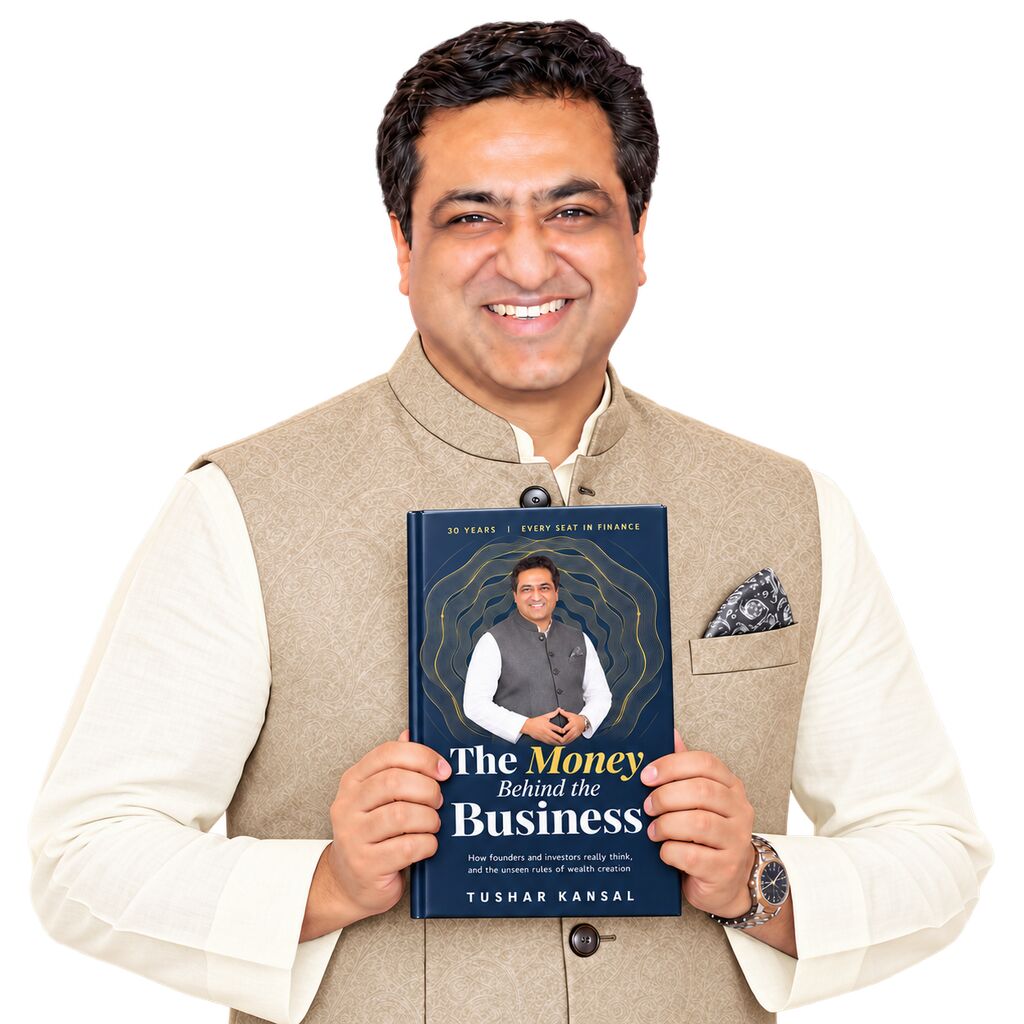
In this exclusive conversation, we delve into the inspiration behind his book, its key ideas and the financial lessons he hopes entrepreneurs and business leaders will take away from it.
1. You have worked across several financial roles, including Big Four advisory, venture capital, treasury management, debt management and corporate finance. What eventually inspired you to establish Kansaltancy Ventures?
My first lesson in business came from a rejection. In 1993, Vidyamandir Classes in Delhi dropped me from its IIT batches. It hurt, but it showed me a market: North Delhi had many ambitious students and few good coaching centres. In 2001, right after my MBA, I borrowed money from my father and opened IITS. By 2006 we had three centres earning about 40% net margins. Then four national brands arrived, margins fell to about 5% within a year, so we sold the operations to Narayana, keeping our properties.
The next decade took me through almost every seat in finance: Big Four advisor, venture investor, treasury head, debt manager, and CFO of a company owned by Guggenheim Partners. Each seat showed me one part of the same picture. The investor sees why a deal is refused; the CFO sees the payroll that must be met on the first of every month.
Good founders rarely failed for lack of ideas; they failed because nobody had explained how money thinks. Kansaltancy Ventures was my answer, and its purpose fits in one line: we help entrepreneurs accelerate their dreams through venture capital and strategic services. Over the last decade, we have prepared more than 5,000 startups and SMEs to meet investors and lenders.
2. Your book, The Money Behind the Business, explores the financial realities that determine whether businesses succeed or struggle. What inspired you to write this book, and what is the one important financial lesson you hope every entrepreneur takes away from reading it?
Most finance books are written from one seat. I wanted to write one from all of them, in plain words, for the ambitious student or young professional deciding whether to stay in a career or build something. That is why every chapter has a section called “Across the Table”. It shows how a founder and an investor read the same moment, such as a demo or a valuation, in completely different ways.
The book opens with this line: ideas start businesses; money decides which of them survive.
If an entrepreneur takes away one lesson, it should be this: treat money as the clock, not the goal. A startup is searching for a business model it can repeat and scale, and runway is the time it has to find one. If you have ₹60 lakh in the bank and spend ₹5 lakh a month, you have twelve months to find the model, raise more money, or close. Every decision a founder makes sits under that clock. Founders who see funding as a scoreboard spend to look big; those who see it as time spend to learn fast, and survive.
3. Having worked on both sides of the fundraising table, you have a distinctive understanding of founders as well as investors. Beyond a promising business idea and financial projections, what are the key factors that make an investor trust a founder and commit capital to a business?
The short answer is trust, shown over a period of time.
A founder is a seeker; an investor is a selector. Venture returns follow a power law: in a fund of twenty companies, perhaps one returns thirty times its money and pays for every other mistake. Founders walk into meetings to impress; investors walk in looking for reasons not to invest.
Three things overcome that default no. The first is a record of kept promises. Serious investors often watch a founder for three to six months before investing. A one-page monthly update builds that record cheaply: the same five to seven numbers, three wins, three honest challenges and specific asks. Silence frightens investors far more than bad news.
The second is a warm introduction: a founder the investor has already backed earns you a hearing that cold emails rarely do.
The third is conviction, but only after the hygiene checks. For years I believed funding was a rational decision. I now believe early-stage investing is fundamentally emotional. The numbers get you through the door. Conviction gets you the cheque. FTX is the warning on the other side: Sequoia wrote its investment of about $214 million down to zero when conviction ran ahead of diligence.
4. Many startups associate raising larger rounds of funding with business success. However, excessive funding can sometimes create pressure, unnecessary dilution and unsustainable expectations. How should founders determine the right amount of capital to raise, and when should they consider alternatives such as debt financing or customer-funded growth?
Raise enough to reach the next milestone that makes the company clearly more valuable, plus a buffer of 18 to 24 months of runway. Rounds take three to six months, so twelve months of runway means fundraising again almost immediately, from weakness.
My golden rule is to watch how much a founder values his own equity. A committed founder raises only what the plan needs, because he believes the company will be worth far more later. A founder who asks for far more than the plan needs, at almost any price, is chasing a headline rather than building a business.
Overfunding can be as dangerous as underfunding. WeWork reached a private valuation of about $47 billion, yet no amount of money could fix long-term leases funded by short-term rent. Zerodha, by contrast, never raised venture capital and grew into one of India’s largest brokers, profitably.
On alternatives, I put it simply: equity is selling ownership; debt is renting money. Debt suits steady, predictable cash flows. Equity suits uncertain but very high growth. India’s toolkit is richer than most owners realise: CGTMSE credit guarantees of up to ₹10 crore for micro and small enterprises, TReDS invoice discounting, and venture debt between equity rounds. Customer-funded growth remains the cleanest capital of all. My first business grew from one centre to three entirely on its own profits.
5. Valuation and equity dilution are among the most important yet frequently misunderstood aspects of startup fundraising. What common mistakes do founders make while negotiating valuations and investment terms, and how can they protect their long-term ownership and business interests?
Valuation and equity dilution are among the most important yet frequently misunderstood aspects of startup fundraising. What common mistakes do founders make while negotiating valuations and investment terms, and how can they protect their long-term ownership and business interests?
The first mistake is treating valuation as a verdict on your worth. It is a negotiated price. If an investor pays ₹2 crore for 20%, the post-money valuation is ₹10 crore and the pre-money valuation is ₹8 crore. That is arithmetic on top of a negotiation, shaped by comparable deals, investor competition and market mood.
The second mistake is ignoring cumulative dilution. In the book, one founder, after an angel round, an ESOP pool, a seed round and a Series A, goes from owning 100% of his company to about 49%, with Series B, C and D still ahead. Owning 20% of a large company beats 100% of a small one, but raise too much, too early and too cheaply, and you may own very little of your own success.
The third mistake is reading only the headline number. Price is what you see; terms are what you live with. A 2x liquidation preference, an ESOP pool carved out of the founders’ shares before the money arrives, or aggressive anti-dilution clauses can matter more than the valuation itself.
The fourth is chasing an inflated valuation. Byju’s was valued at about $22 billion in 2022, and much of that value evaporated within two years. Klarna fell from about $45.6 billion to $6.7 billion in a down round before listing in New York in 2025 at around $15 billion. A fair valuation that you meet and then beat builds trust. An inflated one that you miss destroys it.
6. You have advised thousands of startups, SMEs and growth-stage companies. Based on your experience, what separates businesses that successfully convert funding into sustainable growth from those that struggle despite having access to capital? How important are financial discipline, cash-flow management and governance in this journey?
Capital accelerates good businesses and magnifies the flaws of everything else. The companies that turn funding into lasting growth get four things right.
The first is unit economics. Take a ₹400 food-delivery order. The platform earns ₹80, pays ₹45 to the rider, ₹8 in payment charges and ₹30 as a discount, losing ₹3 before paying a single engineer. At a million orders a day, that is ₹30 lakh lost daily. Dunzo learnt this painfully: its app went offline in January 2025, and Reliance wrote off its entire investment of about ₹1,645 crore. Zomato and Blinkit show the opposite. I was sceptical myself, but their order-by-order focus on unit economics turned the business profitable.
The second is managing cash, not just profit. Sell goods worth ₹10 lakh at a cost of ₹7 lakh, get paid in 90 days while paying suppliers in 30, and you are ₹7 lakh out of pocket while looking profitable on paper. Growth eats cash. Borrow private-equity discipline: close the books within two weeks of month end, explain every gap against budget, and keep a rolling 13-week cash forecast.
The third is choosing necessity over vanity. My test before any large spend is this: if no investor or visitor ever saw it, would we still spend on it?
The fourth is governance. Paytm Payments Bank had a famous brand and millions of users, yet none of that helped once the Reserve Bank of India lost confidence in 2024. Wirecard’s missing €1.9 billion tells the same story in Europe. For SMEs: the tax you save by under-reporting profit today can cost you the capital you need tomorrow.
The final test: does the business perform when the founder is not in the room? If not, you have a profitable business, and a missing robust company culture, and hence the Startup is not yet an institution.
7. With AI, changing investment patterns and evolving funding mechanisms reshaping the business landscape, how do you see the startup funding ecosystem evolving over the next five years?
With AI, changing investment patterns and evolving funding mechanisms reshaping the business landscape, how do you see the startup funding ecosystem evolving over the next five years?
The latest data already shows the direction. According to Tracxn, Indian tech companies raised $10.3 billion in the first nine months of 2026, up about 7% on the previous year, even as the number of funding rounds fell 38% and seed funding dropped 37% to $698 million. The market is narrowing towards fewer, larger, higher-conviction bets.
Over the next five years, I see four shifts. First, AI will make building cheaper. Products that once took a year to build can now be tested in weeks, so founders will need less money to start, and investors will expect real traction before the first cheque. Second, capital will move deeper into technology: AI infrastructure alone attracted about $1.2 billion this year, and deep tech and manufacturing are finally getting serious attention. Third, the quieter market of SME finance will grow louder. GST data and account aggregators let lenders see a business’s real cash flows, and NSE Emerge has crossed 700 SME listings, giving family businesses a route to growth capital without venture funding. Fourth, regulation will shape outcomes as much as markets. Zupee, which came to me when it was practically nothing and grew to a valuation of about $600 million, saw its paid games shut by the 2025 law banning real-money online gaming.
AI can make you faster; it cannot replace judgement, integrity, verified accuracy or the slow work of building yourself. I still read for about three hours a day as I is my habit since School days.
My message to aspiring entrepreneurs is this: think big, start small, grow slow, then grow really fast. Size your risk before you take it, treat rejection as information rather than a verdict, and build something that works when you are not in the room.
Links to buy the Book:
To buy eBook, Paperback or Hardcover from Amazon Kindle in your country
https://www.amazon.com/dp/B0HNN93M5Y
To buy eBook from any Top Bookstore of your country
https://books2read.com/u/3ngPq6
To buy an eBook worldwide on Google Play Books
https://play.google.com/store/books/details/Tushar_Kansal_The_Money_Behind_the_Business?id=y00bEgAAQBAJ
To buy a Physical copy in India – Buy from Pothi
https://store.pothi.com/book/tushar-kansal-the-money-behind-business/